
BuddhistCatholicContemplativeEvangelicalGeneral ChristianHinduJewishLatter-day SaintMuslimNew VisionsProgressive Christian
Beliefs
- Buddhist
- Catholic
- Contemplative
- Evangelical
- General Christian
- Hindu
- Jewish
- Latter-day Saint
- More Voices
- Muslim
- New Visions
- Pagan
- Progressive Christian
Topics
- Religion News
- Food and Religion
- Sports and Religion
- Religious Art
- Religious Music and Entertainment
- Religious Events
- History and Religion
- Style and Religion
- Politics and Religion
- Women in Religion
- Recreation Outdoors and Religion
- Business Finance and Religion
- Careers Workplace and Religion
- Education and Religion
- Family Parenting and Religion
- Health Fitness and Religion
- Home and Religion
- Relationships and Religion
- Technology and Religion
- Travel and Religion
Columnists
- Buddhist Columnists
- Business Finance and Religion Columnists
- Careers Workplace and Religion Columnists
- Catholic Columnists
- Contemplative Columnists
- Education and Religion Columnists
- Evangelists Columnists
- Family Parenting and Religion Columnists
- General Christian Columnists
- Health Fitness and Religion Columnists
- Hindu Columnists
- History and Religion Columnists
- Home and Religion Columnists
- Jewish Columnists
- More Voices Columnists
- Latter Day Columnists
- Muslim Columnists
- New Visions Columnists
- Nonreligious Columnists
- Pagan Columnists
- Politics and Religion Columnists
- Progressive Columnists
- Recreation Outdoors and Religion Columnists
- Relationships and Religion Columnists
- Religion News Columnists
- Religious Art Columnists
- Religious Events Columnists
- Religious Music and Entertainment Columnists
- Sports and Religion Columnists
- Style and Religion Columnists
- Technology and Religion Columnists
- Travel and Religion Columnists
- Women in Religion Columnists
Resource Library
- 2026 Calendar
- Library of World Religions
- The 100 Most Holy Places on Earth
- Patheos Answers
- Podcasts
- Videos
- Faith Leaders Database
- Anglican Episcopalian
- Bahai
- Baptist
- Buddhism
- Christianity
- Confucianism
- Eastern Orthodoxy
- Hinduism
- Holiness and Pentecostal
- ISKCON
- Islam
- Judaism
- Lutheran
- Methodist
- The Church of Jesus Christ of Latter-day Saints
- New Age
- Paganism
- Presbytarian and Reformed
- Protestantism
- Religion Behind the Scenes
- Roman Catholic
- Scientology
- Shia Islam
- Sikhism
- Sufism
- Sunni Islam
- Taoism
- Zen
- See all religions
Research Tools
 Ad-Free & Subscriber Log-In Subscription Support
Ad-Free & Subscriber Log-In Subscription Support
Follow Patheos 

- Trending:
- Forgiveness
- |
- Marriage
- |
- Consciousness
- |
- Death Penalty
- |
- Election
- |
- Halloween
 Epiphenom
- Home
- Nonreligious
- Deep thinkers are more likely to lose their faith
Deep thinkers are more likely to lose their faith
Last updated on: November 12, 2014 at 3:54 am by Epiphenom
Deep thinkers are more likely to lose their faith 2014-11-12T03:54:37+01:00 Epiphenom
Patheos Explore the world's faith through different perspectives on religion and spirituality! Patheos has the views of the prevalent religions and spiritualities of the world.
There’s always a fair amount of interest in whether atheists are more intelligent than believers. When I’ve reported on this in the past, I’ve always been a little sceptical about whether the purported statistical association is meaningful or even real. SO here’s a couple of studies that shed an intriguing light on the problem.
The first by psychologists Gary Lewis, Stuart Ritchie, and Timothy Bates at the University of Edinburgh in Scotland has provided some of the most rigorous evidence to date that the link is indeed real. They took data from the large MacArthur Foundation Survey of Midlife Development in the United States and found that high IQ was significantly associated with every one of six different measures of religion.
For the most part, this association still held even after adjusting for factors like education, sex, age and even personality – the only exception with spirituality, the weakest of all indicators of religion. Overall, link between religion and IQ was strongest for the ‘fundamentalism’ measure.
The authors point out that the effect is very small. And what’s more, there’s still no reason to suppose that atheists are less religious because of their intelligence. There might be some other factor that they didn’t account for that’s related to both.
And that’s where the second new analysis comes in. Led by Amitai Shenhav, a psychologist at Harvard University, the team looked at cognitive style. Basically, they were interested in whether people make snap decisions based on their gut feelings, or whether they ponder things a bit more deeply.
So they asked the questions like this:
“A bat and a ball cost $1.10 in total. The bat costs $1.00 more than the ball. How much does the ball cost?”
The intuitive answer (10 cents) is the wrong one. Stop and think about it for a while and you’ll figure it out! You’ll probably take less time than I did…
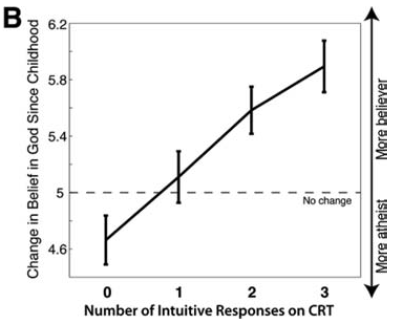
Anyway, it turned out that intuitive thinkers (who get the wrong answer) are more likely to believe in god and immortal souls. Even more intriguingly, deep-thinkers were also more likely to say that they had lost their belief since childhood.
That seems to fit with other research showing that believers in the paranormal seem to have a bunch of faulty, intuitive beliefs about how the world works.
But maybe you’re thinking this isn’t really about IQ? Maybe the religious just couldn’t figure out the right answers (it took me quite a lot of puzzling before I figured that example question out).
Well, in one study they did measure IQ, and IQ was indeed correlated with ‘thinking style’ test scores. That means that cleverer people were more likely to get the answer right.
However, even after adjusting for their higher IQ, deep-thinkers were still more likely to be atheists, and to have lost their childhood religion.
Now, you can probably invent explanations for that just as well as anyone. But one implication, it seems to me, is that this might help to explain the apparent link between atheism and IQ.
You see, if cognitive style and IQ are linked, then it might be that IQ is an innocent bystander here – a case of guilt by association. How you think, and whether you take the time to ponder things through, might be all that matters.
 Lewis, G., Ritchie, S., & Bates, T. (2011). The relationship between intelligence and multiple domains of religious belief: Evidence from a large adult US sample Intelligence DOI: 10.1016/j.intell.2011.08.002
Shenhav A, Rand DG, & Greene JD (2011). Divine intuition: Cognitive style influences belief in God. Journal of experimental psychology. General PMID: 21928924
 This article by Tom Rees was first published on Epiphenom. It is licensed under Creative Commons.
Previous Post

September 26, 2011
Autism and atheism
Browse Our Archives
Select a Category Causes of religion - evolution Causes of religion - psychological Causes of religion - social Demographics Digest Effects of religion - health Effects of religion - psychological Effects of religion - social Notifications Politics Uncategorized
Select a Month March 2016 February 2016 January 2016 December 2015 November 2015 October 2015 September 2015 August 2015 July 2015 June 2015 May 2015 April 2015 March 2015 February 2015 January 2015 December 2014 November 2014 October 2014 September 2014 August 2014 July 2014 June 2014 May 2014 April 2014 March 2014 February 2014 January 2014 December 2013 November 2013 October 2013 September 2013 August 2013 July 2013 June 2013 May 2013 April 2013 March 2013 February 2013 January 2013 December 2012 November 2012 October 2012 September 2012 August 2012 July 2012 June 2012 May 2012 April 2012 March 2012 February 2012 January 2012 December 2011 November 2011 October 2011 September 2011 August 2011 July 2011 June 2011 May 2011 April 2011 March 2011 February 2011 January 2011 December 2010 November 2010 October 2010 September 2010 August 2010 July 2010 June 2010 May 2010 April 2010 March 2010 February 2010 January 2010 December 2009 November 2009 October 2009 September 2009 August 2009 July 2009 June 2009 May 2009 April 2009 March 2009 February 2009 January 2009 December 2008 November 2008 October 2008 September 2008 August 2008 July 2008 June 2008 May 2008 April 2008 March 2008 February 2008 January 2008 December 2007 November 2007 October 2007
Follow Us!
TAKE THE
Religious Wisdom Quiz
Which book of the Bible ends with "Let everything that has breath praise the Lord"?
Select your answer to see how you score.
Psalms Proverbs Revelation Isaiah
Related posts from Epiphenom

Do social crises lead to religious revivals? Nah!

What kind of woman would pray for health...

Can you use religion to change attitudes towards...

Dogmatic atheism and fundamentalist Christianity: creating certainty in...
TRENDING AT PATHEOS Nonreligious

Dethroning Jesus and Enthroning Yourself
Jesus Never Asked to Be Worshipped. He Asked to Be Understood. Christianity...

Why Most Christians are Really Paulians and Jobians
I Don't Care, But It Matters Let's get this out of the...

Essential Tips to Successfully Navigate the Selling Process
Selling a house can feel overwhelming, but it doesn’t have to be....

To Make Remote Work Effective, Think About Others
The COVID-19 pandemic forced many companies to rapidly transition to remote work....

Flexibility Is Key to Solving Problems of Tomorrow
The world of work is undergoing a dramatic transformation. The COVID-19 pandemic...
view all Nonreligious blogs
Ad-Free & Subscriber Log-In Subscription Support
- About Us
- 2026 Calendar
- Videos
- Podcasts
- Library of World Religions
- Faith In Media Tracker
- Advertise With Us
- Write for Us
- Privacy Policy
- Terms of Service
- Do Not Sell My Data
- Contact Us
- Radiant Digital
- Manage Newsletter Subscriptions
- Unsubscribe From Notifications
- Sitemap
Copyright 2008-2026, Patheos. All rights reserved.
Subscription Support Ad-Free & Subscriber Log-In
Follow Patheos