
BuddhistCatholicContemplativeEvangelicalGeneral ChristianHinduJewishLatter-day SaintMuslimNew VisionsProgressive Christian
Beliefs
- Buddhist
- Catholic
- Contemplative
- Evangelical
- General Christian
- Hindu
- Jewish
- Latter-day Saint
- More Voices
- Muslim
- New Visions
- Pagan
- Progressive Christian
Topics
- Religion News
- Food and Religion
- Sports and Religion
- Religious Art
- Religious Music and Entertainment
- Religious Events
- History and Religion
- Style and Religion
- Politics and Religion
- Women in Religion
- Recreation Outdoors and Religion
- Business Finance and Religion
- Careers Workplace and Religion
- Education and Religion
- Family Parenting and Religion
- Health Fitness and Religion
- Home and Religion
- Relationships and Religion
- Technology and Religion
- Travel and Religion
Columnists
- Buddhist Columnists
- Business Finance and Religion Columnists
- Careers Workplace and Religion Columnists
- Catholic Columnists
- Contemplative Columnists
- Education and Religion Columnists
- Evangelists Columnists
- Family Parenting and Religion Columnists
- General Christian Columnists
- Health Fitness and Religion Columnists
- Hindu Columnists
- History and Religion Columnists
- Home and Religion Columnists
- Jewish Columnists
- More Voices Columnists
- Latter Day Columnists
- Muslim Columnists
- New Visions Columnists
- Nonreligious Columnists
- Pagan Columnists
- Politics and Religion Columnists
- Progressive Columnists
- Recreation Outdoors and Religion Columnists
- Relationships and Religion Columnists
- Religion News Columnists
- Religious Art Columnists
- Religious Events Columnists
- Religious Music and Entertainment Columnists
- Sports and Religion Columnists
- Style and Religion Columnists
- Technology and Religion Columnists
- Travel and Religion Columnists
- Women in Religion Columnists
Resource Library
- 2026 Calendar
- Library of World Religions
- The 100 Most Holy Places on Earth
- Patheos Answers
- Podcasts
- Videos
- Faith Leaders Database
- Anglican Episcopalian
- Bahai
- Baptist
- Buddhism
- Christianity
- Confucianism
- Eastern Orthodoxy
- Hinduism
- Holiness and Pentecostal
- ISKCON
- Islam
- Judaism
- Lutheran
- Methodist
- The Church of Jesus Christ of Latter-day Saints
- New Age
- Paganism
- Presbytarian and Reformed
- Protestantism
- Religion Behind the Scenes
- Roman Catholic
- Scientology
- Shia Islam
- Sikhism
- Sufism
- Sunni Islam
- Taoism
- Zen
- See all religions
Research Tools
 Ad-Free & Subscriber Log-In Subscription Support
Follow Patheos 

- Trending:
- Advent
- |
- Forgiveness
- |
- Thanksgiving
- |
- Election
- |
- Seasonal Holidays
- |
- Marriage
 Epiphenom
- Home
- Nonreligious
- Autism and atheism
Autism and atheism
Last updated on: October 31, 2014 at 10:30 pm by Epiphenom
Autism and atheism 2014-10-31T22:30:14+01:00 Epiphenom
Patheos Explore the world's faith through different perspectives on religion and spirituality! Patheos has the views of the prevalent religions and spiritualities of the world.
A new paper on the potential links between autism and lack of god-belief has caught the attention of the blogosphere. You can read Razib’s take on it over at Gene Expression.
Prof Catherine Caldwell-Harris, the psychologist at Boston University, own wrote her own very lucid interpretation of what the results mean over at Science and Religion Today. Heck you can even read the paper itself, if you’re interested!
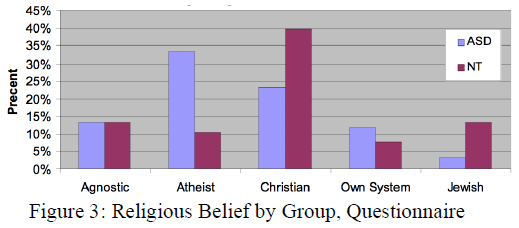
I’m not going to go into the study itself. Basically, they reviewed some online discussion forums, and then also ran a small questionnaire survey, and concluded that people with more symptoms of autism are also less likely to believe in god.
It is, as Caldwell-Harris acknowledges, only quite preliminary evidence. It would probably be wrong to read too much into it. And yet the result seems intuitively correct.
Why? Well, Caldwell-Harris explains that autistic people are less social, less likely to ‘mind-read’ (i.e. understand what’s going on inside other people’s heads), and are less bothered about fitting in.
Any or all of these could contribute to lower religious beliefs among autistics compared with so-called ‘neurotypicals’. Personally, I find the mind-reading ‘mentalization’ argument the most compelling.
After all, we know from neuroimaging research that when people pray they use they same parts of their brain that they use when trying to interact with real people. If autistics aren’t interested in making real friends in this way, why would they be interested in having an imaginary friend?
If it’s hard for them to see that real flesh and blood people have a mind, then it’s bound to be a darned sight harder for them to accept the idea of a disembodied, invisible mind!
But what does this tell us about atheists in general? Well, not a lot, I think. It’s not easy to get a good handle on how common autism is – a lot depends on how you define it and how thorough people are in trying to identify it. Even in the USA, which has the highest reported numbers, it’s still fewer than 1%.
And yet in the countries of Northern Europe, non-belief rates are currently hitting 50%. Given that two-thirds of the autistics in Caldwell-Harris’ sample were believers, then autism clearly is a minor factor.
This is still a fascinating piece of pychological research. Caldwell-Harris wants to do some more research into just why autistics are less interested in religion. And that research could throw an interesting perspective onto why religion is quite so popular!
 This article by Tom Rees was first published on Epiphenom. It is licensed under Creative Commons.
Previous Post

September 19, 2011
Religion seems to undermine property rights and the rule of law
Next Post
September 30, 2011 Deep thinkers are more likely to lose their faith
Browse Our Archives
Select a Category Causes of religion - evolution Causes of religion - psychological Causes of religion - social Demographics Digest Effects of religion - health Effects of religion - psychological Effects of religion - social Notifications Politics Uncategorized
Select a Month March 2016 February 2016 January 2016 December 2015 November 2015 October 2015 September 2015 August 2015 July 2015 June 2015 May 2015 April 2015 March 2015 February 2015 January 2015 December 2014 November 2014 October 2014 September 2014 August 2014 July 2014 June 2014 May 2014 April 2014 March 2014 February 2014 January 2014 December 2013 November 2013 October 2013 September 2013 August 2013 July 2013 June 2013 May 2013 April 2013 March 2013 February 2013 January 2013 December 2012 November 2012 October 2012 September 2012 August 2012 July 2012 June 2012 May 2012 April 2012 March 2012 February 2012 January 2012 December 2011 November 2011 October 2011 September 2011 August 2011 July 2011 June 2011 May 2011 April 2011 March 2011 February 2011 January 2011 December 2010 November 2010 October 2010 September 2010 August 2010 July 2010 June 2010 May 2010 April 2010 March 2010 February 2010 January 2010 December 2009 November 2009 October 2009 September 2009 August 2009 July 2009 June 2009 May 2009 April 2009 March 2009 February 2009 January 2009 December 2008 November 2008 October 2008 September 2008 August 2008 July 2008 June 2008 May 2008 April 2008 March 2008 February 2008 January 2008 December 2007 November 2007 October 2007
Follow Us!
TAKE THE
Religious Wisdom Quiz
True or False: Paul wrote to Titus about overseers needing to be hospitable and able to teach.
Select your answer to see how you score.
FALSE TRUE
Related posts from Epiphenom
Do social crises lead to religious revivals? Nah!

What kind of woman would pray for health...
Can you use religion to change attitudes towards...
Dogmatic atheism and fundamentalist Christianity: creating certainty in...
TRENDING AT PATHEOS Nonreligious

Dethroning Jesus and Enthroning Yourself
Jesus Never Asked to Be Worshipped. He Asked to Be Understood. Christianity...

Why Most Christians are Really Paulians and Jobians
I Don't Care, But It Matters Let's get this out of the...

Essential Tips to Successfully Navigate the Selling Process
Selling a house can feel overwhelming, but it doesn’t have to be....

To Make Remote Work Effective, Think About Others
The COVID-19 pandemic forced many companies to rapidly transition to remote work....

Flexibility Is Key to Solving Problems of Tomorrow
The world of work is undergoing a dramatic transformation. The COVID-19 pandemic...
view all Nonreligious blogs
Ad-Free & Subscriber Log-In Subscription Support
- About Us
- 2026 Calendar
- Videos
- Podcasts
- Library of World Religions
- Faith In Media Tracker
- Advertise With Us
- Write for Us
- Privacy Policy
- Terms of Service
- Do Not Sell My Data
- Contact Us
- Radiant Digital
- Manage Newsletter Subscriptions
- Unsubscribe From Notifications
- Sitemap
Copyright 2008-2026, Patheos, part of the Radiant Digital network of media brands. All rights reserved.
Subscription Support Ad-Free & Subscriber Log-In
Follow Patheos