
BuddhistCatholicContemplativeEvangelicalGeneral ChristianHinduJewishLatter-day SaintMuslimNew VisionsProgressive Christian
Beliefs
- Buddhist
- Catholic
- Contemplative
- Evangelical
- General Christian
- Hindu
- Jewish
- Latter-day Saint
- More Voices
- Muslim
- New Visions
- Pagan
- Progressive Christian
Topics
- Religion News
- Food and Religion
- Sports and Religion
- Religious Art
- Religious Music and Entertainment
- Religious Events
- History and Religion
- Style and Religion
- Politics and Religion
- Women in Religion
- Recreation Outdoors and Religion
- Business Finance and Religion
- Careers Workplace and Religion
- Education and Religion
- Family Parenting and Religion
- Health Fitness and Religion
- Home and Religion
- Relationships and Religion
- Technology and Religion
- Travel and Religion
Columnists
- Buddhist Columnists
- Business Finance and Religion Columnists
- Careers Workplace and Religion Columnists
- Catholic Columnists
- Contemplative Columnists
- Education and Religion Columnists
- Evangelists Columnists
- Family Parenting and Religion Columnists
- General Christian Columnists
- Health Fitness and Religion Columnists
- Hindu Columnists
- History and Religion Columnists
- Home and Religion Columnists
- Jewish Columnists
- More Voices Columnists
- Latter Day Columnists
- Muslim Columnists
- New Visions Columnists
- Nonreligious Columnists
- Pagan Columnists
- Politics and Religion Columnists
- Progressive Columnists
- Recreation Outdoors and Religion Columnists
- Relationships and Religion Columnists
- Religion News Columnists
- Religious Art Columnists
- Religious Events Columnists
- Religious Music and Entertainment Columnists
- Sports and Religion Columnists
- Style and Religion Columnists
- Technology and Religion Columnists
- Travel and Religion Columnists
- Women in Religion Columnists
Resource Library
- 2026 Calendar
- Library of World Religions
- The 100 Most Holy Places on Earth
- Patheos Answers
- Podcasts
- Videos
- Faith Leaders Database
- Anglican Episcopalian
- Bahai
- Baptist
- Buddhism
- Christianity
- Confucianism
- Eastern Orthodoxy
- Hinduism
- Holiness and Pentecostal
- ISKCON
- Islam
- Judaism
- Lutheran
- Methodist
- The Church of Jesus Christ of Latter-day Saints
- New Age
- Paganism
- Presbytarian and Reformed
- Protestantism
- Religion Behind the Scenes
- Roman Catholic
- Scientology
- Shia Islam
- Sikhism
- Sufism
- Sunni Islam
- Taoism
- Zen
- See all religions
Research Tools
 Ad-Free & Subscriber Log-In Subscription Support
Ad-Free & Subscriber Log-In Subscription Support
Follow Patheos 

- Trending:
- Forgiveness
- |
- Marriage
- |
- Consciousness
- |
- Death Penalty
- |
- Election
- |
- Halloween
 Epiphenom
- Home
- Nonreligious
- Why do more children die when Pentecostals are around?
Why do more children die when Pentecostals are around?
Last updated on: November 12, 2014 at 3:58 am by Epiphenom
Why do more children die when Pentecostals are around? 2014-11-12T03:58:57+01:00 Epiphenom
Patheos Explore the world's faith through different perspectives on religion and spirituality! Patheos has the views of the prevalent religions and spiritualities of the world.
 The US has a persistently high infant mortality rate when compared with other wealthy nations. The reasons for this a partly understood – poverty is a major risk factor for childhood death, And it’s believed that the high levels of income and racial stratification could be to blame. Problems with health are infrastructure are also thought to contribute.
But could culture be partly to blame? Quite possibly, and one way to find out is to see whether the dominant culture in a region is linked to higher infant mortality. In the USA, religious denomination is an important facet of culture (even better, it’s easier to quantify than most other cultural traits).
So John Bartowski, of the University of San Antonio, and colleagues, looked at the number of churches of different denominations in 1,900 counties of the USA and compared this with the number of infant deaths as recorded by the Kids Count programme.
So this was a study of whether the numbers of different kinds of Christians in a given area affected infant mortality, rather than a study of whether individual families with particular beliefs have higher or lower mortality.
It’s an ecological study, in other words, looking at the dominant culture of a region. Similar to other recent studies on vaccination rates and trust. Of course, different denominations are present in poor areas compared with wealthy ones so Bartowski statistically controlled for region, black ethnicity, and poverty.
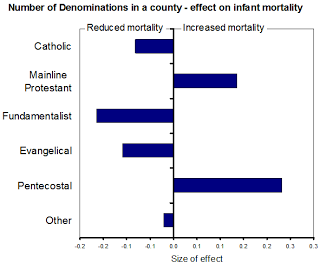
Batowski found that, in general, the more Catholic churches there were in an are the lower infant mortality was. Conversely, more Protestant churches meant higher infant mortality.
But this broad brush conceals a lot of detail. And the beauty of such a rich dataset was that Bartowksi could drill down to look at Protestant denominations in detail.
When he did that, he found that fundamentalist and evangelical churches actually were linked to lower infant mortality. It was mainline Protestant and in particular Pentecostal churches that were linked to higher mortality.
Bartowski speculates that the protective effect of Catholicism “is best explained by the emphasis that Catholicism places on creating a vibrant civic infrastructure, particularly one focused on promoting population health and well-being”, while the “pronatalist tendencies of fundamentalism and evangelicalism (advocacy for children and the unborn) contribute to significantly lower infant mortality rates”.
And Pentecostals? Well, he suspects that “Pentecostal suspicion of conventional medicine and its reliance instead on faith healing” accounts for the higher infant mortality.
But he does also acknowledge that this study can only be taken as preliminary. What, for example to make of the finding that mainline Protestants are linked to higher infant mortality? Is this a spurious result, perhaps as a result of some other unknown factor? Or is there something deeper going on?

Bartkowski, J., Xu, X., & Garcia, G. (2011). Religion and Infant Mortality in the U.S.: A Preliminary Study of Denominational Variations Religions, 2 (3), 264-276 DOI: 10.3390/rel2030264
 This article by Tom Rees was first published on Epiphenom. It is licensed under Creative Commons.
Previous Post

July 21, 2011
We condemn more when we think we're being watched
Next Post
July 31, 2011 Sorry to break it to you like this, but we are all doomed!
Browse Our Archives
Select a Category Causes of religion - evolution Causes of religion - psychological Causes of religion - social Demographics Digest Effects of religion - health Effects of religion - psychological Effects of religion - social Notifications Politics Uncategorized
Select a Month March 2016 February 2016 January 2016 December 2015 November 2015 October 2015 September 2015 August 2015 July 2015 June 2015 May 2015 April 2015 March 2015 February 2015 January 2015 December 2014 November 2014 October 2014 September 2014 August 2014 July 2014 June 2014 May 2014 April 2014 March 2014 February 2014 January 2014 December 2013 November 2013 October 2013 September 2013 August 2013 July 2013 June 2013 May 2013 April 2013 March 2013 February 2013 January 2013 December 2012 November 2012 October 2012 September 2012 August 2012 July 2012 June 2012 May 2012 April 2012 March 2012 February 2012 January 2012 December 2011 November 2011 October 2011 September 2011 August 2011 July 2011 June 2011 May 2011 April 2011 March 2011 February 2011 January 2011 December 2010 November 2010 October 2010 September 2010 August 2010 July 2010 June 2010 May 2010 April 2010 March 2010 February 2010 January 2010 December 2009 November 2009 October 2009 September 2009 August 2009 July 2009 June 2009 May 2009 April 2009 March 2009 February 2009 January 2009 December 2008 November 2008 October 2008 September 2008 August 2008 July 2008 June 2008 May 2008 April 2008 March 2008 February 2008 January 2008 December 2007 November 2007 October 2007
Follow Us!
TAKE THE
Religious Wisdom Quiz
What Christian group believes in baptism for the dead?
Select your answer to see how you score.
Pentecostals Latter-day Saints Anglicans Presbyterians
Related posts from Epiphenom

Do social crises lead to religious revivals? Nah!

What kind of woman would pray for health...

Can you use religion to change attitudes towards...

Dogmatic atheism and fundamentalist Christianity: creating certainty in...
TRENDING AT PATHEOS Nonreligious

Dethroning Jesus and Enthroning Yourself
Jesus Never Asked to Be Worshipped. He Asked to Be Understood. Christianity...

Why Most Christians are Really Paulians and Jobians
I Don't Care, But It Matters Let's get this out of the...

Essential Tips to Successfully Navigate the Selling Process
Selling a house can feel overwhelming, but it doesn’t have to be....

To Make Remote Work Effective, Think About Others
The COVID-19 pandemic forced many companies to rapidly transition to remote work....

Flexibility Is Key to Solving Problems of Tomorrow
The world of work is undergoing a dramatic transformation. The COVID-19 pandemic...
view all Nonreligious blogs
Ad-Free & Subscriber Log-In Subscription Support
- About Us
- 2026 Calendar
- Videos
- Podcasts
- Library of World Religions
- Faith In Media Tracker
- Advertise With Us
- Write for Us
- Privacy Policy
- Terms of Service
- Do Not Sell My Data
- Contact Us
- Radiant Digital
- Manage Newsletter Subscriptions
- Unsubscribe From Notifications
- Sitemap
Copyright 2008-2026, Patheos. All rights reserved.
Subscription Support Ad-Free & Subscriber Log-In
Follow Patheos