
BuddhistCatholicContemplativeEvangelicalGeneral ChristianHinduJewishLatter-day SaintMuslimNew VisionsProgressive Christian
Beliefs
- Buddhist
- Catholic
- Contemplative
- Evangelical
- General Christian
- Hindu
- Jewish
- Latter-day Saint
- More Voices
- Muslim
- New Visions
- Pagan
- Progressive Christian
Topics
- Religion News
- Food and Religion
- Sports and Religion
- Religious Art
- Religious Music and Entertainment
- Religious Events
- History and Religion
- Style and Religion
- Politics and Religion
- Women in Religion
- Recreation Outdoors and Religion
- Business Finance and Religion
- Careers Workplace and Religion
- Education and Religion
- Family Parenting and Religion
- Health Fitness and Religion
- Home and Religion
- Relationships and Religion
- Technology and Religion
- Travel and Religion
Columnists
- Buddhist Columnists
- Business Finance and Religion Columnists
- Careers Workplace and Religion Columnists
- Catholic Columnists
- Contemplative Columnists
- Education and Religion Columnists
- Evangelists Columnists
- Family Parenting and Religion Columnists
- General Christian Columnists
- Health Fitness and Religion Columnists
- Hindu Columnists
- History and Religion Columnists
- Home and Religion Columnists
- Jewish Columnists
- More Voices Columnists
- Latter Day Columnists
- Muslim Columnists
- New Visions Columnists
- Nonreligious Columnists
- Pagan Columnists
- Politics and Religion Columnists
- Progressive Columnists
- Recreation Outdoors and Religion Columnists
- Relationships and Religion Columnists
- Religion News Columnists
- Religious Art Columnists
- Religious Events Columnists
- Religious Music and Entertainment Columnists
- Sports and Religion Columnists
- Style and Religion Columnists
- Technology and Religion Columnists
- Travel and Religion Columnists
- Women in Religion Columnists
Resource Library
- 2026 Calendar
- Library of World Religions
- The 100 Most Holy Places on Earth
- Patheos Answers
- Podcasts
- Videos
- Faith Leaders Database
- Anglican Episcopalian
- Bahai
- Baptist
- Buddhism
- Christianity
- Confucianism
- Eastern Orthodoxy
- Hinduism
- Holiness and Pentecostal
- ISKCON
- Islam
- Judaism
- Lutheran
- Methodist
- The Church of Jesus Christ of Latter-day Saints
- New Age
- Paganism
- Presbytarian and Reformed
- Protestantism
- Religion Behind the Scenes
- Roman Catholic
- Scientology
- Shia Islam
- Sikhism
- Sufism
- Sunni Islam
- Taoism
- Zen
- See all religions
Research Tools
 Ad-Free & Subscriber Log-In Subscription Support
Ad-Free & Subscriber Log-In Subscription Support
Follow Patheos 

- Trending:
- Forgiveness
- |
- Marriage
- |
- Consciousness
- |
- Death Penalty
- |
- Election
- |
- Halloween
 Epiphenom
- Home
- Nonreligious
- Win a copy of ‘Jesus Potter Harry Christ’!
Win a copy of ‘Jesus Potter Harry Christ’!
Last updated on: November 12, 2014 at 4:07 am by Epiphenom
Win a copy of ‘Jesus Potter Harry Christ’! 2014-11-12T04:07:09+01:00 Epiphenom
Patheos Explore the world's faith through different perspectives on religion and spirituality! Patheos has the views of the prevalent religions and spiritualities of the world.
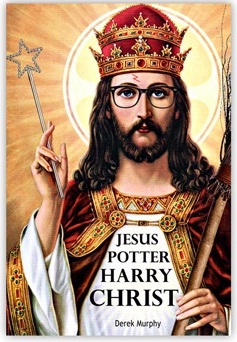 I suspect that most atheists, to the extent that they think about the biblical stories of Jesus at all, probably take the view that they are a big helping of myth built upon a small kernel of truth. That’s certainly the view I took. I know that some people claim that it’s an entire myth – that Jesus the man never existed – but to me that never really seemed credible.
After all, the earliest stories of Jesus date to just a decade or two after his death. How could anyone have fallen for a complete invention so soon after the alleged event?
Well, I’ve just been reading Harry Potter Jesus Christ (don’t be put off by the title! It isn’t sensationalist and is actually rather scholarly). It’s quite a fascinating book – one of those books that takes the facts you already know (at least in broad terms) and presents them viewed through a different lens. Anyway, suffice to say that although I’m still sceptical of the idea that Jesus the Man is a complete myth (we’ll never know for certain, of course), at least now I can see how the myth could have come to be, and how it people could have persuaded themselves that Jesus was real.
So it’s a book well worth reading and, courtesy of the author (Derek Murphy), I have three copies to give away! To find out how you can win one, scroll to the end of the post.
Before you do that, though, you might want to learn a little more about the book. I fired off some questions to Derek ideas and how they came to him. Here are his answers – they’ll give you a flavour of what the book is all about.
Epiphenom: What’s the basic premise of your book?
Derek: That Jesus and Harry Potter are both literary (fictional) characters which incorporate classical (pagan) spirituality and religious ideology, which is itself based in large part on ancient astrology and astronomical observation. I start by using the similarities between Jesus and Harry to raise the question, “how can Jesus be historical if Harry is fictional?” From there, I go over the evidence and history of the belief in the historical Jesus, the problems with the research, and the comparisons between Jesus and older pagan gods to establish the possibility that Jesus may be mostly literary, and then search through ancient sources to try and understand what went into the making of the Jesus myth, and how/when it got mistakenly viewed as history.
Epiphenom: What first interested you in the Jesus myth?
Derek: I was raised Christian and in my teens even flirted with some very cult-esque organizations; it is easy to channel teenage energy and passion into Christian worship. I considered myself a wise and intellectual believer. However as I travelled I had more and more difficulty dealing with pressing questions such as how a just god could “save” mostly Western countries while ignoring (or leaving to accident) everybody else. I began studying theology (in a seminary school, with Franciscan, Dominican and Jesuit classmates), and then switched to philosophy. What I learned raised even more questions. Around this time I found a copy of “The Jesus Mysteries” by Freke and Gandy. It clicked everything into place. Since then I’ve been researching independently; there is a lot of good material on the web but a lot of “Christ Myth Theory” is overstated, or recycles faulty evidence. But when you go to the original sources, Christian or pagan writings, modern scholars, it is pretty easy to find support to make the case that Jesus was never historical. I put out a little book in 2006 to test the waters, but realized if I was going to add to the conversation I had to do a significant amount of new research and present it in a way to catch the attention of people who aren’t already interested in the subject.
Epiphenom: How do you go about creating a god?
Derek: I think humans are naturally god-producing beings. When we’re alone in the forest, surrounded by beauty or natural, it’s natural for us to have this feeling of awe, humility and empowerment all at the same time. When we’re hurt or sick it’s natural for us to ask life or the universe for help – maybe we don’t ask any body in the beginning, but these feelings lead to a kind of sincerity in prayer which could evolve into more detailed description of just who or what is out there. I think most early descriptions of gods and goddesses however are directly related to astronomical observation of the planets – which appear to move by themselves in contrast to the night sky; Mars is red and angry, Venus is bright and beautiful, etc. However much, much later, we do have examples of empires deliberating forging disparate beliefs together in attempts to unify their dominions and simplify their rule. I don’t believe Jesus is necessarily a fake or forgery – it’s probable that he’s a natural synthesis of his times… and yet there is precedent for the argument that some Roman Ruler decided to create a Jewish-Pagan synthesis to try and soothe the continuously rebellious Jews.
Epiphenom: Are all Eurasian mythologies underpinned by a single cosmic archetype?
Derek: No – there are many different gods and goddesses, some of which evolved separately. But most of them are based on constellations or planet movements, so there is some repetition. However two threads that go back a long, long time, are the ideas about the creation of the world coming from a serpent or snake, and being forged through its defeat by a victorious warrior, and a dying, suffering and returning god. There are details to these stories that make it unlikely to be coincidental, and they can probably be traced to a very ancient source, perhaps somewhere in India, that spread out in both directions (Europe/Asia). With the growth of the Greek and Roman Empires, however, cultures were coming together and increasingly gods were being merged together in cultural synthesis. There was a quest to find the best or most powerful god, the god that was behind all others. Eventually this movement resulted in Christianity, which is basically an “everyman” religion that assimilated aspects of everything else.
Epiphenom: What are the similarities between the the Roman and Greek mysteries and the Jesus myth – and how do we know which direction the influence went?
Derek: The main features are the dying and resurrecting gods, the specific dates of worship, and the rituals included in the ceremonies. The only argument that Jesus is NOT one of those other dying and resurrecting gods is that Jesus was real, and he physically resurrected, while the others were myths; but this is a modern argument. Ancient cultures also believed that their gods were real. Christianity is unique in prioritizing a resurrection of the flesh, but the story of Jesus is in no way new. Specifically you have a prophesied infant born to be savior, who is threatened by a ruler and goes into hiding, who comes back to defeat his enemies but at the same time suffers death, is mourned and then (sometimes) comes back. The birth was commonly on December 25th, and the resurrection sometime in the spring. The way we celebrate Christmas and Easter is entirely based on pagan rituals that preceded Christianity. The way we know what came first is that the earliest Christians were already aware of the similarities, and trying to explain them; the foundation of Christian apologetics is the attempt to answer the criticism that a) Jesus wasn’t real or b) his story is a copy from pagan mythology. We find traces of these defenses in the Bible and in all early Christian literature. So even if we ignore the similarities at face value, ignore the fact that we can establish the worship of the other pagan gods centuries earlier, ignore the fact that the Jews, and early Christians were very familiar with these rival deities… we still have the evidence of early Christian writers confirming the similarities and refusing it by using the “diabolical mimicry” argument.
Epiphenom: Tell us about the schisms in the early Church
Derek: I think the most interesting things about schisms is that they existed at all – there are so many of them. And many of these communities believed the one thing that apostolic tradition should have rendered impossible; that Jesus wasn’t a historical man. What the schisms demonstrate is that Christianity was not a single message, flowing from a single source that became tainted as it grew. Instead it was a non-centralized body of ideas and literature, which developed independently, and perhaps only later was rebranded or assimilated under the title of a new lord called Jesus. It is impossible to tell which stories or features associated with the story were developed earlier, or later, than the birth of Christianity, because all of the relevant pieces were already developing on their own before his appearance.
Epiphenom: Why did the ‘Jesus is real’ faction win out?
Derek: The ‘Jesus is real’ faction had a lot going for it. First of all, they were almost entirely poor classes who had nothing to lose. The Jesus was Real faction was also the most simplified, philosophy-devoid, rhetoric filled version of the Jesus story available. It was essentially no different from the already low-class cult of Isis and Sarapis which, although outlawed in the beginning as a dangerous foreign cult, spread through Roman territory (it is likely that the people held responsible and punished by Nero for the fire of Rome were Isis-cult members, not Christians). Sarapis and Jesus were for the first 50 years or so worshipped together as one figure. So it is not really true that suddenly they struck the magic formula and Jesus was instantly more popular than all other faiths. Instead, other faiths were “renamed” under the banner of Jesus, which made little difference to its followers. However, the early Jesus movement also had a desperate belief in the immediate end of the world (which was also common in stoicism), were already slaves or impoverished who were enchanted by stories of God’s love and blessings in heaven, or superstitious practitioners of magic who’d heard of the amazing “power” of the magical word “Jesus”. They were relentless missionaries; they gave up their possessions and gathered in town squares proselytizing; they spoke boldly, refused authorities, challenged traditional gods and struck their temples and idols. Their zeal, tenacity and conviction of their beliefs were contagious. But it should be pointed out that Christianity has changed; the religion as it is today has little in common with the distinctive features of its beginnings; now it is very little from the pagan cults that the early Christians despised.
Win a copy of Jesus Potter Harry Christ!
All you need to do is answer the question “Do you think Jesus existed? Why or Why not?” in the comments below, and the best three answers win a copy (you’ll need to drop me an email with your address).
You need to post your comments on the Epiphenom website. If you’re reading this in one of the many places this blog gets republished, comments there don’t count!
 This article by Tom Rees was first published on Epiphenom. It is licensed under Creative Commons.
Previous Post

June 20, 2011
Fear and God
Next Post
June 29, 2011 And the winners are...
Browse Our Archives
Select a Category Causes of religion - evolution Causes of religion - psychological Causes of religion - social Demographics Digest Effects of religion - health Effects of religion - psychological Effects of religion - social Notifications Politics Uncategorized
Select a Month March 2016 February 2016 January 2016 December 2015 November 2015 October 2015 September 2015 August 2015 July 2015 June 2015 May 2015 April 2015 March 2015 February 2015 January 2015 December 2014 November 2014 October 2014 September 2014 August 2014 July 2014 June 2014 May 2014 April 2014 March 2014 February 2014 January 2014 December 2013 November 2013 October 2013 September 2013 August 2013 July 2013 June 2013 May 2013 April 2013 March 2013 February 2013 January 2013 December 2012 November 2012 October 2012 September 2012 August 2012 July 2012 June 2012 May 2012 April 2012 March 2012 February 2012 January 2012 December 2011 November 2011 October 2011 September 2011 August 2011 July 2011 June 2011 May 2011 April 2011 March 2011 February 2011 January 2011 December 2010 November 2010 October 2010 September 2010 August 2010 July 2010 June 2010 May 2010 April 2010 March 2010 February 2010 January 2010 December 2009 November 2009 October 2009 September 2009 August 2009 July 2009 June 2009 May 2009 April 2009 March 2009 February 2009 January 2009 December 2008 November 2008 October 2008 September 2008 August 2008 July 2008 June 2008 May 2008 April 2008 March 2008 February 2008 January 2008 December 2007 November 2007 October 2007
Follow Us!
TAKE THE
Religious Wisdom Quiz
Who said, "Come and see"?
Select your answer to see how you score.
Peter Paul John the Baptist Philip
Related posts from Epiphenom

Do social crises lead to religious revivals? Nah!

What kind of woman would pray for health...

Can you use religion to change attitudes towards...

Dogmatic atheism and fundamentalist Christianity: creating certainty in...
TRENDING AT PATHEOS Nonreligious

Dethroning Jesus and Enthroning Yourself
Jesus Never Asked to Be Worshipped. He Asked to Be Understood. Christianity...

Why Most Christians are Really Paulians and Jobians
I Don't Care, But It Matters Let's get this out of the...

Essential Tips to Successfully Navigate the Selling Process
Selling a house can feel overwhelming, but it doesn’t have to be....

To Make Remote Work Effective, Think About Others
The COVID-19 pandemic forced many companies to rapidly transition to remote work....

Flexibility Is Key to Solving Problems of Tomorrow
The world of work is undergoing a dramatic transformation. The COVID-19 pandemic...
view all Nonreligious blogs
Ad-Free & Subscriber Log-In Subscription Support
- About Us
- 2026 Calendar
- Videos
- Podcasts
- Library of World Religions
- Faith In Media Tracker
- Advertise With Us
- Write for Us
- Privacy Policy
- Terms of Service
- Do Not Sell My Data
- Contact Us
- Radiant Digital
- Manage Newsletter Subscriptions
- Unsubscribe From Notifications
- Sitemap
Copyright 2008-2026, Patheos. All rights reserved.
Subscription Support Ad-Free & Subscriber Log-In
Follow Patheos