
BuddhistCatholicContemplativeEvangelicalGeneral ChristianHinduJewishLatter-day SaintMuslimNew VisionsProgressive Christian
Beliefs
- Buddhist
- Catholic
- Contemplative
- Evangelical
- General Christian
- Hindu
- Jewish
- Latter-day Saint
- More Voices
- Muslim
- New Visions
- Pagan
- Progressive Christian
Topics
- Religion News
- Food and Religion
- Sports and Religion
- Religious Art
- Religious Music and Entertainment
- Religious Events
- History and Religion
- Style and Religion
- Politics and Religion
- Women in Religion
- Recreation Outdoors and Religion
- Business Finance and Religion
- Careers Workplace and Religion
- Education and Religion
- Family Parenting and Religion
- Health Fitness and Religion
- Home and Religion
- Relationships and Religion
- Technology and Religion
- Travel and Religion
Columnists
- Buddhist Columnists
- Business Finance and Religion Columnists
- Careers Workplace and Religion Columnists
- Catholic Columnists
- Contemplative Columnists
- Education and Religion Columnists
- Evangelists Columnists
- Family Parenting and Religion Columnists
- General Christian Columnists
- Health Fitness and Religion Columnists
- Hindu Columnists
- History and Religion Columnists
- Home and Religion Columnists
- Jewish Columnists
- More Voices Columnists
- Latter Day Columnists
- Muslim Columnists
- New Visions Columnists
- Nonreligious Columnists
- Pagan Columnists
- Politics and Religion Columnists
- Progressive Columnists
- Recreation Outdoors and Religion Columnists
- Relationships and Religion Columnists
- Religion News Columnists
- Religious Art Columnists
- Religious Events Columnists
- Religious Music and Entertainment Columnists
- Sports and Religion Columnists
- Style and Religion Columnists
- Technology and Religion Columnists
- Travel and Religion Columnists
- Women in Religion Columnists
Resource Library
- 2026 Calendar
- Library of World Religions
- The 100 Most Holy Places on Earth
- Patheos Answers
- Podcasts
- Videos
- Faith Leaders Database
- Anglican Episcopalian
- Bahai
- Baptist
- Buddhism
- Christianity
- Confucianism
- Eastern Orthodoxy
- Hinduism
- Holiness and Pentecostal
- ISKCON
- Islam
- Judaism
- Lutheran
- Methodist
- The Church of Jesus Christ of Latter-day Saints
- New Age
- Paganism
- Presbytarian and Reformed
- Protestantism
- Religion Behind the Scenes
- Roman Catholic
- Scientology
- Shia Islam
- Sikhism
- Sufism
- Sunni Islam
- Taoism
- Zen
- See all religions
Research Tools
 Ad-Free & Subscriber Log-In Subscription Support
Ad-Free & Subscriber Log-In Subscription Support
Follow Patheos 

- Trending:
- Forgiveness
- |
- Marriage
- |
- Consciousness
- |
- Death Penalty
- |
- Election
- |
- Halloween
 Epiphenom
- Home
- Nonreligious
- Punitive gods stop cheaters, compassionate gods encourage them
Punitive gods stop cheaters, compassionate gods encourage them
Last updated on: November 12, 2014 at 4:13 am by Epiphenom
Punitive gods stop cheaters, compassionate gods encourage them 2014-11-12T04:13:44+01:00 Epiphenom
Patheos Explore the world's faith through different perspectives on religion and spirituality! Patheos has the views of the prevalent religions and spiritualities of the world.
Probably more important than whether you believe in a God is the type of God you believe in – from a behavioural point of view, at least.
For example, believers in a judgemental god are more likely to support the death penalty, and are more likely to suffer mental ill health. Back in 2006, Gary Jensen (a criminologist at Vanderbildt University) showed that so-called ‘passionate dualism’ – i.e. religious worldview characterised by intense beliefs in a clash between good and evil – is a major cause of homicide.
Now, a new study by Azim Shariff, at the University of Oregon, and Ara Norenzayan, at the University of British Columbia, have looked at how views of God affect cheating. You may remember Shariff from a pivotal study in 2008 on priming religious concepts and honesty.
In this new study, they sat students down to what they thought was a warm-up task on basic numeracy (adding up a bunch of numbers – simple but tedious). Unfortunately, the computer programme had a glitch that showed the answer after a few seconds. The students were asked to be honest and press the space bar to make the answer go away – without looking at it.
Of course, this was no glitch. In fact, they were interested in whether (and how often) the students did the honest thing and pressed the space bar.
It turned out that there was no difference in honesty between atheists and the religious. However, there was a big difference among the religious.
Those who believed in a stern, punishing god were less likely to cheat – while those who believe compassionate, forgiving god were actually more likely to cheat! On average, the two cancelled out – which is why the religious as a whole were no different from atheists.
So does that mean that encouraging belief in punishing gods will reduce cheating. Well, it’s not quite that simple.
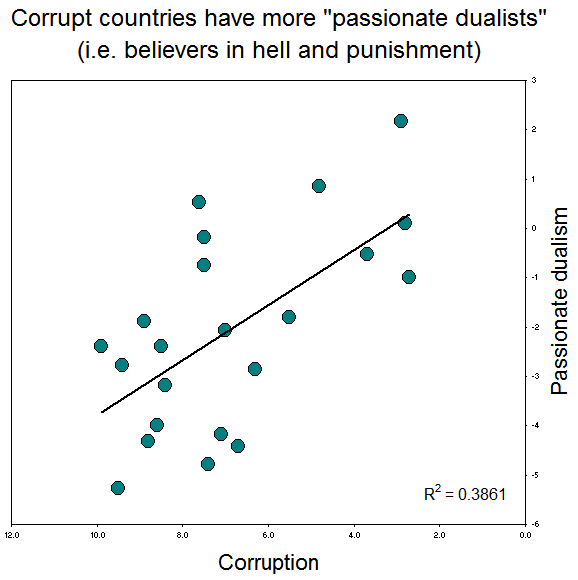 Take, for example, this graph that I just knocked together. It plots ‘Passionate Dualism’ – based on Gary Jensen’s original measure of heaven and hell beliefs – against corruption (the Corruption Perceptions Index). It goes in the opposite way to what you might expect – the greater the level of belief in punitive gods, the more corruption a country has.
One reason this might happen is that Shariff’s study was a scientific study, done in isolation from any context. Yet the most common cause of cheating is actually when people feel that they’ve been hard-done by elsewhere, as this article in the NY Times explains:
“Cheating is especially easy to justify when you frame situations to cast yourself as a victim of some kind of unfairness,” said Dr. Anjan Chatterjee, a neurologist at the University of Pennsylvania who has studied the use of prescription drugs to improve intellectual performance. “Then it becomes a matter of evening the score; you’re not cheating, you’re restoring fairness.”
What’s more, individuals who are convinced that they have the moral high ground are actually more likely to cheat. Perhaps believers in a punitive god have had experiences in the past that make them feel like they are victims of injustice, and also that they are strongly in the right.
Well, this might help to explain it, but it certainly isn’t the full story, and it probably isn’t the most interesting one. Much more interesting is the likelihood that people change adapt their concept of god to suit the society in which they find themselves. Here’s Shariff and Norenzayan:
… the concept of a punishing God should be expected to be more widespread in societies where the threat of freeloading is high, such as those lacking effective social institutions, experiencing internal or external threats, or both. This hypothesis raises the possibility that the widespread belief in benevolent deities is a modern phenomenon—the consequence of a gradual change in religious beliefs.
Their point is that believing in a punishing god is actually very stress-inducing. An earlier study found that reminders of God make Christians less fearful of death – but make Muslims more fearful! That was mainly because, unlike the Christians, they had solid belief in hell. Back then I commented that:
The function of Hell is to reinforce social order by threatening punishment to wrongdoers who can’t be brought to justice by normal societal mechanisms. As a strategy, it’s not terribly successful. Medieval Europe is not renowned as an era of peace, justice and harmony.
But perhaps in the absence of more effective social controls, promoting fear of hell is better than nothing. When better social controls are invented – such as in modern Europe – Hell is no longer needed.
If Hell is no longer needed in modern Europe, then Heaven still is. People still die, and our basic, evolved instincts make us all fear of death. The prospect of heaven can reduce that fear – but only if you abandon the inconvenient concept of hell.
As a result, modern Christianity, reacting to market demand, quietly drops the concept of hell, but retains the concept of heaven.
The feel-good version of religion, like atheism, is what you get when you remove danger and threat from people’s lives.

Shariff, A., & Norenzayan, A. (2011). Mean Gods Make Good People: Different Views of God Predict Cheating Behavior. International Journal for the Psychology of Religion, 21 (2), 85-96 DOI: 10.1080/10508619.2011.556990
 This article by Tom Rees was first published on Epiphenom. It is licensed under Creative Commons.
Previous Post

April 19, 2011
European Christians don't want government to reduce income inequality
Next Post
April 26, 2011 Get out and vote "Yes to AV" in the UK referendum
Browse Our Archives
Select a Category Causes of religion - evolution Causes of religion - psychological Causes of religion - social Demographics Digest Effects of religion - health Effects of religion - psychological Effects of religion - social Notifications Politics Uncategorized
Select a Month March 2016 February 2016 January 2016 December 2015 November 2015 October 2015 September 2015 August 2015 July 2015 June 2015 May 2015 April 2015 March 2015 February 2015 January 2015 December 2014 November 2014 October 2014 September 2014 August 2014 July 2014 June 2014 May 2014 April 2014 March 2014 February 2014 January 2014 December 2013 November 2013 October 2013 September 2013 August 2013 July 2013 June 2013 May 2013 April 2013 March 2013 February 2013 January 2013 December 2012 November 2012 October 2012 September 2012 August 2012 July 2012 June 2012 May 2012 April 2012 March 2012 February 2012 January 2012 December 2011 November 2011 October 2011 September 2011 August 2011 July 2011 June 2011 May 2011 April 2011 March 2011 February 2011 January 2011 December 2010 November 2010 October 2010 September 2010 August 2010 July 2010 June 2010 May 2010 April 2010 March 2010 February 2010 January 2010 December 2009 November 2009 October 2009 September 2009 August 2009 July 2009 June 2009 May 2009 April 2009 March 2009 February 2009 January 2009 December 2008 November 2008 October 2008 September 2008 August 2008 July 2008 June 2008 May 2008 April 2008 March 2008 February 2008 January 2008 December 2007 November 2007 October 2007
Follow Us!
TAKE THE
Religious Wisdom Quiz
Who dreamed of a ladder reaching to heaven?
Select your answer to see how you score.
Isaac Abraham Jacob Joseph
Related posts from Epiphenom

Do social crises lead to religious revivals? Nah!

What kind of woman would pray for health...

Can you use religion to change attitudes towards...

Dogmatic atheism and fundamentalist Christianity: creating certainty in...
TRENDING AT PATHEOS Nonreligious

Dethroning Jesus and Enthroning Yourself
Jesus Never Asked to Be Worshipped. He Asked to Be Understood. Christianity...

Why Most Christians are Really Paulians and Jobians
I Don't Care, But It Matters Let's get this out of the...

Essential Tips to Successfully Navigate the Selling Process
Selling a house can feel overwhelming, but it doesn’t have to be....

To Make Remote Work Effective, Think About Others
The COVID-19 pandemic forced many companies to rapidly transition to remote work....

Flexibility Is Key to Solving Problems of Tomorrow
The world of work is undergoing a dramatic transformation. The COVID-19 pandemic...
view all Nonreligious blogs
Ad-Free & Subscriber Log-In Subscription Support
- About Us
- 2026 Calendar
- Videos
- Podcasts
- Library of World Religions
- Faith In Media Tracker
- Advertise With Us
- Write for Us
- Privacy Policy
- Terms of Service
- Do Not Sell My Data
- Contact Us
- Radiant Digital
- Manage Newsletter Subscriptions
- Unsubscribe From Notifications
- Sitemap
Copyright 2008-2026, Patheos. All rights reserved.
Subscription Support Ad-Free & Subscriber Log-In
Follow Patheos