
BuddhistCatholicContemplativeEvangelicalGeneral ChristianHinduJewishLatter-day SaintMuslimNew VisionsProgressive Christian
Beliefs
- Buddhist
- Catholic
- Contemplative
- Evangelical
- General Christian
- Hindu
- Jewish
- Latter-day Saint
- More Voices
- Muslim
- New Visions
- Pagan
- Progressive Christian
Topics
- Religion News
- Food and Religion
- Sports and Religion
- Religious Art
- Religious Music and Entertainment
- Religious Events
- History and Religion
- Style and Religion
- Politics and Religion
- Women in Religion
- Recreation Outdoors and Religion
- Business Finance and Religion
- Careers Workplace and Religion
- Education and Religion
- Family Parenting and Religion
- Health Fitness and Religion
- Home and Religion
- Relationships and Religion
- Technology and Religion
- Travel and Religion
Columnists
- Buddhist Columnists
- Business Finance and Religion Columnists
- Careers Workplace and Religion Columnists
- Catholic Columnists
- Contemplative Columnists
- Education and Religion Columnists
- Evangelists Columnists
- Family Parenting and Religion Columnists
- General Christian Columnists
- Health Fitness and Religion Columnists
- Hindu Columnists
- History and Religion Columnists
- Home and Religion Columnists
- Jewish Columnists
- More Voices Columnists
- Latter Day Columnists
- Muslim Columnists
- New Visions Columnists
- Nonreligious Columnists
- Pagan Columnists
- Politics and Religion Columnists
- Progressive Columnists
- Recreation Outdoors and Religion Columnists
- Relationships and Religion Columnists
- Religion News Columnists
- Religious Art Columnists
- Religious Events Columnists
- Religious Music and Entertainment Columnists
- Sports and Religion Columnists
- Style and Religion Columnists
- Technology and Religion Columnists
- Travel and Religion Columnists
- Women in Religion Columnists
Resource Library
- 2026 Calendar
- Library of World Religions
- The 100 Most Holy Places on Earth
- Patheos Answers
- Podcasts
- Videos
- Faith Leaders Database
- Anglican Episcopalian
- Bahai
- Baptist
- Buddhism
- Christianity
- Confucianism
- Eastern Orthodoxy
- Hinduism
- Holiness and Pentecostal
- ISKCON
- Islam
- Judaism
- Lutheran
- Methodist
- The Church of Jesus Christ of Latter-day Saints
- New Age
- Paganism
- Presbytarian and Reformed
- Protestantism
- Religion Behind the Scenes
- Roman Catholic
- Scientology
- Shia Islam
- Sikhism
- Sufism
- Sunni Islam
- Taoism
- Zen
- See all religions
Research Tools
 Ad-Free & Subscriber Log-In Subscription Support
Ad-Free & Subscriber Log-In Subscription Support
Follow Patheos 

- Trending:
- Forgiveness
- |
- Marriage
- |
- Consciousness
- |
- Death Penalty
- |
- Election
- |
- Halloween
 Epiphenom
- Home
- Nonreligious
- Bowling together… in most of Europe, at least
Bowling together… in most of Europe, at least
Last updated on: November 12, 2014 at 4:18 am by Epiphenom
Bowling together… in most of Europe, at least 2014-11-12T04:18:10+01:00 Epiphenom
Patheos Explore the world's faith through different perspectives on religion and spirituality! Patheos has the views of the prevalent religions and spiritualities of the world.
Ten years ago, the sociologist Robert Putnam created shockwaves with his analysis of the breakdown of US society in recent decades –
We sign fewer petitions, belong to fewer organizations that meet, know our neighbors less, meet with friends less frequently, and even socialize with our families less often. We’re even bowling alone [Source: Bowling Alone].
Putnam’s analysis of the causes was pretty nuanced (read: no-one really knows), but he did point out that the decline of religion in the US has gone hand in hand with the decline in other forms of so-called ‘social capital’.
In his latest book, American Grace, Putnam goes a bit further, arguing that religion is a kind of social glue. Take a look at this, from a review of the book:
Religious Americans are better citizens than non-religious ones (they give more to secular causes, volunteer more for secular causes, and join more, to mention a few markers of good citizenship). However, it is not their particular theology that predicts good citizenship, but the extent to which they are embedded in a friendship network of religious others (regardless of their religion). [Putnam refers to these religious friends as “powerful, supercharged friends.”]
Well, so much for the USA. What about godless Europe?
Europe must be in a pretty parlous state, without religion to bind communities together! You might think so, couple of pieces of recent research suggest that simple assumption is not really warranted.
Anna Rita Manca, of the ominous-sounding EU Institute for the Protection and Security of the Citizen, crunched through some data from the European Social Survey and found that, sure enough, religious Europeans score highest on ‘Social Capital’.
By ‘social capital’ she’s talking about two kinds of activity:
- Social engagement, individuals participating to organizations that are outward looking and aim
at improving the society at large (cultural, human rights, social, religious, environmental/peace organization). - Private engagement encompasses the organizations that work closer to the private interest of the
respondent (sport, trade union, business, teacher/parents, political party).
Religious people come out higher on social engagement but not private engagement – not too surprising when you look and see that being a member of a religious organisation scores you a point!
But let’s not worry about that, because there’s something much more interesting going on.
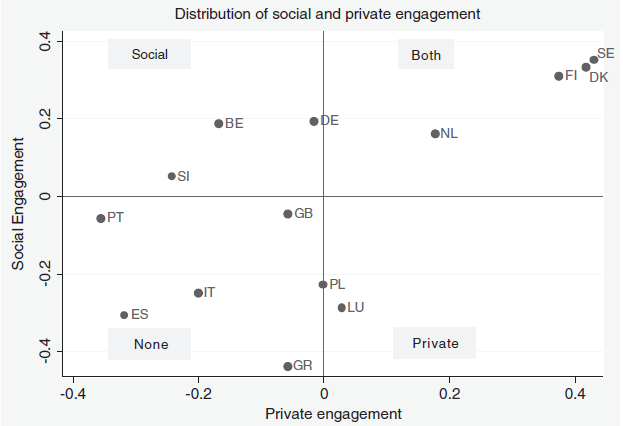
Take a look at this figure, which shows average levels of social capital (both social and private) in European Countries.
In the top right of the graph, in the area representing high levels of social capital, who should we find but our old friends the Nordic countries!
In fact, there’s a general trend here – those countries with the least religion have the most social capital. And that’s despite the fact that, even in Nordic countries, religious individuals tend to score higher.
We’ve been here before. In fact, this seems to be quite a common trend. When you question individuals about their behaviour, the non-religious often seem to come out worse. And yet, when you look at nations, those with the fewest religious people regularly come out on top on a range of social issues.
So what does the future hold? Perhaps, you’re thinking those Nordic countries would come out even higher if they still had their religion. Perhaps they are declining from a golden age some time in their religous past?
Well that’s where research from Francesco Sarracino, at the University of Florence in Italy, comes in. Sarracino used a broad array of measures of social capital, including trust, unpaid voluntary work, and membership in organisations (including religious ones).
He found that, in the period 1980-2000, social capital had increased overall in virtually all European countries – despite declining Church going and declining trust in Church institutions. Sweden, Denmark and Norway have all seen increases in social capital over that time – and this was matched by an increase in well being.
There was one exception to this general European trend: the UK. Now, of all European nations, the UK is most like the USA. Over the past 20 years, social capital in the UK has generally gone down – and the people of the UK have become unhappier.
To me, this says that religion is unimportant for social capital. Rather, there is some shared disease that is corroding society in both the UK and in the USA. If our leaders are genuinely interested in stopping the rot, they should worry less about religion and instead figure out what the real disease is.
 Mascherini, M., Vidoni, D., & Manca, A. (2010). Exploring the Determinants of Civil Participation in 14 European Countries: One-Size-Fits None European Sociological Review DOI: 10.1093/esr/jcq041
Sarracino, F. (2010). Social capital and subjective well-being trends: Comparing 11 western European countries Journal of Socio-Economics, 39 (4), 482-517 DOI: 10.1016/j.socec.2009.10.010
 This article by Tom Rees was first published on Epiphenom. It is licensed under Creative Commons.
Previous Post

March 7, 2011
They said they wanted a revolution
Next Post
March 16, 2011 A basic psychological link between religion and right-wing politics
Browse Our Archives
Select a Category Causes of religion - evolution Causes of religion - psychological Causes of religion - social Demographics Digest Effects of religion - health Effects of religion - psychological Effects of religion - social Notifications Politics Uncategorized
Select a Month March 2016 February 2016 January 2016 December 2015 November 2015 October 2015 September 2015 August 2015 July 2015 June 2015 May 2015 April 2015 March 2015 February 2015 January 2015 December 2014 November 2014 October 2014 September 2014 August 2014 July 2014 June 2014 May 2014 April 2014 March 2014 February 2014 January 2014 December 2013 November 2013 October 2013 September 2013 August 2013 July 2013 June 2013 May 2013 April 2013 March 2013 February 2013 January 2013 December 2012 November 2012 October 2012 September 2012 August 2012 July 2012 June 2012 May 2012 April 2012 March 2012 February 2012 January 2012 December 2011 November 2011 October 2011 September 2011 August 2011 July 2011 June 2011 May 2011 April 2011 March 2011 February 2011 January 2011 December 2010 November 2010 October 2010 September 2010 August 2010 July 2010 June 2010 May 2010 April 2010 March 2010 February 2010 January 2010 December 2009 November 2009 October 2009 September 2009 August 2009 July 2009 June 2009 May 2009 April 2009 March 2009 February 2009 January 2009 December 2008 November 2008 October 2008 September 2008 August 2008 July 2008 June 2008 May 2008 April 2008 March 2008 February 2008 January 2008 December 2007 November 2007 October 2007
Follow Us!
TAKE THE
Religious Wisdom Quiz
What does "Pentecost" mean?
Select your answer to see how you score.
Fiftieth Twelfth Twentieth First
Related posts from Epiphenom

Do social crises lead to religious revivals? Nah!

What kind of woman would pray for health...

Can you use religion to change attitudes towards...

Dogmatic atheism and fundamentalist Christianity: creating certainty in...
TRENDING AT PATHEOS Nonreligious

Dethroning Jesus and Enthroning Yourself
Jesus Never Asked to Be Worshipped. He Asked to Be Understood. Christianity...

Why Most Christians are Really Paulians and Jobians
I Don't Care, But It Matters Let's get this out of the...

Essential Tips to Successfully Navigate the Selling Process
Selling a house can feel overwhelming, but it doesn’t have to be....

To Make Remote Work Effective, Think About Others
The COVID-19 pandemic forced many companies to rapidly transition to remote work....

Flexibility Is Key to Solving Problems of Tomorrow
The world of work is undergoing a dramatic transformation. The COVID-19 pandemic...
view all Nonreligious blogs
Ad-Free & Subscriber Log-In Subscription Support
- About Us
- 2026 Calendar
- Videos
- Podcasts
- Library of World Religions
- Faith In Media Tracker
- Advertise With Us
- Write for Us
- Privacy Policy
- Terms of Service
- Do Not Sell My Data
- Contact Us
- Radiant Digital
- Manage Newsletter Subscriptions
- Unsubscribe From Notifications
- Sitemap
Copyright 2008-2026, Patheos. All rights reserved.
Subscription Support Ad-Free & Subscriber Log-In
Follow Patheos