
BuddhistCatholicContemplativeEvangelicalGeneral ChristianHinduJewishLatter-day SaintMuslimNew VisionsProgressive Christian
Beliefs
- Buddhist
- Catholic
- Contemplative
- Evangelical
- General Christian
- Hindu
- Jewish
- Latter-day Saint
- More Voices
- Muslim
- New Visions
- Pagan
- Progressive Christian
Topics
- Religion News
- Food and Religion
- Sports and Religion
- Religious Art
- Religious Music and Entertainment
- Religious Events
- History and Religion
- Style and Religion
- Politics and Religion
- Women in Religion
- Recreation Outdoors and Religion
- Business Finance and Religion
- Careers Workplace and Religion
- Education and Religion
- Family Parenting and Religion
- Health Fitness and Religion
- Home and Religion
- Relationships and Religion
- Technology and Religion
- Travel and Religion
Columnists
- Buddhist Columnists
- Business Finance and Religion Columnists
- Careers Workplace and Religion Columnists
- Catholic Columnists
- Contemplative Columnists
- Education and Religion Columnists
- Evangelists Columnists
- Family Parenting and Religion Columnists
- General Christian Columnists
- Health Fitness and Religion Columnists
- Hindu Columnists
- History and Religion Columnists
- Home and Religion Columnists
- Jewish Columnists
- More Voices Columnists
- Latter Day Columnists
- Muslim Columnists
- New Visions Columnists
- Nonreligious Columnists
- Pagan Columnists
- Politics and Religion Columnists
- Progressive Columnists
- Recreation Outdoors and Religion Columnists
- Relationships and Religion Columnists
- Religion News Columnists
- Religious Art Columnists
- Religious Events Columnists
- Religious Music and Entertainment Columnists
- Sports and Religion Columnists
- Style and Religion Columnists
- Technology and Religion Columnists
- Travel and Religion Columnists
- Women in Religion Columnists
Resource Library
- 2026 Calendar
- Library of World Religions
- The 100 Most Holy Places on Earth
- Patheos Answers
- Podcasts
- Videos
- Faith Leaders Database
- Anglican Episcopalian
- Bahai
- Baptist
- Buddhism
- Christianity
- Confucianism
- Eastern Orthodoxy
- Hinduism
- Holiness and Pentecostal
- ISKCON
- Islam
- Judaism
- Lutheran
- Methodist
- The Church of Jesus Christ of Latter-day Saints
- New Age
- Paganism
- Presbytarian and Reformed
- Protestantism
- Religion Behind the Scenes
- Roman Catholic
- Scientology
- Shia Islam
- Sikhism
- Sufism
- Sunni Islam
- Taoism
- Zen
- See all religions
Research Tools
 Ad-Free & Subscriber Log-In Subscription Support
Ad-Free & Subscriber Log-In Subscription Support
Follow Patheos 

- Trending:
- Forgiveness
- |
- Marriage
- |
- Consciousness
- |
- Death Penalty
- |
- Election
- |
- Halloween
 Epiphenom
- Home
- Nonreligious
- A basic psychological link between religion and right-wing politics
A basic psychological link between religion and right-wing politics
Last updated on: November 12, 2014 at 4:17 am by Epiphenom
A basic psychological link between religion and right-wing politics 2014-11-12T04:17:38+01:00 Epiphenom
Patheos Explore the world's faith through different perspectives on religion and spirituality! Patheos has the views of the prevalent religions and spiritualities of the world.
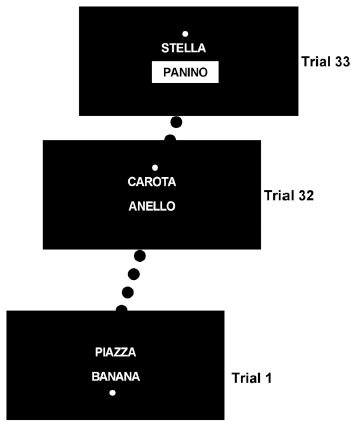
Humans are fine tuned to spot coincidences. Take, for example, an experiment done a few years ago by Paola Bressan and Peter Kramer, psychologists at the University of Padova in Italy. They asked their subjects to watch a computer screen, where dots would appear either above or below a pair of words. They had to press one of two keys on the keyboard, depending on where the dots appeared.
After 32 rounds of this, one of the words, unexpectedly, appeared as white on black (Trial 33 in the picture). Now, this was completely irrelevant to the task at hand, but even so it captured people’s attention. They took longer to press the button, as they couldn’t help pondering the meaning of the unexpected change.
The strange thing was, those who reacted most strongly to this change were those who also reported being religious as a result of personal experience. They found it harder than others to dismiss the coincidence.
Not only was this effect linked solely to religiosity derived from personal experience (and not, for example, linked to family history or church attendance), but this link was entirely explained by belief in the meaningfulness of coincidences.
What’s this got to do with politics, though?
Well, it turns out that something similar happens with political conservatives. David Amodio, a psychologist at New York State University, set up an experiment in which the subjects had to press a key when they saw the letter M, but not when they saw the letter W.
Now, the thing was that almost always it was the letter ‘M’ that was shown, and this set up the expectation that the next letter would also be an ‘M’. So this was a test of whether the subjects could break free of their expectations.
What Amodio found was that liberals were better able to break free of this conditioned response, and to correctly withhold their response when a W was shown.
According to a recent article by Kramer and Bressan, both these experimental results can be explained by the same psychological phenomenon. They speculate that we create ‘schema’ – fundamental concepts about how the world works. Beliefs, in other words.
These schema can be useful, because they speed up mental processing. By employing grand, simple rules of thumb they save mental effort – but at the expense of accuracy.
By employing this schema, the brain can move on from chewing over things that may not have any survival benefit. The results may not be accurate, but they may be good enough not to be actively harmful. One consequence, however, could be illusions and conspiracy beliefs.
Kramer and Bressan’s ideas are pretty speculative. But whatever you think of them, it is truly remarkable that both religiosity and right-wing ideology can be predicted solely on the basis of an inability to cope with randomness.
Now surely that can’t be a coincidence?
 Amodio, D., Jost, J., Master, S., & Yee, C. (2007). Neurocognitive correlates of liberalism and conservatism Nature Neuroscience, 10 (10), 1246-1247 DOI: 10.1038/nn1979
Bressan, P., Kramer, P., & Germani, M. (2008). Visual attentional capture predicts belief in a meaningful world Cortex, 44 (10), 1299-1306 DOI: 10.1016/j.cortex.2007.08.021
Kramer, P., & Bressan, P. (2011). Belief in God and in strong government as accidental cognitive by-products Behavioral and Brain Sciences, 34 (01), 31-32 DOI: 10.1017/S0140525X10002104
 This article by Tom Rees was first published on Epiphenom. It is licensed under Creative Commons.
Previous Post

March 12, 2011
Bowling together... in most of Europe, at least
Next Post
March 22, 2011 Religion and conflict: cause or coincidence?
Browse Our Archives
Select a Category Causes of religion - evolution Causes of religion - psychological Causes of religion - social Demographics Digest Effects of religion - health Effects of religion - psychological Effects of religion - social Notifications Politics Uncategorized
Select a Month March 2016 February 2016 January 2016 December 2015 November 2015 October 2015 September 2015 August 2015 July 2015 June 2015 May 2015 April 2015 March 2015 February 2015 January 2015 December 2014 November 2014 October 2014 September 2014 August 2014 July 2014 June 2014 May 2014 April 2014 March 2014 February 2014 January 2014 December 2013 November 2013 October 2013 September 2013 August 2013 July 2013 June 2013 May 2013 April 2013 March 2013 February 2013 January 2013 December 2012 November 2012 October 2012 September 2012 August 2012 July 2012 June 2012 May 2012 April 2012 March 2012 February 2012 January 2012 December 2011 November 2011 October 2011 September 2011 August 2011 July 2011 June 2011 May 2011 April 2011 March 2011 February 2011 January 2011 December 2010 November 2010 October 2010 September 2010 August 2010 July 2010 June 2010 May 2010 April 2010 March 2010 February 2010 January 2010 December 2009 November 2009 October 2009 September 2009 August 2009 July 2009 June 2009 May 2009 April 2009 March 2009 February 2009 January 2009 December 2008 November 2008 October 2008 September 2008 August 2008 July 2008 June 2008 May 2008 April 2008 March 2008 February 2008 January 2008 December 2007 November 2007 October 2007
Follow Us!
TAKE THE
Religious Wisdom Quiz
Why did Jesus wash His disciples' feet?
Select your answer to see how you score.
They asked Him to Tradition only To show humble service To clean them for eating
Related posts from Epiphenom

Do social crises lead to religious revivals? Nah!

What kind of woman would pray for health...

Can you use religion to change attitudes towards...

Dogmatic atheism and fundamentalist Christianity: creating certainty in...
TRENDING AT PATHEOS Nonreligious

Dethroning Jesus and Enthroning Yourself
Jesus Never Asked to Be Worshipped. He Asked to Be Understood. Christianity...

Why Most Christians are Really Paulians and Jobians
I Don't Care, But It Matters Let's get this out of the...

Essential Tips to Successfully Navigate the Selling Process
Selling a house can feel overwhelming, but it doesn’t have to be....

To Make Remote Work Effective, Think About Others
The COVID-19 pandemic forced many companies to rapidly transition to remote work....

Flexibility Is Key to Solving Problems of Tomorrow
The world of work is undergoing a dramatic transformation. The COVID-19 pandemic...
view all Nonreligious blogs
Ad-Free & Subscriber Log-In Subscription Support
- About Us
- 2026 Calendar
- Videos
- Podcasts
- Library of World Religions
- Faith In Media Tracker
- Advertise With Us
- Write for Us
- Privacy Policy
- Terms of Service
- Do Not Sell My Data
- Contact Us
- Radiant Digital
- Manage Newsletter Subscriptions
- Unsubscribe From Notifications
- Sitemap
Copyright 2008-2026, Patheos. All rights reserved.
Subscription Support Ad-Free & Subscriber Log-In
Follow Patheos