
BuddhistCatholicContemplativeEvangelicalGeneral ChristianHinduJewishLatter-day SaintMuslimNew VisionsProgressive Christian
Beliefs
- Buddhist
- Catholic
- Contemplative
- Evangelical
- General Christian
- Hindu
- Jewish
- Latter-day Saint
- More Voices
- Muslim
- New Visions
- Pagan
- Progressive Christian
Topics
- Religion News
- Food and Religion
- Sports and Religion
- Religious Art
- Religious Music and Entertainment
- Religious Events
- History and Religion
- Style and Religion
- Politics and Religion
- Women in Religion
- Recreation Outdoors and Religion
- Business Finance and Religion
- Careers Workplace and Religion
- Education and Religion
- Family Parenting and Religion
- Health Fitness and Religion
- Home and Religion
- Relationships and Religion
- Technology and Religion
- Travel and Religion
Columnists
- Buddhist Columnists
- Business Finance and Religion Columnists
- Careers Workplace and Religion Columnists
- Catholic Columnists
- Contemplative Columnists
- Education and Religion Columnists
- Evangelists Columnists
- Family Parenting and Religion Columnists
- General Christian Columnists
- Health Fitness and Religion Columnists
- Hindu Columnists
- History and Religion Columnists
- Home and Religion Columnists
- Jewish Columnists
- More Voices Columnists
- Latter Day Columnists
- Muslim Columnists
- New Visions Columnists
- Nonreligious Columnists
- Pagan Columnists
- Politics and Religion Columnists
- Progressive Columnists
- Recreation Outdoors and Religion Columnists
- Relationships and Religion Columnists
- Religion News Columnists
- Religious Art Columnists
- Religious Events Columnists
- Religious Music and Entertainment Columnists
- Sports and Religion Columnists
- Style and Religion Columnists
- Technology and Religion Columnists
- Travel and Religion Columnists
- Women in Religion Columnists
Resource Library
- 2026 Calendar
- Library of World Religions
- The 100 Most Holy Places on Earth
- Patheos Answers
- Podcasts
- Videos
- Faith Leaders Database
- Anglican Episcopalian
- Bahai
- Baptist
- Buddhism
- Christianity
- Confucianism
- Eastern Orthodoxy
- Hinduism
- Holiness and Pentecostal
- ISKCON
- Islam
- Judaism
- Lutheran
- Methodist
- The Church of Jesus Christ of Latter-day Saints
- New Age
- Paganism
- Presbytarian and Reformed
- Protestantism
- Religion Behind the Scenes
- Roman Catholic
- Scientology
- Shia Islam
- Sikhism
- Sufism
- Sunni Islam
- Taoism
- Zen
- See all religions
Research Tools
 Ad-Free & Subscriber Log-In Subscription Support
Ad-Free & Subscriber Log-In Subscription Support
Follow Patheos 

- Trending:
- Forgiveness
- |
- Marriage
- |
- Consciousness
- |
- Death Penalty
- |
- Election
- |
- Halloween
 Epiphenom
- Home
- Nonreligious
- Most people are a bit crazy, and believers are a bit crazier than most
Most people are a bit crazy, and believers are a bit crazier than most
Last updated on: November 12, 2014 at 4:42 am by Epiphenom
Most people are a bit crazy, and believers are a bit crazier than most 2014-11-12T04:42:23+01:00 Epiphenom
Patheos Explore the world's faith through different perspectives on religion and spirituality! Patheos has the views of the prevalent religions and spiritualities of the world.
Full-blown delusions are thought to be pretty rare. By that I mean the truly bizarre delusions, like Capgras syndrome (when you think that relatives or close friends are sometimes replaced by identical-looking impostors), or Subjective Doubles (a belief that there is another person who looks and acts like you) and Controlled Thoughts (that your thoughts are not fully under your control).
It’s actually quite difficult to find out just how common these kinds of delusions are. You can’t just ask people a straight question, because there’s a good chance that they won’t give you a straight answer (nobody wants to seem to be a lunatic).
So Rachel Pechey and Peter Halligan, at Cardiff University in Wales, created a new questionnaire specifically to try to find out how common bizarre delusions actually are. They did this by asking about symptoms without framing them in terms of mental illness, and by asking about them as part of a larger questionnaire covering all kinds of beliefs – including religious and political beliefs.
They interviewed 1,000 people from around Britain, and found that a staggering 78% of them said that they currently experienced one or more bizarre delusions to some degree. Some 26% reported a ‘strong’ experience of a bizarre delusion.
So, for example, when asked “Do you believe that people you know disguise themselves as others to manipulate or influence you?”, 4.4% said that they strongly believe’ this to be true.
They also asked about a range of paranormal and religious beliefs – and you can see the results in the figure below.
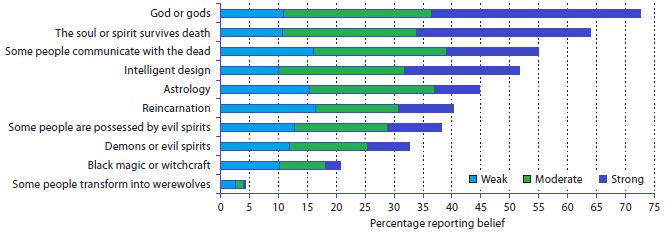
Just over 25% were atheists, but of course some of them might have held one of the other kinds of paranormal beliefs. Hopefully there were no atheists among the 5% of the population who believe in werewolves!
Then they looked at how these paranormal and religious beliefs correlated with the delusional beliefs (to do this, they excluded the werewolf and astrology questions – because they didn’t form part of a common statistical factor along with the other paranormal/religious beliefs).
Well, you probably know where this is heading. There was a good correlation between paranormal/religious beliefs and delusional beliefs. In contrast, there was no correlation between either of these and a third basket of questions relating to political and social beliefs.
This fits with other research, showing that delusional beliefs are more common among the religious and among ‘New-Age believers’ (see When people stop believing in God… they go mental?). Halligan points that delusional beliefs don’t seem to result in as much distress among these populations, and that fits with other evidence that psychotic patients with religious beliefs are less distressed (see Why psychotic patients with religious delusions are harder to cure).
Just why there should be this correlation is harder to say. Certainly, if you’ve had some freaky experiences, then it stands to reason that you’re going to be more open to unorthodox ideas about how the world works.
But Halligan suggests that there may be a deeper connection:
One potential explanation is that holding a belief may impact upon an individual’s wider belief system so that the endorsement of similar (e.g. irrational/unscientific) beliefs becomes more likely. This is in line with the web-of-belief hypothesis advocated by Quine and Ullian, which suggests that a belief coheres with other beliefs held by an individual. In addition, other cognitive factors such as the reasoning biases associated with delusions may also play a role in the development of other abnormal beliefs.
In other words, religion and delusional beliefs may form part of a reinforcing worldview, and both may also be prompted by failures of rational thought. Other research has pointed in a similar direction (see You either believe it all… or you don’t).
 Pechey R, & Halligan P (2011). The Prevalence of Delusion-Like Beliefs Relative to Sociocultural Beliefs in the General Population. Psychopathology, 44 (2), 106-115 PMID: 21196811
 This article by Tom Rees was first published on Epiphenom. It is licensed under Creative Commons.
Previous Post

January 28, 2011
Less God and more democracy
Next Post
February 4, 2011 Casual sex is not so bad after all
Browse Our Archives
Select a Category Causes of religion - evolution Causes of religion - psychological Causes of religion - social Demographics Digest Effects of religion - health Effects of religion - psychological Effects of religion - social Notifications Politics Uncategorized
Select a Month March 2016 February 2016 January 2016 December 2015 November 2015 October 2015 September 2015 August 2015 July 2015 June 2015 May 2015 April 2015 March 2015 February 2015 January 2015 December 2014 November 2014 October 2014 September 2014 August 2014 July 2014 June 2014 May 2014 April 2014 March 2014 February 2014 January 2014 December 2013 November 2013 October 2013 September 2013 August 2013 July 2013 June 2013 May 2013 April 2013 March 2013 February 2013 January 2013 December 2012 November 2012 October 2012 September 2012 August 2012 July 2012 June 2012 May 2012 April 2012 March 2012 February 2012 January 2012 December 2011 November 2011 October 2011 September 2011 August 2011 July 2011 June 2011 May 2011 April 2011 March 2011 February 2011 January 2011 December 2010 November 2010 October 2010 September 2010 August 2010 July 2010 June 2010 May 2010 April 2010 March 2010 February 2010 January 2010 December 2009 November 2009 October 2009 September 2009 August 2009 July 2009 June 2009 May 2009 April 2009 March 2009 February 2009 January 2009 December 2008 November 2008 October 2008 September 2008 August 2008 July 2008 June 2008 May 2008 April 2008 March 2008 February 2008 January 2008 December 2007 November 2007 October 2007
Follow Us!
TAKE THE
Religious Wisdom Quiz
What was the name of the sea Jesus calmed during a storm?
Select your answer to see how you score.
Mediterranean Sea Sea of Galilee Red Sea Dead Sea
Related posts from Epiphenom

Do social crises lead to religious revivals? Nah!

What kind of woman would pray for health...

Can you use religion to change attitudes towards...

Dogmatic atheism and fundamentalist Christianity: creating certainty in...
TRENDING AT PATHEOS Nonreligious

Dethroning Jesus and Enthroning Yourself
Jesus Never Asked to Be Worshipped. He Asked to Be Understood. Christianity...

Why Most Christians are Really Paulians and Jobians
I Don't Care, But It Matters Let's get this out of the...

Essential Tips to Successfully Navigate the Selling Process
Selling a house can feel overwhelming, but it doesn’t have to be....

To Make Remote Work Effective, Think About Others
The COVID-19 pandemic forced many companies to rapidly transition to remote work....

Flexibility Is Key to Solving Problems of Tomorrow
The world of work is undergoing a dramatic transformation. The COVID-19 pandemic...
view all Nonreligious blogs
Ad-Free & Subscriber Log-In Subscription Support
- About Us
- 2026 Calendar
- Videos
- Podcasts
- Library of World Religions
- Faith In Media Tracker
- Advertise With Us
- Write for Us
- Privacy Policy
- Terms of Service
- Do Not Sell My Data
- Contact Us
- Radiant Digital
- Manage Newsletter Subscriptions
- Unsubscribe From Notifications
- Sitemap
Copyright 2008-2026, Patheos. All rights reserved.
Subscription Support Ad-Free & Subscriber Log-In
Follow Patheos