
BuddhistCatholicContemplativeEvangelicalGeneral ChristianHinduJewishLatter-day SaintMuslimNew VisionsProgressive Christian
Beliefs
- Buddhist
- Catholic
- Contemplative
- Evangelical
- General Christian
- Hindu
- Jewish
- Latter-day Saint
- More Voices
- Muslim
- New Visions
- Pagan
- Progressive Christian
Topics
- Religion News
- Food and Religion
- Sports and Religion
- Religious Art
- Religious Music and Entertainment
- Religious Events
- History and Religion
- Style and Religion
- Politics and Religion
- Women in Religion
- Recreation Outdoors and Religion
- Business Finance and Religion
- Careers Workplace and Religion
- Education and Religion
- Family Parenting and Religion
- Health Fitness and Religion
- Home and Religion
- Relationships and Religion
- Technology and Religion
- Travel and Religion
Columnists
- Buddhist Columnists
- Business Finance and Religion Columnists
- Careers Workplace and Religion Columnists
- Catholic Columnists
- Contemplative Columnists
- Education and Religion Columnists
- Evangelists Columnists
- Family Parenting and Religion Columnists
- General Christian Columnists
- Health Fitness and Religion Columnists
- Hindu Columnists
- History and Religion Columnists
- Home and Religion Columnists
- Jewish Columnists
- More Voices Columnists
- Latter Day Columnists
- Muslim Columnists
- New Visions Columnists
- Nonreligious Columnists
- Pagan Columnists
- Politics and Religion Columnists
- Progressive Columnists
- Recreation Outdoors and Religion Columnists
- Relationships and Religion Columnists
- Religion News Columnists
- Religious Art Columnists
- Religious Events Columnists
- Religious Music and Entertainment Columnists
- Sports and Religion Columnists
- Style and Religion Columnists
- Technology and Religion Columnists
- Travel and Religion Columnists
- Women in Religion Columnists
Resource Library
- 2026 Calendar
- Library of World Religions
- The 100 Most Holy Places on Earth
- Patheos Answers
- Podcasts
- Videos
- Faith Leaders Database
- Anglican Episcopalian
- Bahai
- Baptist
- Buddhism
- Christianity
- Confucianism
- Eastern Orthodoxy
- Hinduism
- Holiness and Pentecostal
- ISKCON
- Islam
- Judaism
- Lutheran
- Methodist
- The Church of Jesus Christ of Latter-day Saints
- New Age
- Paganism
- Presbytarian and Reformed
- Protestantism
- Religion Behind the Scenes
- Roman Catholic
- Scientology
- Shia Islam
- Sikhism
- Sufism
- Sunni Islam
- Taoism
- Zen
- See all religions
Research Tools
 Ad-Free & Subscriber Log-In Subscription Support
Ad-Free & Subscriber Log-In Subscription Support
Follow Patheos 

- Trending:
- Forgiveness
- |
- Marriage
- |
- Consciousness
- |
- Death Penalty
- |
- Election
- |
- Halloween
 Epiphenom
- Home
- Nonreligious
- Suppose we were to transplant your brain…
Suppose we were to transplant your brain…
Last updated on: November 12, 2014 at 4:52 am by Epiphenom
Suppose we were to transplant your brain… 2014-11-12T04:52:04+01:00 Epiphenom
Patheos Explore the world's faith through different perspectives on religion and spirituality! Patheos has the views of the prevalent religions and spiritualities of the world.
… what would happen to your personality? I mean, if we took the brain of an African-Caribbean and stuck it in the body of a white Englishman – would the resulting person be black, or white?
And what about if you took the brain of a woman and transplanted it into a man? A rich person into the body of a poor person? Would their behaviour change, or stay the same?
What about transplanting the brain of a Catholic into the body of an atheist?
These are all questions designed to dig into whether social categories depend on ‘essentialism’ – the folk-logic argument that items carry with them some kind of essence that defines what they are. If you think that a man’s body with a woman’s brain would act like a man then you are (in one interpretation, at least) an ‘essentialist’.
Essentialism is interesting because it seems to be closely related to a range of spiritual and religious beliefs. It’s what psychologist Bruce Hood calls “Supersense”.
Now, the brain-transplant situation is a little more complicated because social categories can be driven by situations as much as brain function, but what’s interesting about this new study, lead by Marcos Pereira at the Universidade Federal da Bahia in Brazil, is that they compared how responses varied in different countries.
Take a look at this figure. These show the responses from students at three of the top universities in Spain, Brazil, and England. When the bar goes above the line, it indicates essentialist beliefs (i.e. the new creature would act in a manner appropriate for its body, not its mind).
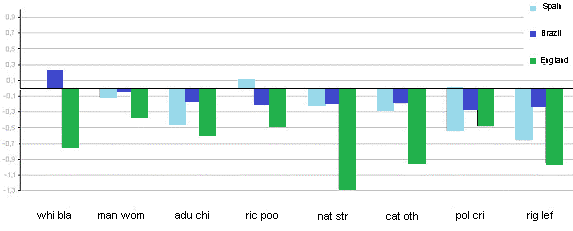
So, taking the first case, of a white man’s brain transplanted into a black man. In Spain, the response averaged zero – so they were equally split as to whether behaviour would be ‘black’ or ‘white’. In Brazil, they tended to think in essentialist terms – the new creation would be ‘black’. In England, on the other hand, it would be white.
There’s a couple of things to note about this study. Firstly, overall the English students were much less essentialist, on average, than the Spanish or Brazilian.
Secondly, the Spanish seem to be more essentialist about Catholicism (“cat oth”) than politics (“rig lef”).
They also asked the question the other way around – what would happen if you put the brain of a non-Catholic into the body of a Catholic. The results were similar, except for the English. Put this way round, the English are more essentialist (although still less so than the Spanish and the Brazilians).
In other words, for the English, a non-Catholic body becomes Catholic if you put a Catholic brain in. But put a Catholic brain into a non-Catholic body, and they are more inclined to think the result would be non-Catholic. Very odd!
In fact, this reflects a general trend. In all three countries, the students were more essentialist if it was a ‘non-dominant’ brain going into a ‘dominant’ body. A female brain put into a male body is more likely to be male than a male brain put into a female body is likely to be female.
But for me, at least, the most interesting result of this study is that the students were not particularly essentialist about Catholicism. They saw it as being more similar to politics than to age or gender. It’s something you decide (or is generated by your brain) rather than something that you are as a result of birth or society.
 Pereira ME, Alvaro Estramiana JL, & Schweiger Gallo I (2010). Essentialism and the expression of social stereotypes: a comparative study of Spain, Brasil and England. The Spanish Journal of Psychology, 13 (2), 808-17 PMID: 20977029
 This article by Tom Rees was first published on Epiphenom. It is licensed under Creative Commons.
Previous Post

November 16, 2010
You are your brand label
Next Post
November 23, 2010 Spirit Possession in Uganda
Browse Our Archives
Select a Category Causes of religion - evolution Causes of religion - psychological Causes of religion - social Demographics Digest Effects of religion - health Effects of religion - psychological Effects of religion - social Notifications Politics Uncategorized
Select a Month March 2016 February 2016 January 2016 December 2015 November 2015 October 2015 September 2015 August 2015 July 2015 June 2015 May 2015 April 2015 March 2015 February 2015 January 2015 December 2014 November 2014 October 2014 September 2014 August 2014 July 2014 June 2014 May 2014 April 2014 March 2014 February 2014 January 2014 December 2013 November 2013 October 2013 September 2013 August 2013 July 2013 June 2013 May 2013 April 2013 March 2013 February 2013 January 2013 December 2012 November 2012 October 2012 September 2012 August 2012 July 2012 June 2012 May 2012 April 2012 March 2012 February 2012 January 2012 December 2011 November 2011 October 2011 September 2011 August 2011 July 2011 June 2011 May 2011 April 2011 March 2011 February 2011 January 2011 December 2010 November 2010 October 2010 September 2010 August 2010 July 2010 June 2010 May 2010 April 2010 March 2010 February 2010 January 2010 December 2009 November 2009 October 2009 September 2009 August 2009 July 2009 June 2009 May 2009 April 2009 March 2009 February 2009 January 2009 December 2008 November 2008 October 2008 September 2008 August 2008 July 2008 June 2008 May 2008 April 2008 March 2008 February 2008 January 2008 December 2007 November 2007 October 2007
Follow Us!
TAKE THE
Religious Wisdom Quiz
Who helped Jesus carry His cross?
Select your answer to see how you score.
Peter Simon of Cyrene John Judas
Related posts from Epiphenom

Do social crises lead to religious revivals? Nah!

What kind of woman would pray for health...

Can you use religion to change attitudes towards...

Dogmatic atheism and fundamentalist Christianity: creating certainty in...
TRENDING AT PATHEOS Nonreligious

Dethroning Jesus and Enthroning Yourself
Jesus Never Asked to Be Worshipped. He Asked to Be Understood. Christianity...

Why Most Christians are Really Paulians and Jobians
I Don't Care, But It Matters Let's get this out of the...

Essential Tips to Successfully Navigate the Selling Process
Selling a house can feel overwhelming, but it doesn’t have to be....

To Make Remote Work Effective, Think About Others
The COVID-19 pandemic forced many companies to rapidly transition to remote work....

Flexibility Is Key to Solving Problems of Tomorrow
The world of work is undergoing a dramatic transformation. The COVID-19 pandemic...
view all Nonreligious blogs
Ad-Free & Subscriber Log-In Subscription Support
- About Us
- 2026 Calendar
- Videos
- Podcasts
- Library of World Religions
- Faith In Media Tracker
- Advertise With Us
- Write for Us
- Privacy Policy
- Terms of Service
- Do Not Sell My Data
- Contact Us
- Radiant Digital
- Manage Newsletter Subscriptions
- Unsubscribe From Notifications
- Sitemap
Copyright 2008-2026, Patheos. All rights reserved.
Subscription Support Ad-Free & Subscriber Log-In
Follow Patheos