
BuddhistCatholicContemplativeEvangelicalGeneral ChristianHinduJewishLatter-day SaintMuslimNew VisionsProgressive Christian
Beliefs
- Buddhist
- Catholic
- Contemplative
- Evangelical
- General Christian
- Hindu
- Jewish
- Latter-day Saint
- More Voices
- Muslim
- New Visions
- Pagan
- Progressive Christian
Topics
- Religion News
- Food and Religion
- Sports and Religion
- Religious Art
- Religious Music and Entertainment
- Religious Events
- History and Religion
- Style and Religion
- Politics and Religion
- Women in Religion
- Recreation Outdoors and Religion
- Business Finance and Religion
- Careers Workplace and Religion
- Education and Religion
- Family Parenting and Religion
- Health Fitness and Religion
- Home and Religion
- Relationships and Religion
- Technology and Religion
- Travel and Religion
Columnists
- Buddhist Columnists
- Business Finance and Religion Columnists
- Careers Workplace and Religion Columnists
- Catholic Columnists
- Contemplative Columnists
- Education and Religion Columnists
- Evangelists Columnists
- Family Parenting and Religion Columnists
- General Christian Columnists
- Health Fitness and Religion Columnists
- Hindu Columnists
- History and Religion Columnists
- Home and Religion Columnists
- Jewish Columnists
- More Voices Columnists
- Latter Day Columnists
- Muslim Columnists
- New Visions Columnists
- Nonreligious Columnists
- Pagan Columnists
- Politics and Religion Columnists
- Progressive Columnists
- Recreation Outdoors and Religion Columnists
- Relationships and Religion Columnists
- Religion News Columnists
- Religious Art Columnists
- Religious Events Columnists
- Religious Music and Entertainment Columnists
- Sports and Religion Columnists
- Style and Religion Columnists
- Technology and Religion Columnists
- Travel and Religion Columnists
- Women in Religion Columnists
Resource Library
- 2026 Calendar
- Library of World Religions
- The 100 Most Holy Places on Earth
- Patheos Answers
- Podcasts
- Videos
- Faith Leaders Database
- Anglican Episcopalian
- Bahai
- Baptist
- Buddhism
- Christianity
- Confucianism
- Eastern Orthodoxy
- Hinduism
- Holiness and Pentecostal
- ISKCON
- Islam
- Judaism
- Lutheran
- Methodist
- The Church of Jesus Christ of Latter-day Saints
- New Age
- Paganism
- Presbytarian and Reformed
- Protestantism
- Religion Behind the Scenes
- Roman Catholic
- Scientology
- Shia Islam
- Sikhism
- Sufism
- Sunni Islam
- Taoism
- Zen
- See all religions
Research Tools
 Ad-Free & Subscriber Log-In Subscription Support
Ad-Free & Subscriber Log-In Subscription Support
Follow Patheos 

- Trending:
- Forgiveness
- |
- Marriage
- |
- Consciousness
- |
- Death Penalty
- |
- Election
- |
- Halloween
 Epiphenom
- Home
- Nonreligious
- Spirit Possession in Uganda
Spirit Possession in Uganda
Last updated on: November 3, 2014 at 7:14 pm by Epiphenom
Spirit Possession in Uganda 2014-11-03T19:14:03+01:00 Epiphenom
Patheos Explore the world's faith through different perspectives on religion and spirituality! Patheos has the views of the prevalent religions and spiritualities of the world.
Spirit possession is common in Uganda, as it is in many parts of the world – especially impoverished areas. It’s a complex syndrome, however, with different spirits have different effects.
In Runyankore, the local language spoken by the Banyankore of Southwestern Uganda, possession by evil spirits is known as Okutembwa and can result in the patient talking in another voice. Possession by the spirits known as Okugwa leads to shaking and falling down. Other spirits can induce a trance-like state.
When asked to explain the causes of possession traditional healers, who are experts in spirit possession, usually give cultural explanations (e.g., neglected cultural obligations and rituals, ancestral spirits, bewitchment) or blame sociocultural conflicts (e.g., disputes over unpaid dowries and land ownership).
But Marjolein van Duijl, who has spent the past 5 years as Head of the Department of Psychiatry at
Mbarara University, noticed that many of the features of spirit possession match up with what Western psychiatrists call dissociation – a disconnect between experiences, thoughts and feelings. It can often result in the feeling that you have been “taken over” by some outside force.
The interesting thing about dissociation is that it’s often caused by traumatic events. So van Duijl set out to discover if traumatic events were the true cause of spirit possession.
With the help of a local team, she interviewed 119 villagers who had been recently treated by local healers for spirit possession, and compared them with a similar group who had not been possessed. She assessed them for symptoms of dissociation, and also quizzed them on traumatic events in their past (using a couple of standardised questionnaires that have been developed specifically for this purpose).
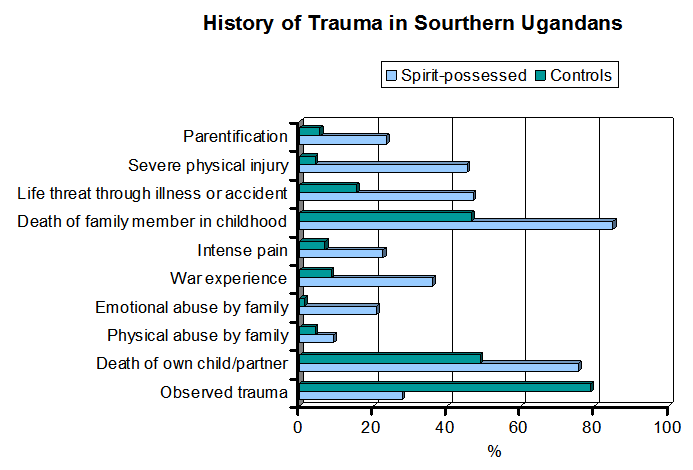
She found that those who were suffering spirit possession did indeed score highly on dissociative symptoms. What’s more, they had experienced far more traumatic events.
You can see an example of what she found in the figure (it’s just a subset of the full findings, to give you a flavour). Pretty much all of the items on this particular trauma questionnaire (the Traumatic Experiences Checklist) were more frequent in those who were possessed (Parentification, by the way, means having to care for your parent when you are only a child – in effect making a parent out of the child).
Traumatic events that directly threatened the life of the individual concerned were particularly common among the possessed.
The strange thing is that the locals were not at all aware of this link. They consistently gave reasonings like “because cultural rituals have not been performed,” or sometimes they blamed obstruction by “the Christian generation,” or said that “It can be a result of unresolved conflicts which the spirits try to settle.”
But if van Duijl is right, then the true cause of spirit possession is, in fact, traumatic experiences that occured in the patient’s past.
Does the misdiagnosis matter? Are these patients having their suffering added to as a result of the misdiagnosis? Maybe not.
“Spirit possession” seems to be a culturally embedded way for a person to manifest their multiple psychological traumatizing events. The rituals around possession may provide a way for the healer and the sufferer to work together to provide a cure. As van Dujil points out:
This also does not imply that all spirit-possessed patients will need their traumatic experiences to be addressed in order to feel better … Remarkably, the vast majority of patients in our study group felt that the treatment by the traditional healer had helped them well (45% felt better and 54% completely healed after treatment).
Given the terrifying situations that so many Ugandans have been exposed to, and the lack of access to modern psychiatric healthcare, the traditional healers seem to be doing a remarkably effective job. They accepting the culturally-embedded interpretations of their patients symptoms, and work with them to effect a cure.
One last thought on all of this. One of the things that struck me was the high levels of trauma experienced even among the controls. To give you an idea of the sorts of harrowing experiences that the people in this study had to deal with, I’m going to leave you with a case that van Duijl reports in the paper:
A 33-year-old woman came to our mental health clinic accompanied by her sister. For many years she had regularly suffered from attacks in which, according to her sister, she displayed aggressive and strange behavior, after which she started talking in different voices, which were not recognized as her own.
These attacks occurred when the family prepared to go to Christian church or to say prayers. During our session, the client shifted into a trancelike state, and started to move her hands like claws and made animal-like noises, after which she began to speak in a strange language and voice. Her sister explained that this was the voice of an uncle who had died many years ago. This uncle still valued traditional cultural beliefs, while their father had turned to Christianity. There had been an unsolved conflict between their father and this uncle as their father refused to perform rituals for the ancestors.
Later during our conversation one leg of the client made involuntary shaking movements. This was distracting the client’s attention. I asked her what her leg was trying to tell us. By bits and pieces the history became clear: The client had been in love for many years with a Muslim man, with whom she had a child. Her father despised the man because of his religion, and her child was forcefully separated from her by her father.
The church attributed her attacks of possession trance states to activities of ‘‘the devil.’’ She had participated in prayer sessions to get rid of these attacks but it had only helped for a short period. We suspected that her attacks, which often occurred when religious activities were performed, were an expression of suppressed anger against her Christian father who had ruined her life because of his rigid principles. Different options for treatment were discussed including traditional healers, counseling and prayer sessions. Although we regularly discussed and referred our patients to traditional healers, in this case the patient preferred to attend counseling sessions to learn to control her attacks and to focus attention on the underlying experience of traumatic loss.
 Duijl, M., Nijenhuis, E., Komproe, I., Gernaat, H., & Jong, J. (2010). Dissociative Symptoms and Reported Trauma Among Patients with Spirit Possession and Matched Healthy Controls in Uganda Culture, Medicine, and Psychiatry, 34 (2), 380-400 DOI: 10.1007/s11013-010-9171-1
 This article by Tom Rees was first published on Epiphenom. It is licensed under Creative Commons.
Previous Post

November 20, 2010
Suppose we were to transplant your brain...
Next Post
November 27, 2010 Religion promotes punishing wrongdoers - but is that a good thing?
Browse Our Archives
Select a Category Causes of religion - evolution Causes of religion - psychological Causes of religion - social Demographics Digest Effects of religion - health Effects of religion - psychological Effects of religion - social Notifications Politics Uncategorized
Select a Month March 2016 February 2016 January 2016 December 2015 November 2015 October 2015 September 2015 August 2015 July 2015 June 2015 May 2015 April 2015 March 2015 February 2015 January 2015 December 2014 November 2014 October 2014 September 2014 August 2014 July 2014 June 2014 May 2014 April 2014 March 2014 February 2014 January 2014 December 2013 November 2013 October 2013 September 2013 August 2013 July 2013 June 2013 May 2013 April 2013 March 2013 February 2013 January 2013 December 2012 November 2012 October 2012 September 2012 August 2012 July 2012 June 2012 May 2012 April 2012 March 2012 February 2012 January 2012 December 2011 November 2011 October 2011 September 2011 August 2011 July 2011 June 2011 May 2011 April 2011 March 2011 February 2011 January 2011 December 2010 November 2010 October 2010 September 2010 August 2010 July 2010 June 2010 May 2010 April 2010 March 2010 February 2010 January 2010 December 2009 November 2009 October 2009 September 2009 August 2009 July 2009 June 2009 May 2009 April 2009 March 2009 February 2009 January 2009 December 2008 November 2008 October 2008 September 2008 August 2008 July 2008 June 2008 May 2008 April 2008 March 2008 February 2008 January 2008 December 2007 November 2007 October 2007
Follow Us!
TAKE THE
Religious Wisdom Quiz
True or False: Cain killed his brother Abel because God rejected Cain's offering.
Select your answer to see how you score.
FALSE TRUE
Related posts from Epiphenom

Do social crises lead to religious revivals? Nah!

What kind of woman would pray for health...

Can you use religion to change attitudes towards...

Dogmatic atheism and fundamentalist Christianity: creating certainty in...
TRENDING AT PATHEOS Nonreligious

Dethroning Jesus and Enthroning Yourself
Jesus Never Asked to Be Worshipped. He Asked to Be Understood. Christianity...

Why Most Christians are Really Paulians and Jobians
I Don't Care, But It Matters Let's get this out of the...

Essential Tips to Successfully Navigate the Selling Process
Selling a house can feel overwhelming, but it doesn’t have to be....

To Make Remote Work Effective, Think About Others
The COVID-19 pandemic forced many companies to rapidly transition to remote work....

Flexibility Is Key to Solving Problems of Tomorrow
The world of work is undergoing a dramatic transformation. The COVID-19 pandemic...
view all Nonreligious blogs
Ad-Free & Subscriber Log-In Subscription Support
- About Us
- 2026 Calendar
- Videos
- Podcasts
- Library of World Religions
- Faith In Media Tracker
- Advertise With Us
- Write for Us
- Privacy Policy
- Terms of Service
- Do Not Sell My Data
- Contact Us
- Radiant Digital
- Manage Newsletter Subscriptions
- Unsubscribe From Notifications
- Sitemap
Copyright 2008-2026, Patheos. All rights reserved.
Subscription Support Ad-Free & Subscriber Log-In
Follow Patheos