
BuddhistCatholicContemplativeEvangelicalGeneral ChristianHinduJewishLatter-day SaintMuslimNew VisionsProgressive Christian
Beliefs
- Buddhist
- Catholic
- Contemplative
- Evangelical
- General Christian
- Hindu
- Jewish
- Latter-day Saint
- More Voices
- Muslim
- New Visions
- Pagan
- Progressive Christian
Topics
- Religion News
- Food and Religion
- Sports and Religion
- Religious Art
- Religious Music and Entertainment
- Religious Events
- History and Religion
- Style and Religion
- Politics and Religion
- Women in Religion
- Recreation Outdoors and Religion
- Business Finance and Religion
- Careers Workplace and Religion
- Education and Religion
- Family Parenting and Religion
- Health Fitness and Religion
- Home and Religion
- Relationships and Religion
- Technology and Religion
- Travel and Religion
Columnists
- Buddhist Columnists
- Business Finance and Religion Columnists
- Careers Workplace and Religion Columnists
- Catholic Columnists
- Contemplative Columnists
- Education and Religion Columnists
- Evangelists Columnists
- Family Parenting and Religion Columnists
- General Christian Columnists
- Health Fitness and Religion Columnists
- Hindu Columnists
- History and Religion Columnists
- Home and Religion Columnists
- Jewish Columnists
- More Voices Columnists
- Latter Day Columnists
- Muslim Columnists
- New Visions Columnists
- Nonreligious Columnists
- Pagan Columnists
- Politics and Religion Columnists
- Progressive Columnists
- Recreation Outdoors and Religion Columnists
- Relationships and Religion Columnists
- Religion News Columnists
- Religious Art Columnists
- Religious Events Columnists
- Religious Music and Entertainment Columnists
- Sports and Religion Columnists
- Style and Religion Columnists
- Technology and Religion Columnists
- Travel and Religion Columnists
- Women in Religion Columnists
Resource Library
- 2026 Calendar
- Library of World Religions
- The 100 Most Holy Places on Earth
- Patheos Answers
- Podcasts
- Videos
- Faith Leaders Database
- Anglican Episcopalian
- Bahai
- Baptist
- Buddhism
- Christianity
- Confucianism
- Eastern Orthodoxy
- Hinduism
- Holiness and Pentecostal
- ISKCON
- Islam
- Judaism
- Lutheran
- Methodist
- The Church of Jesus Christ of Latter-day Saints
- New Age
- Paganism
- Presbytarian and Reformed
- Protestantism
- Religion Behind the Scenes
- Roman Catholic
- Scientology
- Shia Islam
- Sikhism
- Sufism
- Sunni Islam
- Taoism
- Zen
- See all religions
Research Tools
 Ad-Free & Subscriber Log-In Subscription Support
Ad-Free & Subscriber Log-In Subscription Support
Follow Patheos 

- Trending:
- Forgiveness
- |
- Marriage
- |
- Consciousness
- |
- Death Penalty
- |
- Election
- |
- Halloween
 Epiphenom
- Home
- Nonreligious
- How to win elections by changing beliefs in God
How to win elections by changing beliefs in God
Last updated on: November 12, 2014 at 4:52 am by Epiphenom
How to win elections by changing beliefs in God 2014-11-12T04:52:37+01:00 Epiphenom
Patheos Explore the world's faith through different perspectives on religion and spirituality! Patheos has the views of the prevalent religions and spiritualities of the world.
Aaron Kay a psychologist at the University of Waterloo in Ontario, Canada is interested in how people react when you make them feel like they’re not in control of the situation they find themselves in.
He’s previously shown that, if you disturb people’s sense of control, then they tend to compensate by increasing their belief in a controlling god. In a separate study, he also showed that there’s a similar relationship with attitudes to government. What seems to be happening is that, when people lose confidence in their own control, they re-establish their sense of overall control by convincing themselves that some outside agency has control.
Along with some colleagues he’s now shown, in several new studies, that belief in a controlling government and a controlling god seem to be interchangeable. For example:
- In Malaysia prior to a recent national election, people felt that the country was unstable and also their belief in controlling god was high. After the election, belief in governmental stability rose, and belief in a controlling god fell.
- A group of Canadian students who were given a fictitious newspaper article to read (which declared that the minority parties were about to force an election that would result in no clear outcome) had stronger beliefs in a controlling god than students who read an article with a more reassuring message.
Interestingly, it really does seem to be a belief specifically in a controlling god (or government) that’s important here – other kinds of reassurance just don’t have the same effect. Kay gave students two different articles (allegedly from a Canadian news website). One article presented the government as being very capable and effective. The other talked instead about the importance of Canadian heritage and identity to Canadians – intended to make the reader think that being Canadian is very reassuring and meaningful.
Then they asked about beliefs in a controlling god, and also beliefs in God as a source of personal significance (e.g. God provides answers to questions of meaning and purpose).
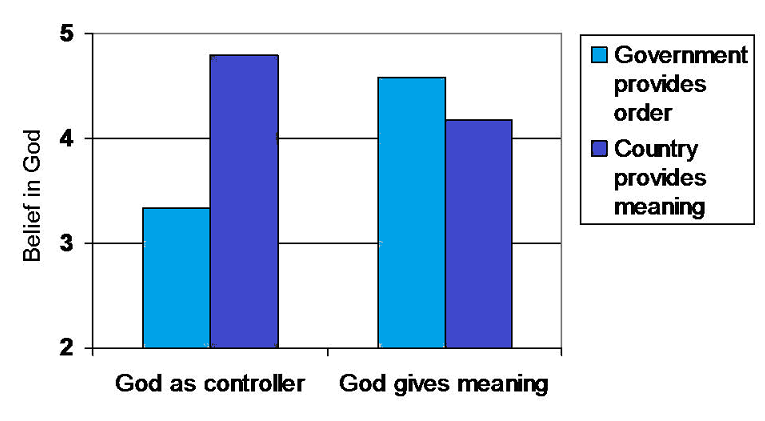
As you can see in the figure, the article portraying the Canadian government as effective significantly reduced the strength of beliefs in a controlling God – but had no effect on beliefs in a ‘meaning-giving’ God. The article on Canadian identity had no effect on either kind of god-belief.
In their last experiment, they showed that the effect works both ways: weaken beliefs in a controlling god (by asking students to read an article, ostensibly published in science, attacking the idea) and they are more likely to believe that the Government is doing a good job
If their findings are correct, it suggests that politicians who are in power should attack the idea of a god being in control!
Kay and colleagues do point out that the American Bible Belt seems to contradict this idea. After all, people there are both fiercely patriotic and highly religious. They argue that, if it wasn’t for the patriotism, these folks would be even more religious.
I have to say that I think they’ve missed a key fact about the religious right. Although white evangelical Protestants are fiercely patriotic, they have a deep-seated distrust of their government. According to a Pew survey in March this year, fully 15% of them never trust their government, compared with 7% of the unaffiliated.
In fact, it seems to me that this inverse relationship between trust in god and trust in the government could go a long way towards helping explain why politics in Europe and the USA are so different. Ultra-libertarianism might actually drive people to religion.
 Kay, A., Shepherd, S., Blatz, C., Chua, S., & Galinsky, A. (2010). For God (or) country: The hydraulic relation between government instability and belief in religious sources of control. Journal of Personality and Social Psychology, 99 (5), 725-739 DOI: 10.1037/a0021140
 This article by Tom Rees was first published on Epiphenom. It is licensed under Creative Commons.
Previous Post

November 7, 2010
European Christians more likely to accept evolution
Next Post
November 16, 2010 You are your brand label
Browse Our Archives
Select a Category Causes of religion - evolution Causes of religion - psychological Causes of religion - social Demographics Digest Effects of religion - health Effects of religion - psychological Effects of religion - social Notifications Politics Uncategorized
Select a Month March 2016 February 2016 January 2016 December 2015 November 2015 October 2015 September 2015 August 2015 July 2015 June 2015 May 2015 April 2015 March 2015 February 2015 January 2015 December 2014 November 2014 October 2014 September 2014 August 2014 July 2014 June 2014 May 2014 April 2014 March 2014 February 2014 January 2014 December 2013 November 2013 October 2013 September 2013 August 2013 July 2013 June 2013 May 2013 April 2013 March 2013 February 2013 January 2013 December 2012 November 2012 October 2012 September 2012 August 2012 July 2012 June 2012 May 2012 April 2012 March 2012 February 2012 January 2012 December 2011 November 2011 October 2011 September 2011 August 2011 July 2011 June 2011 May 2011 April 2011 March 2011 February 2011 January 2011 December 2010 November 2010 October 2010 September 2010 August 2010 July 2010 June 2010 May 2010 April 2010 March 2010 February 2010 January 2010 December 2009 November 2009 October 2009 September 2009 August 2009 July 2009 June 2009 May 2009 April 2009 March 2009 February 2009 January 2009 December 2008 November 2008 October 2008 September 2008 August 2008 July 2008 June 2008 May 2008 April 2008 March 2008 February 2008 January 2008 December 2007 November 2007 October 2007
Follow Us!
TAKE THE
Religious Wisdom Quiz
Which Christian group practices foot washing as an ordinance?
Select your answer to see how you score.
Methodists Catholics Baptists Anabaptists
Related posts from Epiphenom

Do social crises lead to religious revivals? Nah!

What kind of woman would pray for health...

Can you use religion to change attitudes towards...

Dogmatic atheism and fundamentalist Christianity: creating certainty in...
TRENDING AT PATHEOS Nonreligious

Dethroning Jesus and Enthroning Yourself
Jesus Never Asked to Be Worshipped. He Asked to Be Understood. Christianity...

Why Most Christians are Really Paulians and Jobians
I Don't Care, But It Matters Let's get this out of the...

Essential Tips to Successfully Navigate the Selling Process
Selling a house can feel overwhelming, but it doesn’t have to be....

To Make Remote Work Effective, Think About Others
The COVID-19 pandemic forced many companies to rapidly transition to remote work....

Flexibility Is Key to Solving Problems of Tomorrow
The world of work is undergoing a dramatic transformation. The COVID-19 pandemic...
view all Nonreligious blogs
Ad-Free & Subscriber Log-In Subscription Support
- About Us
- 2026 Calendar
- Videos
- Podcasts
- Library of World Religions
- Faith In Media Tracker
- Advertise With Us
- Write for Us
- Privacy Policy
- Terms of Service
- Do Not Sell My Data
- Contact Us
- Radiant Digital
- Manage Newsletter Subscriptions
- Unsubscribe From Notifications
- Sitemap
Copyright 2008-2026, Patheos. All rights reserved.
Subscription Support Ad-Free & Subscriber Log-In
Follow Patheos