
BuddhistCatholicContemplativeEvangelicalGeneral ChristianHinduJewishLatter-day SaintMuslimNew VisionsProgressive Christian
Beliefs
- Buddhist
- Catholic
- Contemplative
- Evangelical
- General Christian
- Hindu
- Jewish
- Latter-day Saint
- More Voices
- Muslim
- New Visions
- Pagan
- Progressive Christian
Topics
- Religion News
- Food and Religion
- Sports and Religion
- Religious Art
- Religious Music and Entertainment
- Religious Events
- History and Religion
- Style and Religion
- Politics and Religion
- Women in Religion
- Recreation Outdoors and Religion
- Business Finance and Religion
- Careers Workplace and Religion
- Education and Religion
- Family Parenting and Religion
- Health Fitness and Religion
- Home and Religion
- Relationships and Religion
- Technology and Religion
- Travel and Religion
Columnists
- Buddhist Columnists
- Business Finance and Religion Columnists
- Careers Workplace and Religion Columnists
- Catholic Columnists
- Contemplative Columnists
- Education and Religion Columnists
- Evangelists Columnists
- Family Parenting and Religion Columnists
- General Christian Columnists
- Health Fitness and Religion Columnists
- Hindu Columnists
- History and Religion Columnists
- Home and Religion Columnists
- Jewish Columnists
- More Voices Columnists
- Latter Day Columnists
- Muslim Columnists
- New Visions Columnists
- Nonreligious Columnists
- Pagan Columnists
- Politics and Religion Columnists
- Progressive Columnists
- Recreation Outdoors and Religion Columnists
- Relationships and Religion Columnists
- Religion News Columnists
- Religious Art Columnists
- Religious Events Columnists
- Religious Music and Entertainment Columnists
- Sports and Religion Columnists
- Style and Religion Columnists
- Technology and Religion Columnists
- Travel and Religion Columnists
- Women in Religion Columnists
Resource Library
- 2026 Calendar
- Library of World Religions
- The 100 Most Holy Places on Earth
- Patheos Answers
- Podcasts
- Videos
- Faith Leaders Database
- Anglican Episcopalian
- Bahai
- Baptist
- Buddhism
- Christianity
- Confucianism
- Eastern Orthodoxy
- Hinduism
- Holiness and Pentecostal
- ISKCON
- Islam
- Judaism
- Lutheran
- Methodist
- The Church of Jesus Christ of Latter-day Saints
- New Age
- Paganism
- Presbytarian and Reformed
- Protestantism
- Religion Behind the Scenes
- Roman Catholic
- Scientology
- Shia Islam
- Sikhism
- Sufism
- Sunni Islam
- Taoism
- Zen
- See all religions
Research Tools
 Ad-Free & Subscriber Log-In Subscription Support
Ad-Free & Subscriber Log-In Subscription Support
Follow Patheos 

- Trending:
- Forgiveness
- |
- Marriage
- |
- Consciousness
- |
- Death Penalty
- |
- Election
- |
- Halloween
 Epiphenom
- Home
- Nonreligious
- The cult of Theoi: sacrificing to the god of uncertainty
The cult of Theoi: sacrificing to the god of uncertainty
Last updated on: November 12, 2014 at 4:48 am by Epiphenom
The cult of Theoi: sacrificing to the god of uncertainty 2014-11-12T04:48:45+01:00 Epiphenom
Patheos Explore the world's faith through different perspectives on religion and spirituality! Patheos has the views of the prevalent religions and spiritualities of the world.
Religion can be a pain in the backside. What with all those prayers and religious meetings – not to mention all the more tangible sacrifices of money and (sometimes) goats.
It’s enough to make an evolutionary psychologist scratch their head and go “hmmm”. Why should people go to all that effort? What’s in it for them?
One theory is that it signals to others that they are ‘true believers’, and so can be trusted. Another holds that beliefs that are ‘demonstrated’ by expensive behaviour are more likely to be believed, and so transmitted.
One idea that’s received surprisingly little attention is that people may simply believe that they get a direct payoff from their sacrifice. They make an offering to their god, and god returns the favour by fixing that business deal (or making the rains come on time).
Paul Frijters, of the University of Queensland, and Juan Barón, at Australian National University, have run a series of studies on university students to investigate this.
It was a two-phase game. In the first phase, the students earned some points. For example, in one variant, they played a ‘public good’ game where everyone contributes anonymously to a central pot, which is then increased and shared equally. The best thing to do is to contribute nothing, and hope that everyone else contributes a lot. But if everyone does that, then no-one takes home much.
Then these points were turned into hard cash, at a rate determined by ‘Theoi’ (represented on a computer). Now, they didn’t know the rules that Theoi used to do this, but they were given the opportunity to contribute some of their points to Theoi, if they so chose.
This cycle was repeated over 20 rounds, and the student’s task was to figure out the optimal contribution to make to Theoi in order to maximise their payout.
Now, what the students didn’t know is that Theoi in fact just worked at random. The amount they contributed (or ‘sacrificed) to Theoi had no effect whatsoever on the outcome.
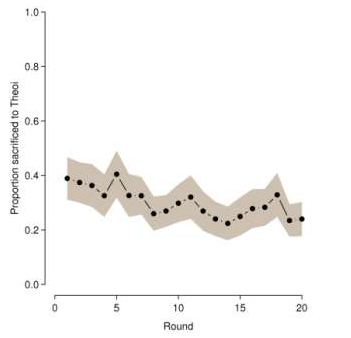 Contributions to Theoi as a percentage of Phase 1 earnings.
Despite this fact, the level of sacrifice to Theoi was remarkably resilient. Although it did decrease as the rounds wore on, it did not decrease by much – and nearly half the students were sacrificing just as much at the end of the experiment as they were at the start.
There were some interesting tweaks. They tried giving the students access to everyone else’s decisions and results. That was a large pool of data – more than enough for them to figure out that Theoi was just acting randomly. But still they didn’t figure it out. In fact, those students who spent longer puzzling over it actually tended to then sacrifice even more!
When they renamed ‘Theoi’ as ‘Weather’, however, the level of sacrifice dropped more quickly. This suggests that anthropomorphisation is important.
What this study shows is that these students seem inherently resistant to learning that the forces at work are random. They started off with the assumption that Theoi would reward sacrifices, and they just didn’t seem able to shake that assumption, despite all the evidence.
So who sacrificed most? Academic discipline didn’t matter – engineers, artists, scientists, all sacrificed about the same.
Nor did religious or superstitious beliefs have any effect on the amount sacrificed. Perhaps that’s because Theoi was clearly not really a god or supernatural in any way. They were just trying to second-guess the experimenter’s fiendish mind.
Women maintained their level of sacrifice more than men. People with lucky charms, or a high sense of self-control (“locus of control”) reduced their level of sacrifice more quickly.
The most significant factor was the amount contributed in Round 1, the “Public Good” game. The people who contribute most in this game are those people who have faith in communal cohesion – that their good deed will be reciprocated. However, I have doubts about whether this effect is real. Fritjers & Baron measured sacrifices as a percentage of winnings in round 1. The people who contributed most in round 1 would also leave it with the fewest points. Perhaps that affected their decision on what proportion to sacrifice.
Still, this is a very interesting study, even though it’s clearly an artificial set-up. What it’s really testing is people’s ability to see the randomness when they’re expecting their sacrifices to have some effect. What it shows is that these students were not very good at this task!
Really they want to believe in Theoi, despite all the evidence to the contrary. And for of them, that conviction seemed nearly impossible to shake.
Paul Frijters, Juan D. Barón. The Cult of Theoi: Economic Uncertainty and Religion. IZA DP No. 4902. April 2010
 This article by Tom Rees was first published on Epiphenom. It is licensed under Creative Commons.
Previous Post

November 27, 2010
Religion promotes punishing wrongdoers - but is that a good thing?
Next Post
December 4, 2010 The emotional problems of the slightly religious
Browse Our Archives
Select a Category Causes of religion - evolution Causes of religion - psychological Causes of religion - social Demographics Digest Effects of religion - health Effects of religion - psychological Effects of religion - social Notifications Politics Uncategorized
Select a Month March 2016 February 2016 January 2016 December 2015 November 2015 October 2015 September 2015 August 2015 July 2015 June 2015 May 2015 April 2015 March 2015 February 2015 January 2015 December 2014 November 2014 October 2014 September 2014 August 2014 July 2014 June 2014 May 2014 April 2014 March 2014 February 2014 January 2014 December 2013 November 2013 October 2013 September 2013 August 2013 July 2013 June 2013 May 2013 April 2013 March 2013 February 2013 January 2013 December 2012 November 2012 October 2012 September 2012 August 2012 July 2012 June 2012 May 2012 April 2012 March 2012 February 2012 January 2012 December 2011 November 2011 October 2011 September 2011 August 2011 July 2011 June 2011 May 2011 April 2011 March 2011 February 2011 January 2011 December 2010 November 2010 October 2010 September 2010 August 2010 July 2010 June 2010 May 2010 April 2010 March 2010 February 2010 January 2010 December 2009 November 2009 October 2009 September 2009 August 2009 July 2009 June 2009 May 2009 April 2009 March 2009 February 2009 January 2009 December 2008 November 2008 October 2008 September 2008 August 2008 July 2008 June 2008 May 2008 April 2008 March 2008 February 2008 January 2008 December 2007 November 2007 October 2007
Follow Us!
TAKE THE
Religious Wisdom Quiz
What was the name for a standard silver coin in Biblical times?
Select your answer to see how you score.
Shekel Mina Denarius Talent
Related posts from Epiphenom

Do social crises lead to religious revivals? Nah!

What kind of woman would pray for health...

Can you use religion to change attitudes towards...

Dogmatic atheism and fundamentalist Christianity: creating certainty in...
TRENDING AT PATHEOS Nonreligious

Dethroning Jesus and Enthroning Yourself
Jesus Never Asked to Be Worshipped. He Asked to Be Understood. Christianity...

Why Most Christians are Really Paulians and Jobians
I Don't Care, But It Matters Let's get this out of the...

Essential Tips to Successfully Navigate the Selling Process
Selling a house can feel overwhelming, but it doesn’t have to be....

To Make Remote Work Effective, Think About Others
The COVID-19 pandemic forced many companies to rapidly transition to remote work....

Flexibility Is Key to Solving Problems of Tomorrow
The world of work is undergoing a dramatic transformation. The COVID-19 pandemic...
view all Nonreligious blogs
Ad-Free & Subscriber Log-In Subscription Support
- About Us
- 2026 Calendar
- Videos
- Podcasts
- Library of World Religions
- Faith In Media Tracker
- Advertise With Us
- Write for Us
- Privacy Policy
- Terms of Service
- Do Not Sell My Data
- Contact Us
- Radiant Digital
- Manage Newsletter Subscriptions
- Unsubscribe From Notifications
- Sitemap
Copyright 2008-2026, Patheos. All rights reserved.
Subscription Support Ad-Free & Subscriber Log-In
Follow Patheos