
BuddhistCatholicContemplativeEvangelicalGeneral ChristianHinduJewishLatter-day SaintMuslimNew VisionsProgressive Christian
Beliefs
- Buddhist
- Catholic
- Contemplative
- Evangelical
- General Christian
- Hindu
- Jewish
- Latter-day Saint
- More Voices
- Muslim
- New Visions
- Pagan
- Progressive Christian
Topics
- Religion News
- Food and Religion
- Sports and Religion
- Religious Art
- Religious Music and Entertainment
- Religious Events
- History and Religion
- Style and Religion
- Politics and Religion
- Women in Religion
- Recreation Outdoors and Religion
- Business Finance and Religion
- Careers Workplace and Religion
- Education and Religion
- Family Parenting and Religion
- Health Fitness and Religion
- Home and Religion
- Relationships and Religion
- Technology and Religion
- Travel and Religion
Columnists
- Buddhist Columnists
- Business Finance and Religion Columnists
- Careers Workplace and Religion Columnists
- Catholic Columnists
- Contemplative Columnists
- Education and Religion Columnists
- Evangelists Columnists
- Family Parenting and Religion Columnists
- General Christian Columnists
- Health Fitness and Religion Columnists
- Hindu Columnists
- History and Religion Columnists
- Home and Religion Columnists
- Jewish Columnists
- More Voices Columnists
- Latter Day Columnists
- Muslim Columnists
- New Visions Columnists
- Nonreligious Columnists
- Pagan Columnists
- Politics and Religion Columnists
- Progressive Columnists
- Recreation Outdoors and Religion Columnists
- Relationships and Religion Columnists
- Religion News Columnists
- Religious Art Columnists
- Religious Events Columnists
- Religious Music and Entertainment Columnists
- Sports and Religion Columnists
- Style and Religion Columnists
- Technology and Religion Columnists
- Travel and Religion Columnists
- Women in Religion Columnists
Resource Library
- 2026 Calendar
- Library of World Religions
- The 100 Most Holy Places on Earth
- Patheos Answers
- Podcasts
- Videos
- Faith Leaders Database
- Anglican Episcopalian
- Bahai
- Baptist
- Buddhism
- Christianity
- Confucianism
- Eastern Orthodoxy
- Hinduism
- Holiness and Pentecostal
- ISKCON
- Islam
- Judaism
- Lutheran
- Methodist
- The Church of Jesus Christ of Latter-day Saints
- New Age
- Paganism
- Presbytarian and Reformed
- Protestantism
- Religion Behind the Scenes
- Roman Catholic
- Scientology
- Shia Islam
- Sikhism
- Sufism
- Sunni Islam
- Taoism
- Zen
- See all religions
Research Tools
 Ad-Free & Subscriber Log-In Subscription Support
Ad-Free & Subscriber Log-In Subscription Support
Follow Patheos 

- Trending:
- Forgiveness
- |
- Marriage
- |
- Consciousness
- |
- Death Penalty
- |
- Election
- |
- Halloween
 Epiphenom
- Home
- Nonreligious
- Seeing the big picture
Seeing the big picture
Last updated on: November 14, 2014 at 10:59 pm by Epiphenom
Seeing the big picture 2014-11-14T22:59:38+01:00 Epiphenom
Patheos Explore the world's faith through different perspectives on religion and spirituality! Patheos has the views of the prevalent religions and spiritualities of the world.
Are you a big-picture person, or do you tune into the detail? Surprisingly, the culture in which you were raised – including your religion (or lack of it) can shape this fundamental aspect of your personality.
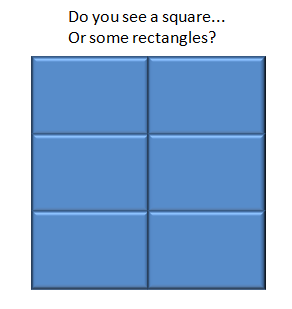
A decade ago, researchers found that while westerners were relatively faster at picking out the component parts of a picture, Asians were relatively quicker to see the global, holistic components. They reckoned this was an effect of cultural differences – the individualistic Westerners versus the collective, community-oriented Asians.
In a new series of studies, Lorenza Colzato, a cognitive psychologist at Leiden University in the Netherlands, and colleagues has shown that, within both of these culture, religion can affect where attention is focussed. Remarkably, it seems that the type of religion, not religion itself, is the critical factor.
The tests use something called a global-local task. Essentially, the subjects are shown either a square or a rectangle, which are themselves made up of smaller squares and rectangles. The task is to spot the shape of either the ‘big’ picture or its components.
Pretty much everyone is faster at identifying the big shape. Asians, however, are even faster than Westerners – but at the cost of slower identification of the smaller component shapes.
Colzato compared a group of Dutch Calvinist Christian Students with a similar group who were raised as atheists. The Calvinists turned out to be ‘detail’ people, at least when compared with the atheists. This bias to the detail was evident even in those whose faith had lapsed, indicating that whatever is causing it must happen during childhood.
Then they swapped countries and religions – Roman Catholics in Italy and Jews in Israel. Here the effect was reversed. In these countries the religious were less detail-oriented, and more focussed on the big picture, than the non religious
In the ultimate test of their theory, they teamed up with Shulan Hsieh, at the National Cheng Keng University in Taiwan, one of the least individualistic countries in the world. They found that local Buddhists were more likely to be ‘big picture’ people than were the local atheists.
Colzato thinks that the different religious cultures are affecting the way their subjects look at the world. Dutch Calvinism is highly individualistic, and so children must (so the theory goes) be rewarded for ‘correct’ behaviour – for focussing on the local, and ignoring the wider environment.
Catholicism and Judaism, on the other hand, emphasize collective, social responsibility. Children growing up in that environment are learn to pay more attention to the wider picture, and less on individual responsibility.
Buddhism is very different. However, according to Colzato, it emphasizes the physical and social context in which the practitioner lives. Since meditation is not a particular feature of Taiwanese Buddhism, it’s unlikely that meditation caused the effects they saw.
Now, it is of course possible that what we’re seeing here is selection bias. It might be that those people whose attentional bias doesn’t mesh well with the predominant religion are more likely to become atheists. That’s possible, although the fact that atheist converts differed from those raised as atheists in the Dutch study would tend to suggest that isn’t the case.
Whatever the source of these differences, it does seem likely that culture, religion, and attentional bias are closely intertwined. After all, you would expect that a collectivist culture would develop a religion that fitted and reinforced their collectivist needs.
If that’s the case, then the rise of atheism could trigger some interesting cross-cultural ‘levelling’!
 Colzato LS, Beest I, van den Wildenberg WP, Scorolli C, Dorchin S, Meiran N, Borghi AM, & Hommel B (2010). God: Do I have your attention? Cognition, 117 (1), 87-94 PMID: 20674890
Lorenza S. Colzato, Bernhard Hommel, Wery Van Den Wildenberg, & Shulan Hsieh (2010). Buddha as an eye opener: A link between prosocial attitude and attentional control Frontiers in Cognition : 10.3389/fpsyg.2010.00156
 This article by Tom Rees was first published on Epiphenom. It is licensed under Creative Commons.
Previous Post

September 6, 2010
Gender, religion, and volunteering
Next Post
September 13, 2010 An eye for an eye
Browse Our Archives
Select a Category Causes of religion - evolution Causes of religion - psychological Causes of religion - social Demographics Digest Effects of religion - health Effects of religion - psychological Effects of religion - social Notifications Politics Uncategorized
Select a Month March 2016 February 2016 January 2016 December 2015 November 2015 October 2015 September 2015 August 2015 July 2015 June 2015 May 2015 April 2015 March 2015 February 2015 January 2015 December 2014 November 2014 October 2014 September 2014 August 2014 July 2014 June 2014 May 2014 April 2014 March 2014 February 2014 January 2014 December 2013 November 2013 October 2013 September 2013 August 2013 July 2013 June 2013 May 2013 April 2013 March 2013 February 2013 January 2013 December 2012 November 2012 October 2012 September 2012 August 2012 July 2012 June 2012 May 2012 April 2012 March 2012 February 2012 January 2012 December 2011 November 2011 October 2011 September 2011 August 2011 July 2011 June 2011 May 2011 April 2011 March 2011 February 2011 January 2011 December 2010 November 2010 October 2010 September 2010 August 2010 July 2010 June 2010 May 2010 April 2010 March 2010 February 2010 January 2010 December 2009 November 2009 October 2009 September 2009 August 2009 July 2009 June 2009 May 2009 April 2009 March 2009 February 2009 January 2009 December 2008 November 2008 October 2008 September 2008 August 2008 July 2008 June 2008 May 2008 April 2008 March 2008 February 2008 January 2008 December 2007 November 2007 October 2007
Follow Us!
TAKE THE
Religious Wisdom Quiz
What did Ezekiel cook his food over as a sign of coming judgment?
Select your answer to see how you score.
Wood Ashes Cow dung Stones
Related posts from Epiphenom

Do social crises lead to religious revivals? Nah!

What kind of woman would pray for health...

Can you use religion to change attitudes towards...

Dogmatic atheism and fundamentalist Christianity: creating certainty in...
TRENDING AT PATHEOS Nonreligious

Dethroning Jesus and Enthroning Yourself
Jesus Never Asked to Be Worshipped. He Asked to Be Understood. Christianity...

Why Most Christians are Really Paulians and Jobians
I Don't Care, But It Matters Let's get this out of the...

Essential Tips to Successfully Navigate the Selling Process
Selling a house can feel overwhelming, but it doesn’t have to be....

To Make Remote Work Effective, Think About Others
The COVID-19 pandemic forced many companies to rapidly transition to remote work....

Flexibility Is Key to Solving Problems of Tomorrow
The world of work is undergoing a dramatic transformation. The COVID-19 pandemic...
view all Nonreligious blogs
Ad-Free & Subscriber Log-In Subscription Support
- About Us
- 2026 Calendar
- Videos
- Podcasts
- Library of World Religions
- Faith In Media Tracker
- Advertise With Us
- Write for Us
- Privacy Policy
- Terms of Service
- Do Not Sell My Data
- Contact Us
- Radiant Digital
- Manage Newsletter Subscriptions
- Unsubscribe From Notifications
- Sitemap
Copyright 2008-2026, Patheos. All rights reserved.
Subscription Support Ad-Free & Subscriber Log-In
Follow Patheos