
BuddhistCatholicContemplativeEvangelicalGeneral ChristianHinduJewishLatter-day SaintMuslimNew VisionsProgressive Christian
Beliefs
- Buddhist
- Catholic
- Contemplative
- Evangelical
- General Christian
- Hindu
- Jewish
- Latter-day Saint
- More Voices
- Muslim
- New Visions
- Pagan
- Progressive Christian
Topics
- Religion News
- Food and Religion
- Sports and Religion
- Religious Art
- Religious Music and Entertainment
- Religious Events
- History and Religion
- Style and Religion
- Politics and Religion
- Women in Religion
- Recreation Outdoors and Religion
- Business Finance and Religion
- Careers Workplace and Religion
- Education and Religion
- Family Parenting and Religion
- Health Fitness and Religion
- Home and Religion
- Relationships and Religion
- Technology and Religion
- Travel and Religion
Columnists
- Buddhist Columnists
- Business Finance and Religion Columnists
- Careers Workplace and Religion Columnists
- Catholic Columnists
- Contemplative Columnists
- Education and Religion Columnists
- Evangelists Columnists
- Family Parenting and Religion Columnists
- General Christian Columnists
- Health Fitness and Religion Columnists
- Hindu Columnists
- History and Religion Columnists
- Home and Religion Columnists
- Jewish Columnists
- More Voices Columnists
- Latter Day Columnists
- Muslim Columnists
- New Visions Columnists
- Nonreligious Columnists
- Pagan Columnists
- Politics and Religion Columnists
- Progressive Columnists
- Recreation Outdoors and Religion Columnists
- Relationships and Religion Columnists
- Religion News Columnists
- Religious Art Columnists
- Religious Events Columnists
- Religious Music and Entertainment Columnists
- Sports and Religion Columnists
- Style and Religion Columnists
- Technology and Religion Columnists
- Travel and Religion Columnists
- Women in Religion Columnists
Resource Library
- 2026 Calendar
- Library of World Religions
- The 100 Most Holy Places on Earth
- Patheos Answers
- Podcasts
- Videos
- Faith Leaders Database
- Anglican Episcopalian
- Bahai
- Baptist
- Buddhism
- Christianity
- Confucianism
- Eastern Orthodoxy
- Hinduism
- Holiness and Pentecostal
- ISKCON
- Islam
- Judaism
- Lutheran
- Methodist
- The Church of Jesus Christ of Latter-day Saints
- New Age
- Paganism
- Presbytarian and Reformed
- Protestantism
- Religion Behind the Scenes
- Roman Catholic
- Scientology
- Shia Islam
- Sikhism
- Sufism
- Sunni Islam
- Taoism
- Zen
- See all religions
Research Tools
 Ad-Free & Subscriber Log-In Subscription Support
Ad-Free & Subscriber Log-In Subscription Support
Follow Patheos 

- Trending:
- Forgiveness
- |
- Marriage
- |
- Consciousness
- |
- Death Penalty
- |
- Election
- |
- Halloween
 Epiphenom
- Home
- Nonreligious
- The bright, the dim, and the in-between
The bright, the dim, and the in-between
Last updated on: November 12, 2014 at 5:02 am by Epiphenom
The bright, the dim, and the in-between 2014-11-12T05:02:10+01:00 Epiphenom
Patheos Explore the world's faith through different perspectives on religion and spirituality! Patheos has the views of the prevalent religions and spiritualities of the world.
Previous research has fairly consistently found a small, but statistically significant, link between religion and intelligence. Non-believers score, on average, a few points higher on IQ tests than believers.
But it’s that word ‘average’ that’s the bugbear. Averages don’t tell you much about what’s actually going on with individuals. What’s more, IQ tests are not by any means the full story about intelligence.
Recent research by Sharon Bertsch (University of Pittsburgh) and Bryan Pesta (Cleveland State University), goes some way to putting some fascinating details on the story.
They were interested to know whether the relationship between religion and intelligence is linear, or whether the effects are bunched up at either end of the intelligence spectrum. Maybe being at the high end is linked to non-religion, and the low end to religion, but in the middle – Mr and Mrs Average – there might be no relationship at all between intelligence and religion.
They also wanted to know whether not just abstract reasoning (IQ), but also the ability to process information was linked to religiosity. They did this by testing their ability to rapidly judge the different line lengths, and to pick letter out from a crowd.
They also tested how prone people are to ‘overclaim’. This is a fascinating test where people are presented with facts (a famous person’s name, a scientific concept, or whatever) and they have to say how familiar they are with it. Some of the facts are false, and using some clever processing they can tease out how much the subjects are overclaiming their familiarity with the real facts.
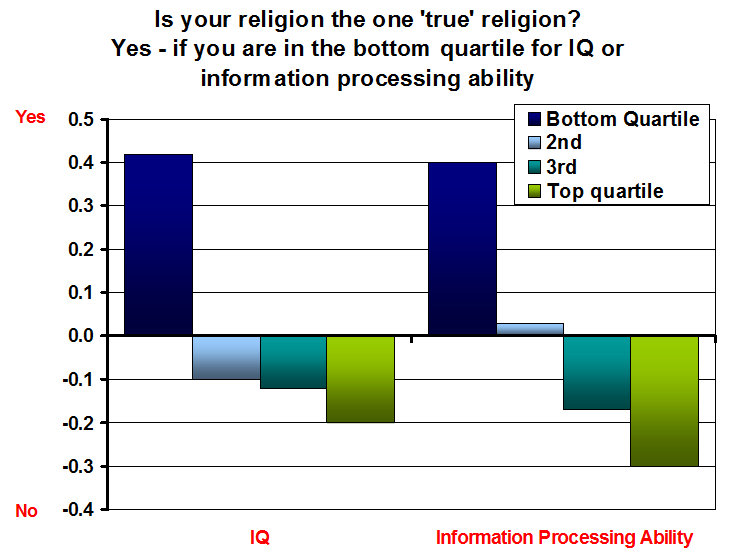
So how did the subjects do? Well, they studied a bunch of undergraduates, so they were a bit smarter than average and none of them were really dumb. Broadly speaking, they confirmed their suspicions: the bottom quartile was the most religious, the top quartile the least, and that there was not too much difference between the two middle quartiles.
In other words, what we have here is an outlier effect. It’s the people on the fringes who are really driving the correlation between intelligence and non-religion.
The effect was strongest for sectarianism – by which they mean the belief that your particular religion is the only true religion. That’s the one shown in the figure. But they got similar results for scriptural acceptance and religious questioning (the brightest quartile were least accepting of scriptural truth and the most willing to question beliefs). And they found the same sort of relationship between information processing ability.
So, the question then is what is really driving this effect? Is it IQ, or is it information-processing ability? Well, they found that, when they lumped both in a statistical model, information-processing ability was actually more powerful as a predictor than IQ. In fact, with information-processing ability in the model, IQ became irrelevant.
Now that’s a remarkable result. Why on earth should judging line lengths, rapidly selecting letter targets, and accurately rating your own familiarity with real-world concepts be linked to non-religion? The authors suggest that these are indicators of the efficiency of neural processing, which in turn might be a building block for the development of more complex cognition and rational thought.
Only more research will tease that one out – and it should be remembered that this research was done in the psychologists guinea pig – mainly white, mainly Christian, US undergraduates. Does it apply to anyone else? Who knows!
On the plus side, however, this is one of the few studies on intelligence and religion that has involved actual lab research, rather than retrospective analysis of data collected for other reasons. That makes it considerably stronger than most studies into this link – albeit for a fairly narrowly defined representation of the human race!
 Bertsch, S., & Pesta, B. (2009). The Wonderlic Personnel Test and elementary cognitive tasks as predictors of religious sectarianism, scriptural acceptance and religious questioning☆ Intelligence, 37 (3), 231-237 DOI: 10.1016/j.intell.2008.10.003
 This article by Tom Rees was first published on Epiphenom. It is licensed under Creative Commons.
Previous Post

July 19, 2010
Who you are!
Next Post
July 25, 2010 Do secular see religious Jews as more trustworthy?
Browse Our Archives
Select a Category Causes of religion - evolution Causes of religion - psychological Causes of religion - social Demographics Digest Effects of religion - health Effects of religion - psychological Effects of religion - social Notifications Politics Uncategorized
Select a Month March 2016 February 2016 January 2016 December 2015 November 2015 October 2015 September 2015 August 2015 July 2015 June 2015 May 2015 April 2015 March 2015 February 2015 January 2015 December 2014 November 2014 October 2014 September 2014 August 2014 July 2014 June 2014 May 2014 April 2014 March 2014 February 2014 January 2014 December 2013 November 2013 October 2013 September 2013 August 2013 July 2013 June 2013 May 2013 April 2013 March 2013 February 2013 January 2013 December 2012 November 2012 October 2012 September 2012 August 2012 July 2012 June 2012 May 2012 April 2012 March 2012 February 2012 January 2012 December 2011 November 2011 October 2011 September 2011 August 2011 July 2011 June 2011 May 2011 April 2011 March 2011 February 2011 January 2011 December 2010 November 2010 October 2010 September 2010 August 2010 July 2010 June 2010 May 2010 April 2010 March 2010 February 2010 January 2010 December 2009 November 2009 October 2009 September 2009 August 2009 July 2009 June 2009 May 2009 April 2009 March 2009 February 2009 January 2009 December 2008 November 2008 October 2008 September 2008 August 2008 July 2008 June 2008 May 2008 April 2008 March 2008 February 2008 January 2008 December 2007 November 2007 October 2007
Follow Us!
TAKE THE
Religious Wisdom Quiz
Who was Mary's cousin?
Select your answer to see how you score.
Leah Rachel Sarah Elizabeth
Related posts from Epiphenom

Do social crises lead to religious revivals? Nah!

What kind of woman would pray for health...

Can you use religion to change attitudes towards...

Dogmatic atheism and fundamentalist Christianity: creating certainty in...
TRENDING AT PATHEOS Nonreligious

Dethroning Jesus and Enthroning Yourself
Jesus Never Asked to Be Worshipped. He Asked to Be Understood. Christianity...

Why Most Christians are Really Paulians and Jobians
I Don't Care, But It Matters Let's get this out of the...

Essential Tips to Successfully Navigate the Selling Process
Selling a house can feel overwhelming, but it doesn’t have to be....

To Make Remote Work Effective, Think About Others
The COVID-19 pandemic forced many companies to rapidly transition to remote work....

Flexibility Is Key to Solving Problems of Tomorrow
The world of work is undergoing a dramatic transformation. The COVID-19 pandemic...
view all Nonreligious blogs
Ad-Free & Subscriber Log-In Subscription Support
- About Us
- 2026 Calendar
- Videos
- Podcasts
- Library of World Religions
- Faith In Media Tracker
- Advertise With Us
- Write for Us
- Privacy Policy
- Terms of Service
- Do Not Sell My Data
- Contact Us
- Radiant Digital
- Manage Newsletter Subscriptions
- Unsubscribe From Notifications
- Sitemap
Copyright 2008-2026, Patheos. All rights reserved.
Subscription Support Ad-Free & Subscriber Log-In
Follow Patheos