
BuddhistCatholicContemplativeEvangelicalGeneral ChristianHinduJewishLatter-day SaintMuslimNew VisionsProgressive Christian
Beliefs
- Buddhist
- Catholic
- Contemplative
- Evangelical
- General Christian
- Hindu
- Jewish
- Latter-day Saint
- More Voices
- Muslim
- New Visions
- Pagan
- Progressive Christian
Topics
- Religion News
- Food and Religion
- Sports and Religion
- Religious Art
- Religious Music and Entertainment
- Religious Events
- History and Religion
- Style and Religion
- Politics and Religion
- Women in Religion
- Recreation Outdoors and Religion
- Business Finance and Religion
- Careers Workplace and Religion
- Education and Religion
- Family Parenting and Religion
- Health Fitness and Religion
- Home and Religion
- Relationships and Religion
- Technology and Religion
- Travel and Religion
Columnists
- Buddhist Columnists
- Business Finance and Religion Columnists
- Careers Workplace and Religion Columnists
- Catholic Columnists
- Contemplative Columnists
- Education and Religion Columnists
- Evangelists Columnists
- Family Parenting and Religion Columnists
- General Christian Columnists
- Health Fitness and Religion Columnists
- Hindu Columnists
- History and Religion Columnists
- Home and Religion Columnists
- Jewish Columnists
- More Voices Columnists
- Latter Day Columnists
- Muslim Columnists
- New Visions Columnists
- Nonreligious Columnists
- Pagan Columnists
- Politics and Religion Columnists
- Progressive Columnists
- Recreation Outdoors and Religion Columnists
- Relationships and Religion Columnists
- Religion News Columnists
- Religious Art Columnists
- Religious Events Columnists
- Religious Music and Entertainment Columnists
- Sports and Religion Columnists
- Style and Religion Columnists
- Technology and Religion Columnists
- Travel and Religion Columnists
- Women in Religion Columnists
Resource Library
- 2026 Calendar
- Library of World Religions
- The 100 Most Holy Places on Earth
- Patheos Answers
- Podcasts
- Videos
- Faith Leaders Database
- Anglican Episcopalian
- Bahai
- Baptist
- Buddhism
- Christianity
- Confucianism
- Eastern Orthodoxy
- Hinduism
- Holiness and Pentecostal
- ISKCON
- Islam
- Judaism
- Lutheran
- Methodist
- The Church of Jesus Christ of Latter-day Saints
- New Age
- Paganism
- Presbytarian and Reformed
- Protestantism
- Religion Behind the Scenes
- Roman Catholic
- Scientology
- Shia Islam
- Sikhism
- Sufism
- Sunni Islam
- Taoism
- Zen
- See all religions
Research Tools
 Ad-Free & Subscriber Log-In Subscription Support
Ad-Free & Subscriber Log-In Subscription Support
Follow Patheos 

- Trending:
- Forgiveness
- |
- Marriage
- |
- Consciousness
- |
- Death Penalty
- |
- Election
- |
- Halloween
 Epiphenom
- Home
- Nonreligious
- Forget your worries with religious zealotry
Forget your worries with religious zealotry
Last updated on: November 12, 2014 at 5:03 am by Epiphenom
Forget your worries with religious zealotry 2014-11-12T05:03:34+01:00 Epiphenom
Patheos Explore the world's faith through different perspectives on religion and spirituality! Patheos has the views of the prevalent religions and spiritualities of the world.
When animals are made to feel anxious and frustrated, they often turn to displacement activities – goals which may be irrelevant, but which they can at least achieve. Rats may run so eagerly on wheel that they starve themselves to death. Dogs may lick themselves so repetitively that they develop skin lesions. But what do humans do?
One thing we can do, according to new research by Ian McGregor and colleagues at York University, Toronto, Canada, is to become more fervent in our pursuit of cherished ideals. When people are frustrated in their attempts to achieve concrete, real-world goals, abstract ideologies provide a readily achievable displacement goal.
To test this theory, they ran a series of studies on undergrads. Basically, the setup was to make them anxious about failure, either by asking them to complete an impossible task or to recount a troubled relationship they had. Then they measured various religious attitudes, including religious zealotry.
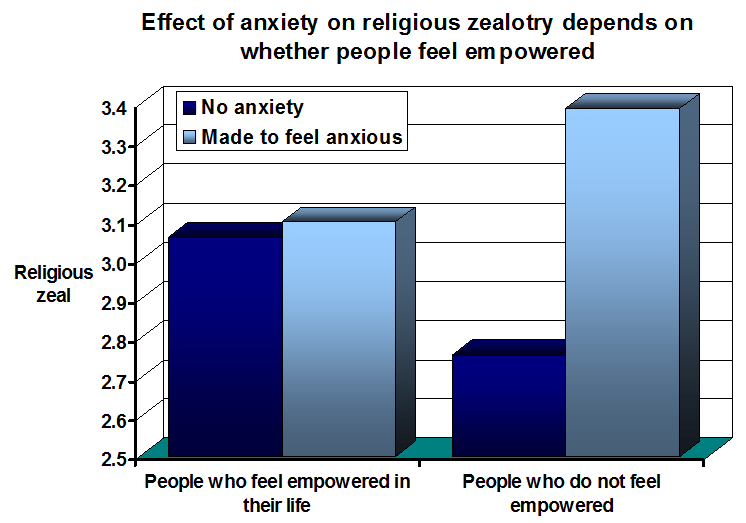
You can see an example of what happened in the figure. In this particular study they asked participants to think of a goal they had in their personal lives, and then to rate how determined they were to achieve it, how in control they felt, and how important it was. The ones who rated highly were considered to be ’empowered’.
It turns out that that the empowered people did not change in zealotry when placed in a anxiety-inducing situation, whereas the unempowered people became much more zealous. Now, this wasn’t because the empowered people felt less anxious. In fact, they felt more anxious. But they didn’t turn to religion as a displacement.
In other studies, they also found that people did not become more superstitious in general. What’s more, the effect was strongest in people who thought of uncertainty as nerve racking and, intriguingly, in those spirited individuals who believe in taking action to deal with problems.
They also found hints that this effect is stronger in those who believe in the three monotheisms, rather than Eastern religions (or atheists, of course), and suggest that this might be why religious extremism is more common in the West:
In Western religion, the allure of ideological zeal may be that it can reliably activate the resilience of transcendent approach motivation when temporal goals are frustrated. Unfortunately, religious extremists in the West have a long history of blood on their hands. The same empowering approach motivation that makes one soar may also obscure one’s view of others’ perspectives and facilitate ideological cruelty in the guise of noble cause. Such self-empowered, anger-related, and risk-immune RAM processes, in combination with scripture that advocates aggression toward others, may inflame religious violence in the West.
Now, this research is pretty preliminary. Other research has found that anxiety and uncertainly increases belief in a controlling God – but this study found no such effect. Of course, it’s possible that both effects (handing over control to a powerful God, or displacing the frustrated goal with an achievable, nontangible one) could both occur in different in people with personalities and in different situations. Then too, there is another theory (Terror Management), which claims that people cling to their ‘in-group’ cultural traditions when threatened.
But this research is encouraging because, although we’ve long known intuitively that people turn to religion when they feel stressed and unhappy. The question is how and why. Now, at least, we have three good theories about what is going on here. Only further research is going to tease them apart!
 McGregor I, Nash K, & Prentice M (2010). Reactive approach motivation (RAM) for religion. Journal of personality and social psychology, 99 (1), 148-61 PMID: 20565192
 This article by Tom Rees was first published on Epiphenom. It is licensed under Creative Commons.
Previous Post

July 7, 2010
What values motivate the non-religious in the UK?
Next Post
July 13, 2010 Xanax redux
Browse Our Archives
Select a Category Causes of religion - evolution Causes of religion - psychological Causes of religion - social Demographics Digest Effects of religion - health Effects of religion - psychological Effects of religion - social Notifications Politics Uncategorized
Select a Month March 2016 February 2016 January 2016 December 2015 November 2015 October 2015 September 2015 August 2015 July 2015 June 2015 May 2015 April 2015 March 2015 February 2015 January 2015 December 2014 November 2014 October 2014 September 2014 August 2014 July 2014 June 2014 May 2014 April 2014 March 2014 February 2014 January 2014 December 2013 November 2013 October 2013 September 2013 August 2013 July 2013 June 2013 May 2013 April 2013 March 2013 February 2013 January 2013 December 2012 November 2012 October 2012 September 2012 August 2012 July 2012 June 2012 May 2012 April 2012 March 2012 February 2012 January 2012 December 2011 November 2011 October 2011 September 2011 August 2011 July 2011 June 2011 May 2011 April 2011 March 2011 February 2011 January 2011 December 2010 November 2010 October 2010 September 2010 August 2010 July 2010 June 2010 May 2010 April 2010 March 2010 February 2010 January 2010 December 2009 November 2009 October 2009 September 2009 August 2009 July 2009 June 2009 May 2009 April 2009 March 2009 February 2009 January 2009 December 2008 November 2008 October 2008 September 2008 August 2008 July 2008 June 2008 May 2008 April 2008 March 2008 February 2008 January 2008 December 2007 November 2007 October 2007
Follow Us!
TAKE THE
Religious Wisdom Quiz
What happened to Lot's wife as they fled Sodom?
Select your answer to see how you score.
She turned into a pillar of salt She became blind She fell into a well She died by fire
Related posts from Epiphenom

Do social crises lead to religious revivals? Nah!

What kind of woman would pray for health...

Can you use religion to change attitudes towards...

Dogmatic atheism and fundamentalist Christianity: creating certainty in...
TRENDING AT PATHEOS Nonreligious

Dethroning Jesus and Enthroning Yourself
Jesus Never Asked to Be Worshipped. He Asked to Be Understood. Christianity...

Why Most Christians are Really Paulians and Jobians
I Don't Care, But It Matters Let's get this out of the...

Essential Tips to Successfully Navigate the Selling Process
Selling a house can feel overwhelming, but it doesn’t have to be....

To Make Remote Work Effective, Think About Others
The COVID-19 pandemic forced many companies to rapidly transition to remote work....

Flexibility Is Key to Solving Problems of Tomorrow
The world of work is undergoing a dramatic transformation. The COVID-19 pandemic...
view all Nonreligious blogs
Ad-Free & Subscriber Log-In Subscription Support
- About Us
- 2026 Calendar
- Videos
- Podcasts
- Library of World Religions
- Faith In Media Tracker
- Advertise With Us
- Write for Us
- Privacy Policy
- Terms of Service
- Do Not Sell My Data
- Contact Us
- Radiant Digital
- Manage Newsletter Subscriptions
- Unsubscribe From Notifications
- Sitemap
Copyright 2008-2026, Patheos. All rights reserved.
Subscription Support Ad-Free & Subscriber Log-In
Follow Patheos