
BuddhistCatholicContemplativeEvangelicalGeneral ChristianHinduJewishLatter-day SaintMuslimNew VisionsProgressive Christian
Beliefs
- Buddhist
- Catholic
- Contemplative
- Evangelical
- General Christian
- Hindu
- Jewish
- Latter-day Saint
- More Voices
- Muslim
- New Visions
- Pagan
- Progressive Christian
Topics
- Religion News
- Food and Religion
- Sports and Religion
- Religious Art
- Religious Music and Entertainment
- Religious Events
- History and Religion
- Style and Religion
- Politics and Religion
- Women in Religion
- Recreation Outdoors and Religion
- Business Finance and Religion
- Careers Workplace and Religion
- Education and Religion
- Family Parenting and Religion
- Health Fitness and Religion
- Home and Religion
- Relationships and Religion
- Technology and Religion
- Travel and Religion
Columnists
- Buddhist Columnists
- Business Finance and Religion Columnists
- Careers Workplace and Religion Columnists
- Catholic Columnists
- Contemplative Columnists
- Education and Religion Columnists
- Evangelists Columnists
- Family Parenting and Religion Columnists
- General Christian Columnists
- Health Fitness and Religion Columnists
- Hindu Columnists
- History and Religion Columnists
- Home and Religion Columnists
- Jewish Columnists
- More Voices Columnists
- Latter Day Columnists
- Muslim Columnists
- New Visions Columnists
- Nonreligious Columnists
- Pagan Columnists
- Politics and Religion Columnists
- Progressive Columnists
- Recreation Outdoors and Religion Columnists
- Relationships and Religion Columnists
- Religion News Columnists
- Religious Art Columnists
- Religious Events Columnists
- Religious Music and Entertainment Columnists
- Sports and Religion Columnists
- Style and Religion Columnists
- Technology and Religion Columnists
- Travel and Religion Columnists
- Women in Religion Columnists
Resource Library
- 2026 Calendar
- Library of World Religions
- The 100 Most Holy Places on Earth
- Patheos Answers
- Podcasts
- Videos
- Faith Leaders Database
- Anglican Episcopalian
- Bahai
- Baptist
- Buddhism
- Christianity
- Confucianism
- Eastern Orthodoxy
- Hinduism
- Holiness and Pentecostal
- ISKCON
- Islam
- Judaism
- Lutheran
- Methodist
- The Church of Jesus Christ of Latter-day Saints
- New Age
- Paganism
- Presbytarian and Reformed
- Protestantism
- Religion Behind the Scenes
- Roman Catholic
- Scientology
- Shia Islam
- Sikhism
- Sufism
- Sunni Islam
- Taoism
- Zen
- See all religions
Research Tools
 Ad-Free & Subscriber Log-In Subscription Support
Follow Patheos 

- Trending:
- Advent
- |
- Forgiveness
- |
- Thanksgiving
- |
- Election
- |
- Seasonal Holidays
- |
- Marriage
 Epiphenom
- Home
- Nonreligious
- Studying science doesn’t make you an atheist… but studying literature does!
Studying science doesn’t make you an atheist… but studying literature does!
Last updated on: November 12, 2014 at 5:08 am by Epiphenom
Studying science doesn’t make you an atheist… but studying literature does! 2014-11-12T05:08:10+01:00 Epiphenom
Patheos Explore the world's faith through different perspectives on religion and spirituality! Patheos has the views of the prevalent religions and spiritualities of the world.
Chris Mooney has an interview with Elaine Ecklund, the researcher who’s been documenting the religious beliefs of academics for several years. I’ve blogged about her work last year.
One of the things Mooney picks up on is her conclusion that, although scientists are much less religious than the general population, it doesn’t seem to be that studying science is the cause. That’s because prospective scientists are mostly non-religious in the first place.
I guess that’s not too surprising. There’s a considerable anti-science movement within conservative Christianity, so highly religious people are less likely to go into science in the first place. And there’s no reason to suppose that learning about science should necessarily conflict with liberal religion. After all, mainstream religions have successfully accommodated science within their worldviews (often reconstructing God as a remote figure who lets evolution and the laws of physics do most of the work – although see this earlier blog post for more on that).
And yet there is something odd going on here. Because college in the US is, in fact, a major non-religious epiphany for many students.

Take, for example, data from the ongoing Spirituality in Higher Education Study. This study is following nearly 15,000 students through their college years.
They’ve found that religious attendance plummets during college years – as shown in the figure on the right (which I nicked from the Salt Lake Tribune). According to the study organizers, this drop in attendance is closely related to an increase in “alcohol consumption and partying”. A shocking indictment of college life, I’m sure you’ll agree!
But it’s not just the hedonism and freedom of college life that entices students away from religion. You can see this in some remarkable data from the Monitoring the Future Study (the paper is here, but behind a paywall).
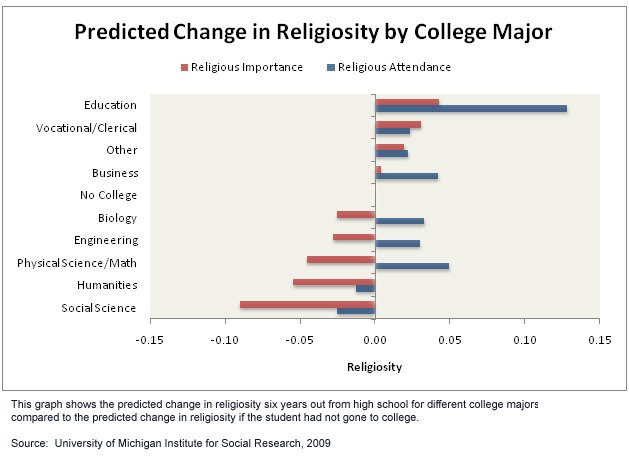
They estimated how much religiosity changes for kids who do not go to college. Then they compared that with changes in religiosity over 6 years for kids who study a range of disciplines.
The data are shown in the graph at the top of this story. Basically, for the biological and physical sciences it’s a mixed picture, similar to what Ecklund found. Church attendance goes up, while beliefs go down. Perhaps that’s because, as they join the workforce, they feel under increased pressure to conform socially.
For vocational subjects, the effect is all positive. These folks come out of college more religious than you might expect – which may reflect the different natures of the colleges that teach these subjects.
But both the Humanities and the Social Sciences see dramatic declines in attendance and even more in religious beliefs.
Now, this might simply be because they were more religious to start with – but then, so were those who went into education. So I suspect that broadening world views is the major reason these students lose their faith – a conclusion also suggested by the fact that, in the Spirituality in Higher Education Study, participation in a “study abroad program” also created increased skepticism about religion.
In other words, humanities and social sciences, much more than biological and mathematical sciences, challenge you to imagine the world through the eyes of others. And this exercise in imagination undercuts religious dogma far more effectively than any science lesson can.
As the Michigan researchers conclude: “”Our results suggest that it is Postmodernism, not Science, that is the bête noir of religiosity.”
 This article by Tom Rees was first published on Epiphenom. It is licensed under Creative Commons.
Previous Post

May 15, 2010
Epiphenom? There's a (Nokia) app for that!
Next Post
May 18, 2010 Will the financial crisis turn people to religion?
Browse Our Archives
Select a Category Causes of religion - evolution Causes of religion - psychological Causes of religion - social Demographics Digest Effects of religion - health Effects of religion - psychological Effects of religion - social Notifications Politics Uncategorized
Select a Month March 2016 February 2016 January 2016 December 2015 November 2015 October 2015 September 2015 August 2015 July 2015 June 2015 May 2015 April 2015 March 2015 February 2015 January 2015 December 2014 November 2014 October 2014 September 2014 August 2014 July 2014 June 2014 May 2014 April 2014 March 2014 February 2014 January 2014 December 2013 November 2013 October 2013 September 2013 August 2013 July 2013 June 2013 May 2013 April 2013 March 2013 February 2013 January 2013 December 2012 November 2012 October 2012 September 2012 August 2012 July 2012 June 2012 May 2012 April 2012 March 2012 February 2012 January 2012 December 2011 November 2011 October 2011 September 2011 August 2011 July 2011 June 2011 May 2011 April 2011 March 2011 February 2011 January 2011 December 2010 November 2010 October 2010 September 2010 August 2010 July 2010 June 2010 May 2010 April 2010 March 2010 February 2010 January 2010 December 2009 November 2009 October 2009 September 2009 August 2009 July 2009 June 2009 May 2009 April 2009 March 2009 February 2009 January 2009 December 2008 November 2008 October 2008 September 2008 August 2008 July 2008 June 2008 May 2008 April 2008 March 2008 February 2008 January 2008 December 2007 November 2007 October 2007
Follow Us!
TAKE THE
Religious Wisdom Quiz
What animal did Peter see in vision?
Select your answer to see how you score.
Sheep Goats Clean and unclean animals Lions
Related posts from Epiphenom

Do social crises lead to religious revivals? Nah!

What kind of woman would pray for health...
Can you use religion to change attitudes towards...
Dogmatic atheism and fundamentalist Christianity: creating certainty in...
TRENDING AT PATHEOS Nonreligious

Dethroning Jesus and Enthroning Yourself
Jesus Never Asked to Be Worshipped. He Asked to Be Understood. Christianity...

Why Most Christians are Really Paulians and Jobians
I Don't Care, But It Matters Let's get this out of the...

Essential Tips to Successfully Navigate the Selling Process
Selling a house can feel overwhelming, but it doesn’t have to be....

To Make Remote Work Effective, Think About Others
The COVID-19 pandemic forced many companies to rapidly transition to remote work....

Flexibility Is Key to Solving Problems of Tomorrow
The world of work is undergoing a dramatic transformation. The COVID-19 pandemic...
view all Nonreligious blogs
Ad-Free & Subscriber Log-In Subscription Support
- About Us
- 2026 Calendar
- Videos
- Podcasts
- Library of World Religions
- Faith In Media Tracker
- Advertise With Us
- Write for Us
- Privacy Policy
- Terms of Service
- Do Not Sell My Data
- Contact Us
- Radiant Digital
- Manage Newsletter Subscriptions
- Unsubscribe From Notifications
- Sitemap
Copyright 2008-2026, Patheos, part of the Radiant Digital network of media brands. All rights reserved.
Subscription Support Ad-Free & Subscriber Log-In
Follow Patheos