
BuddhistCatholicContemplativeEvangelicalGeneral ChristianHinduJewishLatter-day SaintMuslimNew VisionsProgressive Christian
Beliefs
- Buddhist
- Catholic
- Contemplative
- Evangelical
- General Christian
- Hindu
- Jewish
- Latter-day Saint
- More Voices
- Muslim
- New Visions
- Pagan
- Progressive Christian
Topics
- Religion News
- Food and Religion
- Sports and Religion
- Religious Art
- Religious Music and Entertainment
- Religious Events
- History and Religion
- Style and Religion
- Politics and Religion
- Women in Religion
- Recreation Outdoors and Religion
- Business Finance and Religion
- Careers Workplace and Religion
- Education and Religion
- Family Parenting and Religion
- Health Fitness and Religion
- Home and Religion
- Relationships and Religion
- Technology and Religion
- Travel and Religion
Columnists
- Buddhist Columnists
- Business Finance and Religion Columnists
- Careers Workplace and Religion Columnists
- Catholic Columnists
- Contemplative Columnists
- Education and Religion Columnists
- Evangelists Columnists
- Family Parenting and Religion Columnists
- General Christian Columnists
- Health Fitness and Religion Columnists
- Hindu Columnists
- History and Religion Columnists
- Home and Religion Columnists
- Jewish Columnists
- More Voices Columnists
- Latter Day Columnists
- Muslim Columnists
- New Visions Columnists
- Nonreligious Columnists
- Pagan Columnists
- Politics and Religion Columnists
- Progressive Columnists
- Recreation Outdoors and Religion Columnists
- Relationships and Religion Columnists
- Religion News Columnists
- Religious Art Columnists
- Religious Events Columnists
- Religious Music and Entertainment Columnists
- Sports and Religion Columnists
- Style and Religion Columnists
- Technology and Religion Columnists
- Travel and Religion Columnists
- Women in Religion Columnists
Resource Library
- 2026 Calendar
- Library of World Religions
- The 100 Most Holy Places on Earth
- Patheos Answers
- Podcasts
- Videos
- Faith Leaders Database
- Anglican Episcopalian
- Bahai
- Baptist
- Buddhism
- Christianity
- Confucianism
- Eastern Orthodoxy
- Hinduism
- Holiness and Pentecostal
- ISKCON
- Islam
- Judaism
- Lutheran
- Methodist
- The Church of Jesus Christ of Latter-day Saints
- New Age
- Paganism
- Presbytarian and Reformed
- Protestantism
- Religion Behind the Scenes
- Roman Catholic
- Scientology
- Shia Islam
- Sikhism
- Sufism
- Sunni Islam
- Taoism
- Zen
- See all religions
Research Tools
 Ad-Free & Subscriber Log-In Subscription Support
Ad-Free & Subscriber Log-In Subscription Support
Follow Patheos 

- Trending:
- Forgiveness
- |
- Marriage
- |
- Consciousness
- |
- Death Penalty
- |
- Election
- |
- Halloween
 Epiphenom
- Home
- Nonreligious
- Did fornicating Farm Girls boost the rise of atheism in Britain?
Did fornicating Farm Girls boost the rise of atheism in Britain?
Last updated on: November 12, 2014 at 5:06 am by Epiphenom
Did fornicating Farm Girls boost the rise of atheism in Britain? 2014-11-12T05:06:13+01:00 Epiphenom
Patheos Explore the world's faith through different perspectives on religion and spirituality! Patheos has the views of the prevalent religions and spiritualities of the world.
These days, Britain is one of the most atheistic countries around. It wasn’t always like that, of course, but one of the problems with trying to work out how the present state of affairs came about is that there are very few statistics on religion the stretch back far enough.
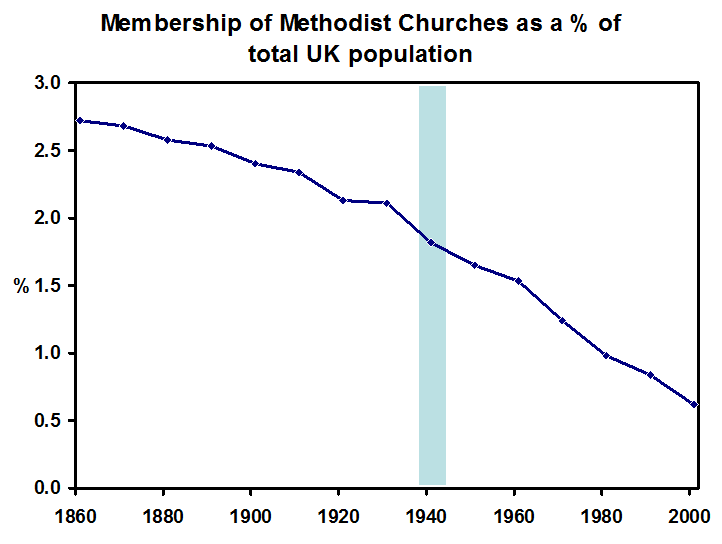
Stepping into the breach is Steven Bruce and Tony Glendinning, of the University of Aberdeen in Scotland. They’ve put together a time-series from data collected by the Methodists Churches, who have been among the most rigorous in collecting data on their membership.
If you look at the raw numbers, it looks at first sight as though Methodist membership held up quite well – at least until recent decades. But over that same period of time, the total population of the UK nearly trebled.
When you plot membership as a percentage of the total population, a different picture emerges. Methodist membership has actually been declining since records began, with the decline accelerating in the post-war period decades.
Broadly similar patterns (with a few hiccups) can be seen in many other measures of religion in the UK (although inevitably more murky because the data are more patchy). Overall church membership peaked around 1904, Sunday School enrolment peaked in the same decade, and baptisms peaked around 1930.
What caused this decline? Well, membership goes down when the churches lose members – either to death or defection – faster than they can recruit. And the evidence suggests that the major reason for the decline is failure to bind children into the religion of their parents.
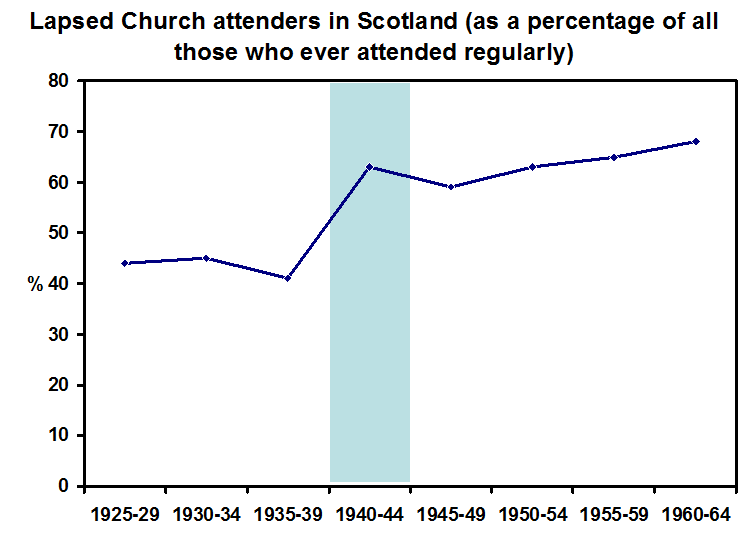
This really kicked off during the Second World War. Here’s another graph, showing showing the percentage of people in Scotland who stopped attending, according to when they were born. Mostly these are people who went to church as children, but who stopped attending before they turned 21.
There was a sudden surge in the numbers of people who stopped attending, which started for people born during the war and persisted afterwards.
The Second World War caused an enormous upheaval in European society, and trying to trace any one factor as the cause of the rise in godlessness is problematic. However, one clue is that a major reason for young adults to abandon Christianity is having parents from different denominations.
In other words, its much more difficult to pass on religion to your children if parents have different views – even if those differences are as minor as the differences between Anglicans and Methodists.
Now, add to this the fact that the War brought a revolution in the social mobility of women. Young women broke free from their traditional roles, and by 1943 90% of single women aged 18-40 were employed either in the armed forces or in industry.
Many women found themselves posted to areas of the country far from home, often with others – both men and women – of very different social backgrounds. And with that came not only a broadened outlook but also sexual emancipation. One ‘Land Girl’ working in Romney Marsh recalled:
There were troops everywhere. You could just take your pick. You didn’t know how many were married; you just had to take their word for it. . . . I had several boyfriends during the war. . . . It was a case of a broken heart one night and the next night a new boyfriend’
One result of this freedom was that women born between 1914-1924 were twice as likely to have had sex before marriage than women born 10 years before. But, perhaps more importantly, both men and women were exposed to perspectives on the world that they would never have gained previously.
According to Bruce & Glendinning, the war weakened the community ties that help the successful transmission of any shared cultural characteristic:
With vast numbers of young men in the armed forces being moved around the country, one way or another, almost all single British women between 1939 and 1945 experienced an unprecedented degree of social mixing. A large part of the eligible population had a chance to engage in pleasant and positive social interaction with people from very different social, regional, cultural and religious backgrounds (Harris 2000: 113). Not all such mixing resulted in a broadening of horizons and a weakening of previous loyalties. The aliens – inner-city evacuees, servicemen, foreigners – could be handy scapegoats for those who saw no benefit from the disruption of old ways of life but for many of those whose children were to form the missing generation of church members in the 1960s, the war was a liberating experience.
As a result, women were less likely to marry the local lad from the same street and church. And it’s the mixing together of different world views and perspectives that is fatal for the successful transmission of religion.
 Bruce, S, & Glendinning, T (2010). When was secularization? Dating the decline of the British churches and locating its cause. The British Journal of Sociology, 61 (1), 107-126
 This article by Tom Rees was first published on Epiphenom. It is licensed under Creative Commons.
Previous Post

May 28, 2010
Protestants tempt fate, but atheists don't!
Next Post
June 3, 2010 Children can tell the difference between science and religion
Browse Our Archives
Select a Category Causes of religion - evolution Causes of religion - psychological Causes of religion - social Demographics Digest Effects of religion - health Effects of religion - psychological Effects of religion - social Notifications Politics Uncategorized
Select a Month March 2016 February 2016 January 2016 December 2015 November 2015 October 2015 September 2015 August 2015 July 2015 June 2015 May 2015 April 2015 March 2015 February 2015 January 2015 December 2014 November 2014 October 2014 September 2014 August 2014 July 2014 June 2014 May 2014 April 2014 March 2014 February 2014 January 2014 December 2013 November 2013 October 2013 September 2013 August 2013 July 2013 June 2013 May 2013 April 2013 March 2013 February 2013 January 2013 December 2012 November 2012 October 2012 September 2012 August 2012 July 2012 June 2012 May 2012 April 2012 March 2012 February 2012 January 2012 December 2011 November 2011 October 2011 September 2011 August 2011 July 2011 June 2011 May 2011 April 2011 March 2011 February 2011 January 2011 December 2010 November 2010 October 2010 September 2010 August 2010 July 2010 June 2010 May 2010 April 2010 March 2010 February 2010 January 2010 December 2009 November 2009 October 2009 September 2009 August 2009 July 2009 June 2009 May 2009 April 2009 March 2009 February 2009 January 2009 December 2008 November 2008 October 2008 September 2008 August 2008 July 2008 June 2008 May 2008 April 2008 March 2008 February 2008 January 2008 December 2007 November 2007 October 2007
Follow Us!
TAKE THE
Religious Wisdom Quiz
I was fed by ravens at a brook and later by a widow whose oil and flour never ran out. Who am I?
Select your answer to see how you score.
Elijah Moses Samuel Elisha
Related posts from Epiphenom

Do social crises lead to religious revivals? Nah!

What kind of woman would pray for health...

Can you use religion to change attitudes towards...

Dogmatic atheism and fundamentalist Christianity: creating certainty in...
TRENDING AT PATHEOS Nonreligious

Dethroning Jesus and Enthroning Yourself
Jesus Never Asked to Be Worshipped. He Asked to Be Understood. Christianity...

Why Most Christians are Really Paulians and Jobians
I Don't Care, But It Matters Let's get this out of the...

Essential Tips to Successfully Navigate the Selling Process
Selling a house can feel overwhelming, but it doesn’t have to be....

To Make Remote Work Effective, Think About Others
The COVID-19 pandemic forced many companies to rapidly transition to remote work....

Flexibility Is Key to Solving Problems of Tomorrow
The world of work is undergoing a dramatic transformation. The COVID-19 pandemic...
view all Nonreligious blogs
Ad-Free & Subscriber Log-In Subscription Support
- About Us
- 2026 Calendar
- Videos
- Podcasts
- Library of World Religions
- Faith In Media Tracker
- Advertise With Us
- Write for Us
- Privacy Policy
- Terms of Service
- Do Not Sell My Data
- Contact Us
- Radiant Digital
- Manage Newsletter Subscriptions
- Unsubscribe From Notifications
- Sitemap
Copyright 2008-2026, Patheos. All rights reserved.
Subscription Support Ad-Free & Subscriber Log-In
Follow Patheos