
BuddhistCatholicContemplativeEvangelicalGeneral ChristianHinduJewishLatter-day SaintMuslimNew VisionsProgressive Christian
Beliefs
- Buddhist
- Catholic
- Contemplative
- Evangelical
- General Christian
- Hindu
- Jewish
- Latter-day Saint
- More Voices
- Muslim
- New Visions
- Pagan
- Progressive Christian
Topics
- Religion News
- Food and Religion
- Sports and Religion
- Religious Art
- Religious Music and Entertainment
- Religious Events
- History and Religion
- Style and Religion
- Politics and Religion
- Women in Religion
- Recreation Outdoors and Religion
- Business Finance and Religion
- Careers Workplace and Religion
- Education and Religion
- Family Parenting and Religion
- Health Fitness and Religion
- Home and Religion
- Relationships and Religion
- Technology and Religion
- Travel and Religion
Columnists
- Buddhist Columnists
- Business Finance and Religion Columnists
- Careers Workplace and Religion Columnists
- Catholic Columnists
- Contemplative Columnists
- Education and Religion Columnists
- Evangelists Columnists
- Family Parenting and Religion Columnists
- General Christian Columnists
- Health Fitness and Religion Columnists
- Hindu Columnists
- History and Religion Columnists
- Home and Religion Columnists
- Jewish Columnists
- More Voices Columnists
- Latter Day Columnists
- Muslim Columnists
- New Visions Columnists
- Nonreligious Columnists
- Pagan Columnists
- Politics and Religion Columnists
- Progressive Columnists
- Recreation Outdoors and Religion Columnists
- Relationships and Religion Columnists
- Religion News Columnists
- Religious Art Columnists
- Religious Events Columnists
- Religious Music and Entertainment Columnists
- Sports and Religion Columnists
- Style and Religion Columnists
- Technology and Religion Columnists
- Travel and Religion Columnists
- Women in Religion Columnists
Resource Library
- 2026 Calendar
- Library of World Religions
- The 100 Most Holy Places on Earth
- Patheos Answers
- Podcasts
- Videos
- Faith Leaders Database
- Anglican Episcopalian
- Bahai
- Baptist
- Buddhism
- Christianity
- Confucianism
- Eastern Orthodoxy
- Hinduism
- Holiness and Pentecostal
- ISKCON
- Islam
- Judaism
- Lutheran
- Methodist
- The Church of Jesus Christ of Latter-day Saints
- New Age
- Paganism
- Presbytarian and Reformed
- Protestantism
- Religion Behind the Scenes
- Roman Catholic
- Scientology
- Shia Islam
- Sikhism
- Sufism
- Sunni Islam
- Taoism
- Zen
- See all religions
Research Tools
 Ad-Free & Subscriber Log-In Subscription Support
Ad-Free & Subscriber Log-In Subscription Support
Follow Patheos 

- Trending:
- Forgiveness
- |
- Marriage
- |
- Consciousness
- |
- Death Penalty
- |
- Election
- |
- Halloween
 Epiphenom
- Home
- Nonreligious
- Why religion can lead to racism
Why religion can lead to racism
Last updated on: November 3, 2014 at 9:39 pm by Epiphenom
Why religion can lead to racism 2014-11-03T21:39:33+01:00 Epiphenom
Patheos Explore the world's faith through different perspectives on religion and spirituality! Patheos has the views of the prevalent religions and spiritualities of the world.
Religious people are more racist than average [edit: this is in the USA. It probably also applies to Europe, but not necessarily to the rest of the world]. That fact has been known for decades, and it’s rather surprising given that mainstream religions are unanimous in preaching racial tolerance. Just why this should be is not well understood.
Does religion really cause racism, or is it that are racists drawn to religion? Three recent studies have shed a little light on that question, with fascinating results.
Do subconscious religious prompts increase racism?
Can you make someone more racist simply by subtly reminding them about religion? That’s what Wade Rowatt and colleagues set out to discover. They gave a group of college students a task that had religious cues embedded within it. The idea was to prime their subconscious with religious thoughts.
Then they asked them about their racial attitudes. Although the primed students didn’t come straight out and admit to greater racism, their covert racism did increase. Rowatt and colleagues also found that students, when religiously primed, were more likely to agree that they dislike African-Americans.
So religious thoughts seem to trigger racist thoughts. One obvious explanation for this is that religion tends to increase benevolence towards co-religionists, but can increase hostility towards outsiders.
But in the USA, most Whites and African-Americans are Protestant Christians – not only the same religion, but the same sect! It’s true that worship and religious styles are often segregated, but it seems far-fetched to say that the religious differences came first.
There might be more to this study than first meets the eye, however. Rowatt’s group of students were rather unusual. They were all undergraduates at a southern, Christian university (Baylor College, Texas). There is a powerful tradition of segregation in this region. Perhaps the religious prompts were triggering feelings of social conservatism?
Religious conformity is linked to racist attitudes
That would fit with the results of a recent analysis of studies reaching back over several decades and looking at the correlation between different aspects of religion and racism (all of which were done mostly or entirely in the USA). This analysis, by Deborah Hall at Duke University and colleagues, found no correlation between racism and the liberal, ‘questioning’ form of religion.
The aspect of religion that was linked strongly to racism was so-called ‘extrinsic’ religiosity – a measure of whether the individual’s religious attitudes are driven by a desire for social conformity and social status.
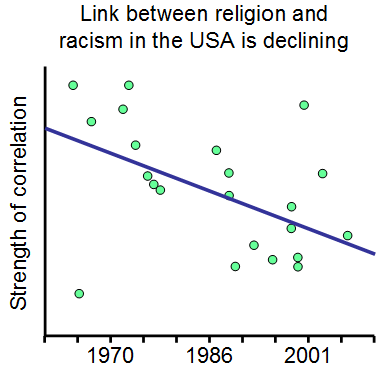 An even more fascinating finding was that the strength of this correlation is declining. As racist attitudes gradually become socially unacceptable, so the link between ‘extrinsic’ religiosity and racism is ebbing away.
They also found a tight link between fundamentalist religion and racism. This isn’t too surprising, but what was interesting was that there were close parallels between fundamentalism, racism, and right-wing authoritarianism.
Fundamentalists also tend to be ‘right-wing authoritarians’ – they value obedience to authority, hostility to outsiders, and conventionalism. When you take this into account, it turns out that right-wing authoritarianism pretty much explains the link between fundamentalism and racism.
Does religious fundamentalism increase right-wing authoritarianism?
The world view promoted by religious fundamentalism has many facets that look a lot like the precursors of right wing authoritarianism. Fundamentalists tend to believe that knowledge consists of simple truths which are either right or wrong (good or evil, with us or against us), which are unchanging, and which are handed down by a powerful authority and not to be questioned. All of these could lead to right-wing authoritarianism.
Laura Barnes, at Oklahoma State University, and her grad student John Hathcoat set out to test this model analysing the beliefs of undergraduate students. They used a statistical technique, bootstrapping, to test whether the model was plausible.
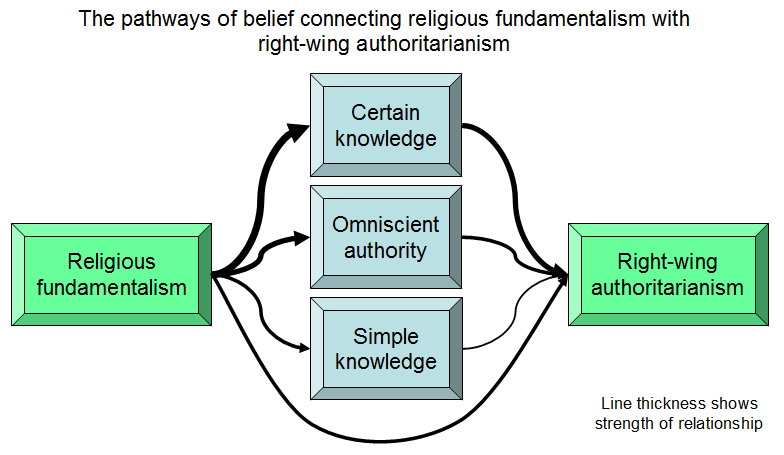 They found that three key beliefs about how the world works seemed to mediate the relationship between fundamentalism and authoritarianism: certain knowledge (the idea that there are fixed, absolute truths), simple knowledge (the idea that the world is simple and straightforward, not complex), and omniscient authority (the idea that authority should be obeyed).
This analysis doesn’t prove the causal link, but it does show that it’s plausible. What’s more, they tested a model that worked in the opposite direction, and found it didn’t fit the data nearly so well.
In other words, fundamentalist beliefs really do seem to lead down a pathway towards right-wing authoritarianism (and so on to racism).
 Megan K. Johnson, Wade C. Rowatt, & Jordan LaBouff (2010). Priming Christian Religious Concepts Increases Racial Prejudice Social Psychological and Personality Science, 1 (2), 119-126 : 10.1177/1948550609357246
Hall, D., Matz, D., & Wood, W. (2009). Why Don’t We Practice What We Preach? A Meta-Analytic Review of Religious Racism Personality and Social Psychology Review, 14 (1), 126-139 DOI: 10.1177/1088868309352179
Hathcoat, J., & Barnes, L. (2010). Explaining the Relationship Among Fundamentalism and Authoritarianism: An Epistemic Connection International Journal for the Psychology of Religion, 20 (2), 73-84 DOI: 10.1080/10508611003607884
 This article by Tom Rees was first published on Epiphenom. It is licensed under Creative Commons.
Previous Post

April 15, 2010
Why cloning is yucky
Next Post
April 21, 2010 The ethical dilemma for doctors in religious hospitals
Browse Our Archives
Select a Category Causes of religion - evolution Causes of religion - psychological Causes of religion - social Demographics Digest Effects of religion - health Effects of religion - psychological Effects of religion - social Notifications Politics Uncategorized
Select a Month March 2016 February 2016 January 2016 December 2015 November 2015 October 2015 September 2015 August 2015 July 2015 June 2015 May 2015 April 2015 March 2015 February 2015 January 2015 December 2014 November 2014 October 2014 September 2014 August 2014 July 2014 June 2014 May 2014 April 2014 March 2014 February 2014 January 2014 December 2013 November 2013 October 2013 September 2013 August 2013 July 2013 June 2013 May 2013 April 2013 March 2013 February 2013 January 2013 December 2012 November 2012 October 2012 September 2012 August 2012 July 2012 June 2012 May 2012 April 2012 March 2012 February 2012 January 2012 December 2011 November 2011 October 2011 September 2011 August 2011 July 2011 June 2011 May 2011 April 2011 March 2011 February 2011 January 2011 December 2010 November 2010 October 2010 September 2010 August 2010 July 2010 June 2010 May 2010 April 2010 March 2010 February 2010 January 2010 December 2009 November 2009 October 2009 September 2009 August 2009 July 2009 June 2009 May 2009 April 2009 March 2009 February 2009 January 2009 December 2008 November 2008 October 2008 September 2008 August 2008 July 2008 June 2008 May 2008 April 2008 March 2008 February 2008 January 2008 December 2007 November 2007 October 2007
Follow Us!
TAKE THE
Religious Wisdom Quiz
What proportion of lepers healed by Jesus returned to thank Him?
Select your answer to see how you score.
All ten One out of ten None Five
Related posts from Epiphenom

Do social crises lead to religious revivals? Nah!

What kind of woman would pray for health...

Can you use religion to change attitudes towards...

Dogmatic atheism and fundamentalist Christianity: creating certainty in...
TRENDING AT PATHEOS Nonreligious

Dethroning Jesus and Enthroning Yourself
Jesus Never Asked to Be Worshipped. He Asked to Be Understood. Christianity...

Why Most Christians are Really Paulians and Jobians
I Don't Care, But It Matters Let's get this out of the...

Essential Tips to Successfully Navigate the Selling Process
Selling a house can feel overwhelming, but it doesn’t have to be....

To Make Remote Work Effective, Think About Others
The COVID-19 pandemic forced many companies to rapidly transition to remote work....

Flexibility Is Key to Solving Problems of Tomorrow
The world of work is undergoing a dramatic transformation. The COVID-19 pandemic...
view all Nonreligious blogs
Ad-Free & Subscriber Log-In Subscription Support
- About Us
- 2026 Calendar
- Videos
- Podcasts
- Library of World Religions
- Faith In Media Tracker
- Advertise With Us
- Write for Us
- Privacy Policy
- Terms of Service
- Do Not Sell My Data
- Contact Us
- Radiant Digital
- Manage Newsletter Subscriptions
- Unsubscribe From Notifications
- Sitemap
Copyright 2008-2026, Patheos. All rights reserved.
Subscription Support Ad-Free & Subscriber Log-In
Follow Patheos