
BuddhistCatholicContemplativeEvangelicalGeneral ChristianHinduJewishLatter-day SaintMuslimNew VisionsProgressive Christian
Beliefs
- Buddhist
- Catholic
- Contemplative
- Evangelical
- General Christian
- Hindu
- Jewish
- Latter-day Saint
- More Voices
- Muslim
- New Visions
- Pagan
- Progressive Christian
Topics
- Religion News
- Food and Religion
- Sports and Religion
- Religious Art
- Religious Music and Entertainment
- Religious Events
- History and Religion
- Style and Religion
- Politics and Religion
- Women in Religion
- Recreation Outdoors and Religion
- Business Finance and Religion
- Careers Workplace and Religion
- Education and Religion
- Family Parenting and Religion
- Health Fitness and Religion
- Home and Religion
- Relationships and Religion
- Technology and Religion
- Travel and Religion
Columnists
- Buddhist Columnists
- Business Finance and Religion Columnists
- Careers Workplace and Religion Columnists
- Catholic Columnists
- Contemplative Columnists
- Education and Religion Columnists
- Evangelists Columnists
- Family Parenting and Religion Columnists
- General Christian Columnists
- Health Fitness and Religion Columnists
- Hindu Columnists
- History and Religion Columnists
- Home and Religion Columnists
- Jewish Columnists
- More Voices Columnists
- Latter Day Columnists
- Muslim Columnists
- New Visions Columnists
- Nonreligious Columnists
- Pagan Columnists
- Politics and Religion Columnists
- Progressive Columnists
- Recreation Outdoors and Religion Columnists
- Relationships and Religion Columnists
- Religion News Columnists
- Religious Art Columnists
- Religious Events Columnists
- Religious Music and Entertainment Columnists
- Sports and Religion Columnists
- Style and Religion Columnists
- Technology and Religion Columnists
- Travel and Religion Columnists
- Women in Religion Columnists
Resource Library
- 2026 Calendar
- Library of World Religions
- The 100 Most Holy Places on Earth
- Patheos Answers
- Podcasts
- Videos
- Faith Leaders Database
- Anglican Episcopalian
- Bahai
- Baptist
- Buddhism
- Christianity
- Confucianism
- Eastern Orthodoxy
- Hinduism
- Holiness and Pentecostal
- ISKCON
- Islam
- Judaism
- Lutheran
- Methodist
- The Church of Jesus Christ of Latter-day Saints
- New Age
- Paganism
- Presbytarian and Reformed
- Protestantism
- Religion Behind the Scenes
- Roman Catholic
- Scientology
- Shia Islam
- Sikhism
- Sufism
- Sunni Islam
- Taoism
- Zen
- See all religions
Research Tools
 Ad-Free & Subscriber Log-In Subscription Support
Ad-Free & Subscriber Log-In Subscription Support
Follow Patheos 

- Trending:
- Forgiveness
- |
- Marriage
- |
- Consciousness
- |
- Death Penalty
- |
- Election
- |
- Halloween
 Epiphenom
- Home
- Nonreligious
- Spite is the flipside of brotherly love
Spite is the flipside of brotherly love
Last updated on: November 12, 2014 at 5:12 am by Epiphenom
Spite is the flipside of brotherly love 2014-11-12T05:12:28+01:00 Epiphenom
Patheos Explore the world's faith through different perspectives on religion and spirituality! Patheos has the views of the prevalent religions and spiritualities of the world.
The biologist JBS Haldane famously said that he would lay down his life for two brothers… or eight cousins. That’s kinship altruism – the idea that it makes evolutionary sense to sacrifice yourself to benefit close relatives (who share a lot of your genes). But there’s another side to kinship altruism, as described by two Oxford University biologists, Stuart West and Andy Gardner, in a recent paper in Science.
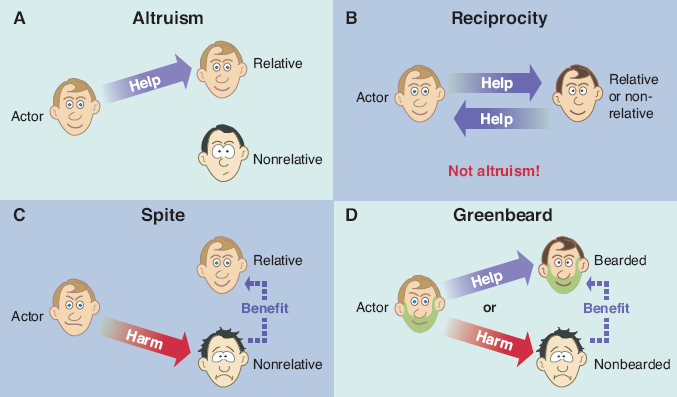 They point out that spiteful behaviour – acting cruelly for no gain to yourself – actually makes sense (in certain circumstances) for the same reason kinship altruism does. If your relatives benefit from your spiteful behaviour (or even if the target of your spite is less related to you than the average stranger) then then your genes could benefit.
In fact, from an evolutionary perspective, spite and kinship altruism are the same thing (they’re both explained in mathematical terms using ‘Hamilton’s Rule’).
Now, West & Gardner don’t mention religion, but this fact has interesting implications. As the anthropologist Lyle Steadman has pointed out, almost all the world’s religions use kinship terms (mother, father, brother, sister) to refer to their co-religionists.
The idea is that religion helps to stabilise large societies by subverting our intuitive kinship altruism and extending it to non-relatives. Which is all well and good for co-religionists, but the downside is that people of a different religion then become emphatically non-kin (failing both real and religious kinship criteria).
Which might help to explain the spiteful actions that often occur between followers of different gods.
West and Gardner also discuss so-called ‘green beards’. This refers to genes (or gene-complexes) that code for an altruistic trait and also for a signal. Dawkins coined the term to describe the hypothetical case of a gene that simultaneously codes for the green beard itself and also for co-operative behaviour towards fellow green beards.
It’s been suggested that just such a linkage could explain the rise of religion – if religious displays are a reliable guide to honest behaviour.
However, West & Gardner put the kybosh on that idea. Green beards are unlikely to be relevant to human evolution, because personality traits are complex and not due to genes that could also code for a visible signal:
Some models for altruism in humans and social insects implicitly invoke greenbeard mechanisms without realizing this, such as the suggestion that altruistic individuals differ from individuals who are not altruistic in some observable characteristic [such as being more likely to smile and laugh] or models of “strong reciprocity” that assume punishment and altruism to be genetically linked. However, there is no reason to suspect that traits such as smiling or punishment will be encoded by the same gene or closely linked genes as those that lead to altruism. Consequently, falsebeards could arise, and these proposed explanations for altruism would not be evolutionarily stable.
And finally… I actually learned about this article from a Christian blogger, who picked up on one sentence about how kinship altruism can lead to a particular kind of social behaviour. He says the authors:
… point out that “strict lifetime monogamy, in which females only mate with one male in their entire life, is crucial for the evolution of eusociality.” This provides a very natural scientific basis for understanding the critical importance of “thou shalt not commit adultery”
Now, this is very funny when you know that ‘eusocial’ is a very specific term used to describe the kind of society exemplified by honey bees – one dominant queen, with a slavish workforce comprising her sterile daughters. It sounds like adultery is the only way to save us from a bleak future!
I don’t think the blogger is actually hoping for a bible-based eusocial future for humans. Most likely he simply doesn’t realise what eusocial means – hard to believe when the paper illustrates it with pictures of termites and sterile worker shrimps!
 West SA, & Gardner A (2010). Altruism, spite, and greenbeards. Science (New York, N.Y.), 327 (5971), 1341-4 PMID: 20223978
 This article by Tom Rees was first published on Epiphenom. It is licensed under Creative Commons.
Previous Post

April 4, 2010
You either believe in it all, or you don’t
Next Post
April 12, 2010 Blood donations: religious and non-religious are equally generous
Browse Our Archives
Select a Category Causes of religion - evolution Causes of religion - psychological Causes of religion - social Demographics Digest Effects of religion - health Effects of religion - psychological Effects of religion - social Notifications Politics Uncategorized
Select a Month March 2016 February 2016 January 2016 December 2015 November 2015 October 2015 September 2015 August 2015 July 2015 June 2015 May 2015 April 2015 March 2015 February 2015 January 2015 December 2014 November 2014 October 2014 September 2014 August 2014 July 2014 June 2014 May 2014 April 2014 March 2014 February 2014 January 2014 December 2013 November 2013 October 2013 September 2013 August 2013 July 2013 June 2013 May 2013 April 2013 March 2013 February 2013 January 2013 December 2012 November 2012 October 2012 September 2012 August 2012 July 2012 June 2012 May 2012 April 2012 March 2012 February 2012 January 2012 December 2011 November 2011 October 2011 September 2011 August 2011 July 2011 June 2011 May 2011 April 2011 March 2011 February 2011 January 2011 December 2010 November 2010 October 2010 September 2010 August 2010 July 2010 June 2010 May 2010 April 2010 March 2010 February 2010 January 2010 December 2009 November 2009 October 2009 September 2009 August 2009 July 2009 June 2009 May 2009 April 2009 March 2009 February 2009 January 2009 December 2008 November 2008 October 2008 September 2008 August 2008 July 2008 June 2008 May 2008 April 2008 March 2008 February 2008 January 2008 December 2007 November 2007 October 2007
Follow Us!
TAKE THE
Religious Wisdom Quiz
Which writer besides Solomon and David contributed to Proverbs?
Select your answer to see how you score.
Nathan Moses Agur Asaph
Related posts from Epiphenom

Do social crises lead to religious revivals? Nah!

What kind of woman would pray for health...

Can you use religion to change attitudes towards...

Dogmatic atheism and fundamentalist Christianity: creating certainty in...
TRENDING AT PATHEOS Nonreligious

Dethroning Jesus and Enthroning Yourself
Jesus Never Asked to Be Worshipped. He Asked to Be Understood. Christianity...

Why Most Christians are Really Paulians and Jobians
I Don't Care, But It Matters Let's get this out of the...

Essential Tips to Successfully Navigate the Selling Process
Selling a house can feel overwhelming, but it doesn’t have to be....

To Make Remote Work Effective, Think About Others
The COVID-19 pandemic forced many companies to rapidly transition to remote work....

Flexibility Is Key to Solving Problems of Tomorrow
The world of work is undergoing a dramatic transformation. The COVID-19 pandemic...
view all Nonreligious blogs
Ad-Free & Subscriber Log-In Subscription Support
- About Us
- 2026 Calendar
- Videos
- Podcasts
- Library of World Religions
- Faith In Media Tracker
- Advertise With Us
- Write for Us
- Privacy Policy
- Terms of Service
- Do Not Sell My Data
- Contact Us
- Radiant Digital
- Manage Newsletter Subscriptions
- Unsubscribe From Notifications
- Sitemap
Copyright 2008-2026, Patheos. All rights reserved.
Subscription Support Ad-Free & Subscriber Log-In
Follow Patheos