
BuddhistCatholicContemplativeEvangelicalGeneral ChristianHinduJewishLatter-day SaintMuslimNew VisionsProgressive Christian
Beliefs
- Buddhist
- Catholic
- Contemplative
- Evangelical
- General Christian
- Hindu
- Jewish
- Latter-day Saint
- More Voices
- Muslim
- New Visions
- Pagan
- Progressive Christian
Topics
- Religion News
- Food and Religion
- Sports and Religion
- Religious Art
- Religious Music and Entertainment
- Religious Events
- History and Religion
- Style and Religion
- Politics and Religion
- Women in Religion
- Recreation Outdoors and Religion
- Business Finance and Religion
- Careers Workplace and Religion
- Education and Religion
- Family Parenting and Religion
- Health Fitness and Religion
- Home and Religion
- Relationships and Religion
- Technology and Religion
- Travel and Religion
Columnists
- Buddhist Columnists
- Business Finance and Religion Columnists
- Careers Workplace and Religion Columnists
- Catholic Columnists
- Contemplative Columnists
- Education and Religion Columnists
- Evangelists Columnists
- Family Parenting and Religion Columnists
- General Christian Columnists
- Health Fitness and Religion Columnists
- Hindu Columnists
- History and Religion Columnists
- Home and Religion Columnists
- Jewish Columnists
- More Voices Columnists
- Latter Day Columnists
- Muslim Columnists
- New Visions Columnists
- Nonreligious Columnists
- Pagan Columnists
- Politics and Religion Columnists
- Progressive Columnists
- Recreation Outdoors and Religion Columnists
- Relationships and Religion Columnists
- Religion News Columnists
- Religious Art Columnists
- Religious Events Columnists
- Religious Music and Entertainment Columnists
- Sports and Religion Columnists
- Style and Religion Columnists
- Technology and Religion Columnists
- Travel and Religion Columnists
- Women in Religion Columnists
Resource Library
- 2026 Calendar
- Library of World Religions
- The 100 Most Holy Places on Earth
- Patheos Answers
- Podcasts
- Videos
- Faith Leaders Database
- Anglican Episcopalian
- Bahai
- Baptist
- Buddhism
- Christianity
- Confucianism
- Eastern Orthodoxy
- Hinduism
- Holiness and Pentecostal
- ISKCON
- Islam
- Judaism
- Lutheran
- Methodist
- The Church of Jesus Christ of Latter-day Saints
- New Age
- Paganism
- Presbytarian and Reformed
- Protestantism
- Religion Behind the Scenes
- Roman Catholic
- Scientology
- Shia Islam
- Sikhism
- Sufism
- Sunni Islam
- Taoism
- Zen
- See all religions
Research Tools
 Ad-Free & Subscriber Log-In Subscription Support
Ad-Free & Subscriber Log-In Subscription Support
Follow Patheos 

- Trending:
- Forgiveness
- |
- Marriage
- |
- Consciousness
- |
- Death Penalty
- |
- Election
- |
- Halloween
 Epiphenom
- Home
- Nonreligious
- Did world religions help bring about complex societies?
Did world religions help bring about complex societies?
Last updated on: November 12, 2014 at 5:14 am by Epiphenom
Did world religions help bring about complex societies? 2014-11-12T05:14:59+01:00 Epiphenom
Patheos Explore the world's faith through different perspectives on religion and spirituality! Patheos has the views of the prevalent religions and spiritualities of the world.
This is a long post, but hang on in there because it’s worth it. There’s a wonderful paper just out in Science that sheds new light on a mystery of human behaviour: why do people sometimes do good deeds even when they gain nothing from it.
Some forms of altruism can be easily explained by evolution, but evolution can’t explain why people are sometimes generous to completely anonymous strangers. This new study may have found a solution: it isn’t something inherent to our nature, but rather something that we learn to do.
You might have seen something of it already – it’s featured on several news wires. I’m not going to go into detail on the headline results, because you can find them elsewhere (Wired magazine has a nice write up, for example).
What interests me most about this study is the link they found to religion. But first, here’s a quick overview of what they did, and the major finding. The heart of the study was a standard battery of economic games designed to test their subject’s understanding of fairness:
- In the ‘Dictator Game’ Player 1 is given a fixed pool of money (equal to 1 day’s wages), and can share as much (or as little) as she likes with Player 2.
- In the ‘Ultimatum Game’, Player 2 is given the chance to reject offers that she feels are insultingly small.
- In the ‘Third Party Punishment Game’ a third player is given some money as well, and she can spend some of it to punish Player 1, if she thinks that the offer to Player 2 is too small.
Now, the logical thing to do in all these games is to hold on to all your money. You have nothing to gain by sharing (the games are anonymous), and all that happens is that you go home with less. However, what usually happens is that people do share some money (usually not 50%, however!).
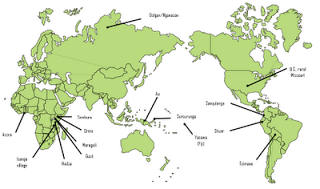 What makes this new study unique is that they’ve put together data from the world over, including the rather marvellous Hadza (you can see the locations on the map). Then they compared how much people contributed with what kind of society they lived in.
They found that contributions were smallest in societies that did not have a market economy (e.g. hunter gatherers). And they found that punishment was lowest in societies formed of small groups.
This potentially resolves the conundrum! What it suggests is that anonymous altruism is not part of our evolutionary make up, but instead is something that we learn from the society around us. The reason big, complex societies can exist is that we drum it into our kids that they must be fair and kind to strangers (against their natural instincts).
So what’s the connection with religion?
Well, they also showed that, in two out of the three games, the anonymous contributions were higher in those groups that had converted from tribal religions (in which gods do not enforce morality) to follow a ‘world religion’ (in practice, either Christianity or Islam).
On the face of it, this is supports the idea that ‘world religion’ is a cultural adaptation to allow the formation of complex societies. The invention of and all-seeing, morally concerned god increases the honesty in anonymous transactions, and thus allowing large, integrated communities to develop.
When you look at the history of religions, it’s clear that the development of religious ideas has progressed in tandem with the increasing complexity of society. Robert Wright has written a book on the topic, and in the supplementary material the study authors give a nice summary of these ideas.
It all sounds very plausible. However, it’s not quite that simple, for a whole host of reasons.
First is the problem that a ‘world religion’ may be a consequence, not a cause, of a complex society. A world religion is essentially one that’s popular over large geographic area. However, the exchange of ideas that always goes together with the exchange of goods will inevitably bring about a convergence of beliefs to create a ‘world religion’.
So you would expect a complex, diverse society to develop some kind of syncretic belief system – a ‘World Religion’. And that belief system would inevitably encapsulate the social norms of the complex society that created it. People create a god in their image.
Suppose, for example, that countries with more parasites end up with more fractured societies that are naturally less trusting of strangers. After all, strangers could bring with them disease. Surprisingly, studies have found that this is exactly the pattern you see – people living in high parasite regions are less open to strangers and have more fractured religions (Fincher & Thornhill, 2008). These societies, with their tribal rather than world religions, would naturally be less co-operative in anonymous games.
Perhaps moralising gods moralising gods are not required for complex societies. After all, the Romans and Greeks managed created large, complex societies despite having a pantheon of gods who were not exactly paragons of virtue.
And the reality is that, in modern societies at least, non-belief is correlated with less corruption and more trust. Social norms, rather than god beliefs, seem to be of primary importance.
As support for the hypothesis that ‘world religions’ promote pro-social behaviour, they quote the work of Shariff & Norenzayan. That was a small study which found that, in a similar economic game, subliminal religious primes (i.e. a quick flash of a religious word) were marginally more effective in believers than non-believers.
However, they also showed that non-religious primes were equally effective, and also that without the priming both religious and non-religious were equally pro-social. What’s more, other studies (Randolph-Seng & Nielsen, 2007, Ahmed 2009) have shown that pro-social effects of religion are all about the situation, rather than the beliefs.
Put these findings together, and what you get is the strong suggestion that the way to encourage pro-social behaviour is to remind people about their cultural training (religious or otherwise). The more you reinforce a social norm of co-operation, the more people will co-operate.
Now, that doesn’t rule out a role of religion in stabilising societies. In fact, I’m inclined to that that there must be a link. But it is fearsomely difficult to prove, and it’s clear that whatever the link is, it’s much more complicated than it appears at first sight.
I’m going to leave you with one other niggling anomaly from the paper. Remember that ‘world religion’ was associated with more pro-social behaviour in only two out of the three games? Maybe you were wondering which was the one out?
Well, the game that was the ‘Third Party Punishment’ game. This is the game in which Player 1 should give more money if they fear that Player 3 might spend some cash to punish offers that were too low. It’s a particularly relevant test because third party intervention to enforce the rules is a crucial feature of complex society.
Unlike the other two games, being Christian or Muslim had no effect on Player 1’s offers. What makes this doubly fascinating is that this is the only game in which wealth and income affected Player 1’s decisions.
The authors suspect it might be that the introduction of a ‘judge’ reduces the intrinsic motivation. In other words, the offers players make depends on what they think the judge will approve of, rather than what they themselves think is fair.
However, I couldn’t help but be reminded of another study that looked at punishment behaviour in a similar game. They examined a cross-section of relatively high income countries, and found high levels of co-operative punishment, and low-levels of anti-social punishment, in the least religious societies (Copenhagen and Melbourne).
Conceivably, if you don’t believe that there is a god on hand to enforce the rules, you might just be motivated to do it yourself!
 Henrich, J., Ensminger, J., McElreath, R., Barr, A., Barrett, C., Bolyanatz, A., Cardenas, J., Gurven, M., Gwako, E., Henrich, N., Lesorogol, C., Marlowe, F., Tracer, D., & Ziker, J. (2010). Markets, Religion, Community Size, and the Evolution of Fairness and Punishment Science, 327 (5972), 1480-1484 DOI: 10.1126/science.1182238
 This article by Tom Rees was first published on Epiphenom. It is licensed under Creative Commons.
Previous Post

March 18, 2010
Death by human stampede
Next Post
March 23, 2010 Research Blogging Awards 2010
Browse Our Archives
Select a Category Causes of religion - evolution Causes of religion - psychological Causes of religion - social Demographics Digest Effects of religion - health Effects of religion - psychological Effects of religion - social Notifications Politics Uncategorized
Select a Month March 2016 February 2016 January 2016 December 2015 November 2015 October 2015 September 2015 August 2015 July 2015 June 2015 May 2015 April 2015 March 2015 February 2015 January 2015 December 2014 November 2014 October 2014 September 2014 August 2014 July 2014 June 2014 May 2014 April 2014 March 2014 February 2014 January 2014 December 2013 November 2013 October 2013 September 2013 August 2013 July 2013 June 2013 May 2013 April 2013 March 2013 February 2013 January 2013 December 2012 November 2012 October 2012 September 2012 August 2012 July 2012 June 2012 May 2012 April 2012 March 2012 February 2012 January 2012 December 2011 November 2011 October 2011 September 2011 August 2011 July 2011 June 2011 May 2011 April 2011 March 2011 February 2011 January 2011 December 2010 November 2010 October 2010 September 2010 August 2010 July 2010 June 2010 May 2010 April 2010 March 2010 February 2010 January 2010 December 2009 November 2009 October 2009 September 2009 August 2009 July 2009 June 2009 May 2009 April 2009 March 2009 February 2009 January 2009 December 2008 November 2008 October 2008 September 2008 August 2008 July 2008 June 2008 May 2008 April 2008 March 2008 February 2008 January 2008 December 2007 November 2007 October 2007
Follow Us!
TAKE THE
Religious Wisdom Quiz
What does Paul offer to do if Onesimus owes Philemon anything?
Select your answer to see how you score.
Forgive the debt Pay it back himself Pray for resolution Have the church pay it
Related posts from Epiphenom

Do social crises lead to religious revivals? Nah!

What kind of woman would pray for health...

Can you use religion to change attitudes towards...

Dogmatic atheism and fundamentalist Christianity: creating certainty in...
TRENDING AT PATHEOS Nonreligious

Dethroning Jesus and Enthroning Yourself
Jesus Never Asked to Be Worshipped. He Asked to Be Understood. Christianity...

Why Most Christians are Really Paulians and Jobians
I Don't Care, But It Matters Let's get this out of the...

Essential Tips to Successfully Navigate the Selling Process
Selling a house can feel overwhelming, but it doesn’t have to be....

To Make Remote Work Effective, Think About Others
The COVID-19 pandemic forced many companies to rapidly transition to remote work....

Flexibility Is Key to Solving Problems of Tomorrow
The world of work is undergoing a dramatic transformation. The COVID-19 pandemic...
view all Nonreligious blogs
Ad-Free & Subscriber Log-In Subscription Support
- About Us
- 2026 Calendar
- Videos
- Podcasts
- Library of World Religions
- Faith In Media Tracker
- Advertise With Us
- Write for Us
- Privacy Policy
- Terms of Service
- Do Not Sell My Data
- Contact Us
- Radiant Digital
- Manage Newsletter Subscriptions
- Unsubscribe From Notifications
- Sitemap
Copyright 2008-2026, Patheos. All rights reserved.
Subscription Support Ad-Free & Subscriber Log-In
Follow Patheos