
BuddhistCatholicContemplativeEvangelicalGeneral ChristianHinduJewishLatter-day SaintMuslimNew VisionsProgressive Christian
Beliefs
- Buddhist
- Catholic
- Contemplative
- Evangelical
- General Christian
- Hindu
- Jewish
- Latter-day Saint
- More Voices
- Muslim
- New Visions
- Pagan
- Progressive Christian
Topics
- Religion News
- Food and Religion
- Sports and Religion
- Religious Art
- Religious Music and Entertainment
- Religious Events
- History and Religion
- Style and Religion
- Politics and Religion
- Women in Religion
- Recreation Outdoors and Religion
- Business Finance and Religion
- Careers Workplace and Religion
- Education and Religion
- Family Parenting and Religion
- Health Fitness and Religion
- Home and Religion
- Relationships and Religion
- Technology and Religion
- Travel and Religion
Columnists
- Buddhist Columnists
- Business Finance and Religion Columnists
- Careers Workplace and Religion Columnists
- Catholic Columnists
- Contemplative Columnists
- Education and Religion Columnists
- Evangelists Columnists
- Family Parenting and Religion Columnists
- General Christian Columnists
- Health Fitness and Religion Columnists
- Hindu Columnists
- History and Religion Columnists
- Home and Religion Columnists
- Jewish Columnists
- More Voices Columnists
- Latter Day Columnists
- Muslim Columnists
- New Visions Columnists
- Nonreligious Columnists
- Pagan Columnists
- Politics and Religion Columnists
- Progressive Columnists
- Recreation Outdoors and Religion Columnists
- Relationships and Religion Columnists
- Religion News Columnists
- Religious Art Columnists
- Religious Events Columnists
- Religious Music and Entertainment Columnists
- Sports and Religion Columnists
- Style and Religion Columnists
- Technology and Religion Columnists
- Travel and Religion Columnists
- Women in Religion Columnists
Resource Library
- 2026 Calendar
- Library of World Religions
- The 100 Most Holy Places on Earth
- Patheos Answers
- Podcasts
- Videos
- Faith Leaders Database
- Anglican Episcopalian
- Bahai
- Baptist
- Buddhism
- Christianity
- Confucianism
- Eastern Orthodoxy
- Hinduism
- Holiness and Pentecostal
- ISKCON
- Islam
- Judaism
- Lutheran
- Methodist
- The Church of Jesus Christ of Latter-day Saints
- New Age
- Paganism
- Presbytarian and Reformed
- Protestantism
- Religion Behind the Scenes
- Roman Catholic
- Scientology
- Shia Islam
- Sikhism
- Sufism
- Sunni Islam
- Taoism
- Zen
- See all religions
Research Tools
 Ad-Free & Subscriber Log-In Subscription Support
Ad-Free & Subscriber Log-In Subscription Support
Follow Patheos 

- Trending:
- Forgiveness
- |
- Marriage
- |
- Consciousness
- |
- Death Penalty
- |
- Election
- |
- Halloween
 Epiphenom
- Home
- Nonreligious
- Can going to church change your views of god?
Can going to church change your views of god?
Last updated on: November 12, 2014 at 5:17 am by Epiphenom
Can going to church change your views of god? 2014-11-12T05:17:20+01:00 Epiphenom
Patheos Explore the world's faith through different perspectives on religion and spirituality! Patheos has the views of the prevalent religions and spiritualities of the world.
Christians don’t agree on the nature of their god. Their different ideas are many and varied, but one broad way of looking at it is that they tend to believe either in a personal god (one who takes an active, day-to-day interest in people’s lives and also intervenes), or an impersonal, distant god (the sort of god who lights the blue touch paper at the moment of creation and then retires to a safe distance).
So who believes in what kind of god? Well, that’s the topic of a recent paper by Scott Schieman at the University of Toronto (I was going to post on an anxiety study today, but Schieman’s paper has recently hit the newswires, and the reports miss what’s really the central point of his study).
We already know that poor people, the poorly educated, African-Americans, and women – i.e. people with low social status – tend to prefer an active, personal god. That’s not too surprising.
What Schieman wanted to know was whether belief in a personal god was linked to religious activities. He found that it was, and in an intriguing way.
He took data from the Baylor religion survey, and compared individual’s socio-economic status (a combination of income and education) and compared it with beliefs in divine involvement and divine control. He did that by creating a statistical model derived from the data, and you can see one of the outputs from that model in this figure.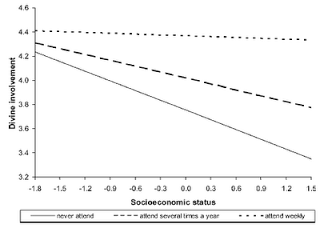 The figure shows how belief in divine involvement varies with socioeconomic status for three different groups: people who go to church weekly, those who go several times a year, and those who never go to church.
Look first at the right-hand side of the graph (where the rich people are). It shows what you might expect: people who go Church every week tend to believe in divine involvement, but people who never go to church are less likely to (but they still score fairly high).
Now look at people with low status, on the left. All of them have high levels of beliefs in divine involvement – even if they don’t go to Church!
The effect of that is that, among people who go to church weekly, levels of belief in divine involvement stay high as you move up the socio-economic scale. For people who never go to Church, these beliefs drop away as you progress upwards.
Schieman interprets this as evidence that going to church regularly can reinforce belief in divine involvement:
My observations … [contest] the view that SES is uniformly associated with lower levels of belief in divine involvement and control. The finding that high SES individuals tend to report similar levels of divine involvement and control as their low SES peers—when they share high levels of religious involvement—challenges the assertion that higher SES contributes to “demythologized beliefs” processes. In contrast, the results are more consistent with the view that exposure to messages and lessons in religious activities reinforces systems of “religious explanations”— especially doctrine about God’s involvement and causal relevance in everyday life.
What he’s saying is that the reason high status people don’t believe in a personal god is not because their education and wealth persuade them that such beliefs are wrong, but rather because they stop going to church. And when they stop going to church, their beliefs in a personal god are no longer reinforced.
He does also acknowledge that causality can work in the other direction (high status people who don’t believe in a personal god don’t go to church). However, after pondering this one quite a bit, I suspect he’s on to something.
After all, there are lots of reasons for a low status person to believe in a personal god, even if they don’t go to church. That’s fairly uncontroversial.
But you can well imagine that a high status person might have reasons to go to church, even if they don’t believe in a personal god. And yet, those that do go to church regularly do actually believe in a personal god.
Could it be that repeated exposure to an environment that promotes a particular ideology actually influences your beliefs, despite all the external factors that work to undermine them? It wouldn’t be the first time that had happened!
 Schieman, S. (2010). Socioeconomic Status and Beliefs about God’s Influence in Everyday Life Sociology of Religion, 71 (1), 25-51 DOI: 10.1093/socrel/srq004
 This article by Tom Rees was first published on Epiphenom. It is licensed under Creative Commons.
Previous Post

March 10, 2010
In Hastings tomorrow
Next Post
March 15, 2010 Altruism has 3 degrees of separation
Browse Our Archives
Select a Category Causes of religion - evolution Causes of religion - psychological Causes of religion - social Demographics Digest Effects of religion - health Effects of religion - psychological Effects of religion - social Notifications Politics Uncategorized
Select a Month March 2016 February 2016 January 2016 December 2015 November 2015 October 2015 September 2015 August 2015 July 2015 June 2015 May 2015 April 2015 March 2015 February 2015 January 2015 December 2014 November 2014 October 2014 September 2014 August 2014 July 2014 June 2014 May 2014 April 2014 March 2014 February 2014 January 2014 December 2013 November 2013 October 2013 September 2013 August 2013 July 2013 June 2013 May 2013 April 2013 March 2013 February 2013 January 2013 December 2012 November 2012 October 2012 September 2012 August 2012 July 2012 June 2012 May 2012 April 2012 March 2012 February 2012 January 2012 December 2011 November 2011 October 2011 September 2011 August 2011 July 2011 June 2011 May 2011 April 2011 March 2011 February 2011 January 2011 December 2010 November 2010 October 2010 September 2010 August 2010 July 2010 June 2010 May 2010 April 2010 March 2010 February 2010 January 2010 December 2009 November 2009 October 2009 September 2009 August 2009 July 2009 June 2009 May 2009 April 2009 March 2009 February 2009 January 2009 December 2008 November 2008 October 2008 September 2008 August 2008 July 2008 June 2008 May 2008 April 2008 March 2008 February 2008 January 2008 December 2007 November 2007 October 2007
Follow Us!
TAKE THE
Religious Wisdom Quiz
Who betrayed Jesus with a kiss?
Select your answer to see how you score.
Herod Peter Thomas Judas
Related posts from Epiphenom

Do social crises lead to religious revivals? Nah!

What kind of woman would pray for health...

Can you use religion to change attitudes towards...

Dogmatic atheism and fundamentalist Christianity: creating certainty in...
TRENDING AT PATHEOS Nonreligious

Dethroning Jesus and Enthroning Yourself
Jesus Never Asked to Be Worshipped. He Asked to Be Understood. Christianity...

Why Most Christians are Really Paulians and Jobians
I Don't Care, But It Matters Let's get this out of the...

Essential Tips to Successfully Navigate the Selling Process
Selling a house can feel overwhelming, but it doesn’t have to be....

To Make Remote Work Effective, Think About Others
The COVID-19 pandemic forced many companies to rapidly transition to remote work....

Flexibility Is Key to Solving Problems of Tomorrow
The world of work is undergoing a dramatic transformation. The COVID-19 pandemic...
view all Nonreligious blogs
Ad-Free & Subscriber Log-In Subscription Support
- About Us
- 2026 Calendar
- Videos
- Podcasts
- Library of World Religions
- Faith In Media Tracker
- Advertise With Us
- Write for Us
- Privacy Policy
- Terms of Service
- Do Not Sell My Data
- Contact Us
- Radiant Digital
- Manage Newsletter Subscriptions
- Unsubscribe From Notifications
- Sitemap
Copyright 2008-2026, Patheos. All rights reserved.
Subscription Support Ad-Free & Subscriber Log-In
Follow Patheos