
BuddhistCatholicContemplativeEvangelicalGeneral ChristianHinduJewishLatter-day SaintMuslimNew VisionsProgressive Christian
Beliefs
- Buddhist
- Catholic
- Contemplative
- Evangelical
- General Christian
- Hindu
- Jewish
- Latter-day Saint
- More Voices
- Muslim
- New Visions
- Pagan
- Progressive Christian
Topics
- Religion News
- Food and Religion
- Sports and Religion
- Religious Art
- Religious Music and Entertainment
- Religious Events
- History and Religion
- Style and Religion
- Politics and Religion
- Women in Religion
- Recreation Outdoors and Religion
- Business Finance and Religion
- Careers Workplace and Religion
- Education and Religion
- Family Parenting and Religion
- Health Fitness and Religion
- Home and Religion
- Relationships and Religion
- Technology and Religion
- Travel and Religion
Columnists
- Buddhist Columnists
- Business Finance and Religion Columnists
- Careers Workplace and Religion Columnists
- Catholic Columnists
- Contemplative Columnists
- Education and Religion Columnists
- Evangelists Columnists
- Family Parenting and Religion Columnists
- General Christian Columnists
- Health Fitness and Religion Columnists
- Hindu Columnists
- History and Religion Columnists
- Home and Religion Columnists
- Jewish Columnists
- More Voices Columnists
- Latter Day Columnists
- Muslim Columnists
- New Visions Columnists
- Nonreligious Columnists
- Pagan Columnists
- Politics and Religion Columnists
- Progressive Columnists
- Recreation Outdoors and Religion Columnists
- Relationships and Religion Columnists
- Religion News Columnists
- Religious Art Columnists
- Religious Events Columnists
- Religious Music and Entertainment Columnists
- Sports and Religion Columnists
- Style and Religion Columnists
- Technology and Religion Columnists
- Travel and Religion Columnists
- Women in Religion Columnists
Resource Library
- 2026 Calendar
- Library of World Religions
- The 100 Most Holy Places on Earth
- Patheos Answers
- Podcasts
- Videos
- Faith Leaders Database
- Anglican Episcopalian
- Bahai
- Baptist
- Buddhism
- Christianity
- Confucianism
- Eastern Orthodoxy
- Hinduism
- Holiness and Pentecostal
- ISKCON
- Islam
- Judaism
- Lutheran
- Methodist
- The Church of Jesus Christ of Latter-day Saints
- New Age
- Paganism
- Presbytarian and Reformed
- Protestantism
- Religion Behind the Scenes
- Roman Catholic
- Scientology
- Shia Islam
- Sikhism
- Sufism
- Sunni Islam
- Taoism
- Zen
- See all religions
Research Tools
 Ad-Free & Subscriber Log-In Subscription Support
Ad-Free & Subscriber Log-In Subscription Support
Follow Patheos 

- Trending:
- Forgiveness
- |
- Marriage
- |
- Consciousness
- |
- Death Penalty
- |
- Election
- |
- Halloween
 Epiphenom
- Home
- Nonreligious
- Atheism increases trust
Atheism increases trust
Last updated on: November 14, 2014 at 11:25 pm by Epiphenom
Atheism increases trust 2014-11-14T23:25:32+01:00 Epiphenom
Patheos Explore the world's faith through different perspectives on religion and spirituality! Patheos has the views of the prevalent religions and spiritualities of the world.
 In modern, industrialised societies, we put an awful lot of trust in strangers. That’s good, because if we couldn’t trust strangers then most of our economic and social transactions would struggle. In fact, trust is a cornerstone of economic growth.
It’s hardly surprising, then, that nations with high levels of trust are also the wealthiest. They also often have a high number of atheists – Sweden is the classic example.
But does atheism add to that trust, or take away from it? After all, atheists are (famously) one of the least trusted minorities in the USA.
Two Swedish researchers (Niclas Berggren and Christian Bjørnskov of the Ratio Institute in Stockholm) have looked at what role religion has in explaining different levels of trust in countries around the world, and in different States of the USA (Working paper only, available here).
The first thing they show is that non-religion and trust are correlated. In countries with more religious people, and in states with more religious people, fewer people are will to answer “yes” to the question “In general, do you think most people can be trusted or can’t you be too careful?”
Well, that’s interesting in itself, but of course there could be any number of reasons for that correlation. For example, income inequality erodes trust, and it also increases religiosity. Berggren and Bjørnskov take care of most of them by adding them into their model.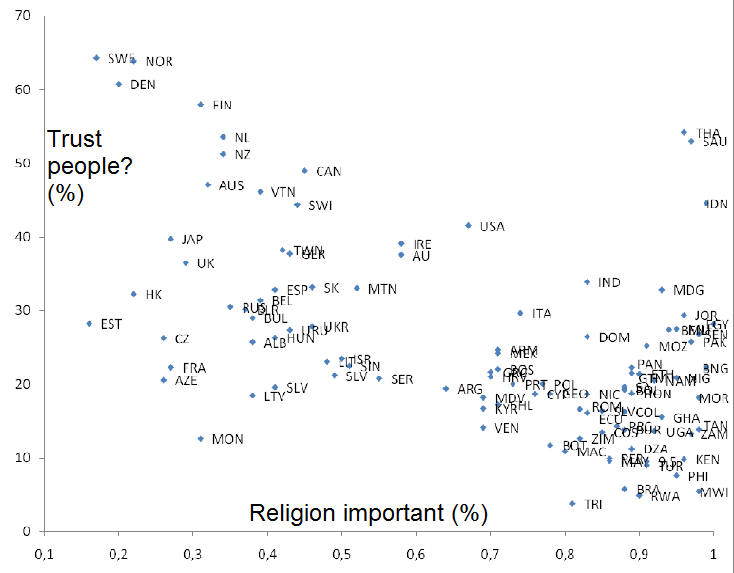 However, even after adjusting for income inequality, presence of a monarchy (increases trust, apparently), post-communism, and proportion of Muslims, Catholics or eastern religious people (none of the religions had any effect), the correlation remains pretty robust.
Just in case there’s something magic about Nordic countries, they even included them as an ‘explanatory factor’ (it turns out that there does indeed seem to be something special about them – it’s not just the atheism)
For the US states, they adjusted again for income inequality, blacks, and ages. They also took into account from which countries the local’s ancestors had emigrated. Again, the correlation stuck.
To give you a feel for how strong the effect is, if you go from the average nation religiosity (67% of people saying that religion is important in their lives) to Nordic levels (20%), the number of trusting people goes up by about 8-10 percentage points (and this is after adjusting for all the factors mentioned above).
Among US states, the effect is similar. If you move from the average (65%) to the least religious (Vermont, 42%), then trust increases by about 5-10 percentage points.
How did they demonstrate causality?
What they’ve shown is a correlation, of course. So how can they be confident that it’s atheism increasing trust, rather than trust increasing atheism? Well, they use a statistical trick (guess I have to be careful with that word, given the climate email controversy!) call ‘instrumented variables’. Basically, this means choosing another variable that correlates with religion but can’t directly be influenced by trust.
They chose GDP which might seems strange choice given that trust is an important cause of economic growth. However, they show that the other factors included in the model account for this relationship, and that GDP is independent of reverse causality.
How could more religion mean less trust?
It seems strange, given that religion is supposed to increase honest behaviour, that people in less religious countries have more trust in their neighbours. Berggren and Bjørnskov argue that this is probably because of the divisive effect that religion can have:
The main reason to expect a negative effect, of the kind we have identified, is that religions may cause division and rift, both in that religious people may distrust those who do not share their beliefs and who are not subject to the same enforcement mechanisms as they are, and in that nonreligious people may regard with suspicion those who take religiosity seriously.
In other words, one explanation for these results might that religion promotes distrust of people outside the group. It sounds intuitively plausible, and it’s an idea that’s supported by other the research into the causes of distrust.
While you might expect that people distrust anyone who’s different from them, it turns out that that is not the case. Diversity only increases distrust when the different groups are segregated from each other. This is from a talk by Eric Uslaner, at the University of Maryland:
… diversity can also drive people apart–when people feel threatened by minority groups. Most critically, diversity can drive down trust when there is little opportunity for contact between groups groups–as where the minority group is geographically segregated from the majority.
However, Uslaner also points out that religious diversity does not itself seem to greatly increase distrust. It’s the strength of religious feeling that’s critically important:
Religious fractionalization is only weakly related to ethnic and linguistic diversity. Religious fundamentalists are significantly less trusting than adherents of mainstream religions (Uslaner, 2002, ch. 4) and religious conflict is at the heart of many inter-state and intra-state wars. So we might expect that religious diversity would be more strongly (negatively) related to generalized trust–but again, we see only a weak relationship.
Now, the interesting thing about religious diversity is that it actually decreases the level of religious fervour. If religious fervour is critical to distrust, that would help explain the unexpectedly weak relationship between religious diversity and trust.
Well, so much for the philosophizing. What we need now is for someone to tease out these two factors to see which explains the link between atheism and trust.
__________________________________________________________________________
 This article by Tom Rees was first published on Epiphenom. It is licensed under Creative Commons.
Previous Post

December 11, 2009
Live blogging the NSRN
Next Post
December 18, 2009 Religion continues to decline in the UK
Browse Our Archives
Select a Category Causes of religion - evolution Causes of religion - psychological Causes of religion - social Demographics Digest Effects of religion - health Effects of religion - psychological Effects of religion - social Notifications Politics Uncategorized
Select a Month March 2016 February 2016 January 2016 December 2015 November 2015 October 2015 September 2015 August 2015 July 2015 June 2015 May 2015 April 2015 March 2015 February 2015 January 2015 December 2014 November 2014 October 2014 September 2014 August 2014 July 2014 June 2014 May 2014 April 2014 March 2014 February 2014 January 2014 December 2013 November 2013 October 2013 September 2013 August 2013 July 2013 June 2013 May 2013 April 2013 March 2013 February 2013 January 2013 December 2012 November 2012 October 2012 September 2012 August 2012 July 2012 June 2012 May 2012 April 2012 March 2012 February 2012 January 2012 December 2011 November 2011 October 2011 September 2011 August 2011 July 2011 June 2011 May 2011 April 2011 March 2011 February 2011 January 2011 December 2010 November 2010 October 2010 September 2010 August 2010 July 2010 June 2010 May 2010 April 2010 March 2010 February 2010 January 2010 December 2009 November 2009 October 2009 September 2009 August 2009 July 2009 June 2009 May 2009 April 2009 March 2009 February 2009 January 2009 December 2008 November 2008 October 2008 September 2008 August 2008 July 2008 June 2008 May 2008 April 2008 March 2008 February 2008 January 2008 December 2007 November 2007 October 2007
Follow Us!
TAKE THE
Religious Wisdom Quiz
"I am the Alpha and the Omega, the ____ and the End,” says the Lord God.
Select your answer to see how you score.
Truth Light Beginning Eternal
Related posts from Epiphenom

Do social crises lead to religious revivals? Nah!

What kind of woman would pray for health...

Can you use religion to change attitudes towards...

Dogmatic atheism and fundamentalist Christianity: creating certainty in...
TRENDING AT PATHEOS Nonreligious

Dethroning Jesus and Enthroning Yourself
Jesus Never Asked to Be Worshipped. He Asked to Be Understood. Christianity...

Why Most Christians are Really Paulians and Jobians
I Don't Care, But It Matters Let's get this out of the...

Essential Tips to Successfully Navigate the Selling Process
Selling a house can feel overwhelming, but it doesn’t have to be....

To Make Remote Work Effective, Think About Others
The COVID-19 pandemic forced many companies to rapidly transition to remote work....

Flexibility Is Key to Solving Problems of Tomorrow
The world of work is undergoing a dramatic transformation. The COVID-19 pandemic...
view all Nonreligious blogs
Ad-Free & Subscriber Log-In Subscription Support
- About Us
- 2026 Calendar
- Videos
- Podcasts
- Library of World Religions
- Faith In Media Tracker
- Advertise With Us
- Write for Us
- Privacy Policy
- Terms of Service
- Do Not Sell My Data
- Contact Us
- Radiant Digital
- Manage Newsletter Subscriptions
- Unsubscribe From Notifications
- Sitemap
Copyright 2008-2026, Patheos. All rights reserved.
Subscription Support Ad-Free & Subscriber Log-In
Follow Patheos