
BuddhistCatholicContemplativeEvangelicalGeneral ChristianHinduJewishLatter-day SaintMuslimNew VisionsProgressive Christian
Beliefs
- Buddhist
- Catholic
- Contemplative
- Evangelical
- General Christian
- Hindu
- Jewish
- Latter-day Saint
- More Voices
- Muslim
- New Visions
- Pagan
- Progressive Christian
Topics
- Religion News
- Food and Religion
- Sports and Religion
- Religious Art
- Religious Music and Entertainment
- Religious Events
- History and Religion
- Style and Religion
- Politics and Religion
- Women in Religion
- Recreation Outdoors and Religion
- Business Finance and Religion
- Careers Workplace and Religion
- Education and Religion
- Family Parenting and Religion
- Health Fitness and Religion
- Home and Religion
- Relationships and Religion
- Technology and Religion
- Travel and Religion
Columnists
- Buddhist Columnists
- Business Finance and Religion Columnists
- Careers Workplace and Religion Columnists
- Catholic Columnists
- Contemplative Columnists
- Education and Religion Columnists
- Evangelists Columnists
- Family Parenting and Religion Columnists
- General Christian Columnists
- Health Fitness and Religion Columnists
- Hindu Columnists
- History and Religion Columnists
- Home and Religion Columnists
- Jewish Columnists
- More Voices Columnists
- Latter Day Columnists
- Muslim Columnists
- New Visions Columnists
- Nonreligious Columnists
- Pagan Columnists
- Politics and Religion Columnists
- Progressive Columnists
- Recreation Outdoors and Religion Columnists
- Relationships and Religion Columnists
- Religion News Columnists
- Religious Art Columnists
- Religious Events Columnists
- Religious Music and Entertainment Columnists
- Sports and Religion Columnists
- Style and Religion Columnists
- Technology and Religion Columnists
- Travel and Religion Columnists
- Women in Religion Columnists
Resource Library
- 2026 Calendar
- Library of World Religions
- The 100 Most Holy Places on Earth
- Patheos Answers
- Podcasts
- Videos
- Faith Leaders Database
- Anglican Episcopalian
- Bahai
- Baptist
- Buddhism
- Christianity
- Confucianism
- Eastern Orthodoxy
- Hinduism
- Holiness and Pentecostal
- ISKCON
- Islam
- Judaism
- Lutheran
- Methodist
- The Church of Jesus Christ of Latter-day Saints
- New Age
- Paganism
- Presbytarian and Reformed
- Protestantism
- Religion Behind the Scenes
- Roman Catholic
- Scientology
- Shia Islam
- Sikhism
- Sufism
- Sunni Islam
- Taoism
- Zen
- See all religions
Research Tools
 Ad-Free & Subscriber Log-In Subscription Support
Ad-Free & Subscriber Log-In Subscription Support
Follow Patheos 

- Trending:
- Forgiveness
- |
- Marriage
- |
- Consciousness
- |
- Death Penalty
- |
- Election
- |
- Halloween
 Epiphenom
- Home
- Nonreligious
- Why religious communes succeed and secular ones fail
Why religious communes succeed and secular ones fail
Last updated on: November 13, 2014 at 6:02 pm by Epiphenom
Why religious communes succeed and secular ones fail 2014-11-13T18:02:28+01:00 Epiphenom
Patheos Explore the world's faith through different perspectives on religion and spirituality! Patheos has the views of the prevalent religions and spiritualities of the world.
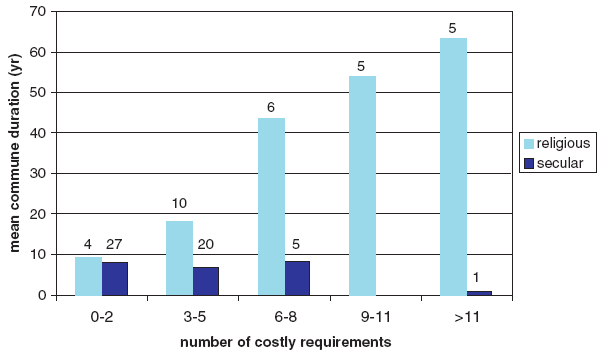 Here’s an interesting graph. It’s from a study comparing religious and secular communes in 19th century USA. Michael was talking about this study in the comments so I thought it would be nice to show the data and talk it through.
It looks at how long each commune lasted, and compares it with the onerous commitments (everything from giving up certain kinds of food, to abstaining from sex, to cutting ties with the outside world) that each commune demanded from its members.
There’s two things to notice here. First, the religious communes lasted a lot longer than the secular ones. Second, the more ‘costly requirements’ imposed, the longer the commune lasted – but only for religious communes, not secular ones.
What’s going on here? Well, the idea is that the ‘costly requirements’ allow potential members to send a signal. If you are prepared to put up with all the arbitrary rules that make your life difficult, then that’s good evidence that you really, really want to be part of the group. It’s a classic ‘costly signal’.
So why doesn’t it work for secular communes? Sosis argues that religious rituals are more powerful, because of the supernatural connection (p230):
Thus, it appears that the relative success of religious communes is a result of religious rituals and constraints being imbued with sanctity, whereas the rituals and constraints of secular communes are not consecrated. As Rappaport (1971) stated, “to invest social conventions with sanctity is to hide their arbitrariness in a cloak of seeming necessity”
I think that’s part of the explanation. A costly commitment has to be justified if people are going to accept it as a price of group membership. For religious communes, it’s fairly straightforward. You can argue it’s what the god demands – and who can prove otherwise?
For secular communes, there has to be a ‘real world’ justification. If you are going to ask people to hand over their possessions, you’d better have thought through your rationalization pretty well.
You can see this in Sosis’ data. 90% of secular communes have five or fewer costly commitments, whereas half of religious communes have six or more. Secularists simply aren’t attracted to this kind of mentality. It’s a tough sell.
But I also think there’s something else going on here. For people to join a group and stay in it, they have to get something out of it. Crucially, they have to get more out of it than they put in.
For the religious, there’s a lot to gain from being in a religious commune. Typically, they might feel that they’ll be rewarded by their god in this life or the next. And, arguably, the stricter the group the more rewards they might feel they’re going to get.
For the secular, all rewards are solely in the material realm (I don’t mean possessions, I mean rewards like being among friends you can trust). And the potential payoff from group membership has to be greater than the costs of membership.
After all, that’s the whole point of costly signalling. It acts to screen out people who aren’t really committed to the group. For the secular, there just isn’t very much point to being a commune member. It’s a religious idea, which has been taken up by idealistic secularists only for them to see their vision fail.
_______________________________________________________________________________________
Sosis, R., & Bressler, E. (2003). Cooperation and Commune Longevity: A Test of the Costly Signaling Theory of Religion Cross-Cultural Research, 37 (2), 211-239 DOI: 10.1177/1069397103037002003
 This work by Tom Rees is licensed under a Creative Commons Attribution-Share Alike 2.0 UK: England & Wales License.
Previous Post

September 25, 2009
Religion as a costly signal: why the idea is bunk
Browse Our Archives
Select a Category Causes of religion - evolution Causes of religion - psychological Causes of religion - social Demographics Digest Effects of religion - health Effects of religion - psychological Effects of religion - social Notifications Politics Uncategorized
Select a Month March 2016 February 2016 January 2016 December 2015 November 2015 October 2015 September 2015 August 2015 July 2015 June 2015 May 2015 April 2015 March 2015 February 2015 January 2015 December 2014 November 2014 October 2014 September 2014 August 2014 July 2014 June 2014 May 2014 April 2014 March 2014 February 2014 January 2014 December 2013 November 2013 October 2013 September 2013 August 2013 July 2013 June 2013 May 2013 April 2013 March 2013 February 2013 January 2013 December 2012 November 2012 October 2012 September 2012 August 2012 July 2012 June 2012 May 2012 April 2012 March 2012 February 2012 January 2012 December 2011 November 2011 October 2011 September 2011 August 2011 July 2011 June 2011 May 2011 April 2011 March 2011 February 2011 January 2011 December 2010 November 2010 October 2010 September 2010 August 2010 July 2010 June 2010 May 2010 April 2010 March 2010 February 2010 January 2010 December 2009 November 2009 October 2009 September 2009 August 2009 July 2009 June 2009 May 2009 April 2009 March 2009 February 2009 January 2009 December 2008 November 2008 October 2008 September 2008 August 2008 July 2008 June 2008 May 2008 April 2008 March 2008 February 2008 January 2008 December 2007 November 2007 October 2007
Follow Us!
TAKE THE
Religious Wisdom Quiz
Who said, "As for me, I know that my redeemer lives"?
Select your answer to see how you score.
Moses Abraham Job Joseph
Related posts from Epiphenom

Do social crises lead to religious revivals? Nah!

What kind of woman would pray for health...

Can you use religion to change attitudes towards...

Dogmatic atheism and fundamentalist Christianity: creating certainty in...
TRENDING AT PATHEOS Nonreligious

Dethroning Jesus and Enthroning Yourself
Jesus Never Asked to Be Worshipped. He Asked to Be Understood. Christianity...

Why Most Christians are Really Paulians and Jobians
I Don't Care, But It Matters Let's get this out of the...

Essential Tips to Successfully Navigate the Selling Process
Selling a house can feel overwhelming, but it doesn’t have to be....

To Make Remote Work Effective, Think About Others
The COVID-19 pandemic forced many companies to rapidly transition to remote work....

Flexibility Is Key to Solving Problems of Tomorrow
The world of work is undergoing a dramatic transformation. The COVID-19 pandemic...
view all Nonreligious blogs
Ad-Free & Subscriber Log-In Subscription Support
- About Us
- 2026 Calendar
- Videos
- Podcasts
- Library of World Religions
- Faith In Media Tracker
- Advertise With Us
- Write for Us
- Privacy Policy
- Terms of Service
- Do Not Sell My Data
- Contact Us
- Radiant Digital
- Manage Newsletter Subscriptions
- Unsubscribe From Notifications
- Sitemap
Copyright 2008-2026, Patheos. All rights reserved.
Subscription Support Ad-Free & Subscriber Log-In
Follow Patheos