
BuddhistCatholicContemplativeEvangelicalGeneral ChristianHinduJewishLatter-day SaintMuslimNew VisionsProgressive Christian
Beliefs
- Buddhist
- Catholic
- Contemplative
- Evangelical
- General Christian
- Hindu
- Jewish
- Latter-day Saint
- More Voices
- Muslim
- New Visions
- Pagan
- Progressive Christian
Topics
- Religion News
- Food and Religion
- Sports and Religion
- Religious Art
- Religious Music and Entertainment
- Religious Events
- History and Religion
- Style and Religion
- Politics and Religion
- Women in Religion
- Recreation Outdoors and Religion
- Business Finance and Religion
- Careers Workplace and Religion
- Education and Religion
- Family Parenting and Religion
- Health Fitness and Religion
- Home and Religion
- Relationships and Religion
- Technology and Religion
- Travel and Religion
Columnists
- Buddhist Columnists
- Business Finance and Religion Columnists
- Careers Workplace and Religion Columnists
- Catholic Columnists
- Contemplative Columnists
- Education and Religion Columnists
- Evangelists Columnists
- Family Parenting and Religion Columnists
- General Christian Columnists
- Health Fitness and Religion Columnists
- Hindu Columnists
- History and Religion Columnists
- Home and Religion Columnists
- Jewish Columnists
- More Voices Columnists
- Latter Day Columnists
- Muslim Columnists
- New Visions Columnists
- Nonreligious Columnists
- Pagan Columnists
- Politics and Religion Columnists
- Progressive Columnists
- Recreation Outdoors and Religion Columnists
- Relationships and Religion Columnists
- Religion News Columnists
- Religious Art Columnists
- Religious Events Columnists
- Religious Music and Entertainment Columnists
- Sports and Religion Columnists
- Style and Religion Columnists
- Technology and Religion Columnists
- Travel and Religion Columnists
- Women in Religion Columnists
Resource Library
- 2026 Calendar
- Library of World Religions
- The 100 Most Holy Places on Earth
- Patheos Answers
- Podcasts
- Videos
- Faith Leaders Database
- Anglican Episcopalian
- Bahai
- Baptist
- Buddhism
- Christianity
- Confucianism
- Eastern Orthodoxy
- Hinduism
- Holiness and Pentecostal
- ISKCON
- Islam
- Judaism
- Lutheran
- Methodist
- The Church of Jesus Christ of Latter-day Saints
- New Age
- Paganism
- Presbytarian and Reformed
- Protestantism
- Religion Behind the Scenes
- Roman Catholic
- Scientology
- Shia Islam
- Sikhism
- Sufism
- Sunni Islam
- Taoism
- Zen
- See all religions
Research Tools
 Ad-Free & Subscriber Log-In Subscription Support
Ad-Free & Subscriber Log-In Subscription Support
Follow Patheos 

- Trending:
- Forgiveness
- |
- Marriage
- |
- Consciousness
- |
- Death Penalty
- |
- Election
- |
- Halloween
 Epiphenom
- Home
- Nonreligious
- Why are atheists so disliked?
Why are atheists so disliked?
Last updated on: November 22, 2014 at 1:01 am by Epiphenom
Why are atheists so disliked? 2014-11-22T01:01:35+01:00 Epiphenom
Patheos Explore the world's faith through different perspectives on religion and spirituality! Patheos has the views of the prevalent religions and spiritualities of the world.
Bruce Hood has a post up about the atheist bus ad controversy in the US state of Iowa (OK, it was a couple of weeks ago, but I’ve been away…). What caught my eye was a comment by Konrad:
The thing that got me was the governor of the state saying that he found the ad disturbing. Clearly, people seem to treat religious adherence as symbolic of group identity so that they find the idea of atheists in their midst as threatening as that of enemy spies.
The hostile reaction to what was a pretty innocuous ad certainly is extraordinary. But is group identity – and the distrust of non-group members, really the cause of it?
Some intriguing hints come in a masters thesis by Will Gervais, a student at the University of British Columbia (I took it with me on vacation for some pool-side reading!). In it he describes a series of three experiments in anti-atheist prejudice among fellow students.
The first was an implicit association task. What this found is that religious people have a fairly deep-seated conception of atheists as unpleasant and untrustworthy – but it was the lack of trust that came through strongest.
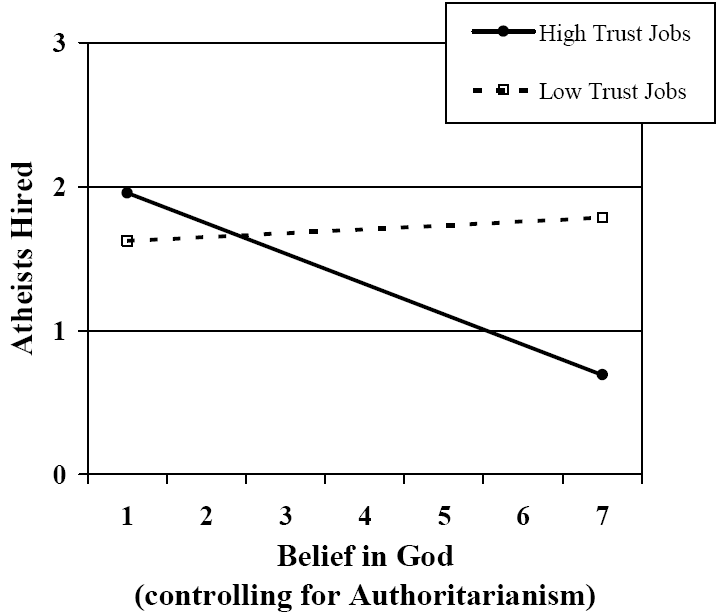
The second explored the idea of trust further, by exploring how religiosity affects willingness to hire atheists.
It turns out that it depends on the kind of job. Religious people were quite prepared to hire atheists for jobs that don’t require require particularly trustworthy people. But they weren’t prepared to hire atheists for high trust jobs.
Religious people didn’t show this bias when the jobs were split into those that do or do not require pleasant people, or when the jobs were split according to the required degree of intelligence.
These two experiments show that the primary driver for religious hostility to atheists is specifically a lack of trust, rather than a belief that they’re more generally unpleasant. But it doesn’t explain why they have this level of distrust.
It could be in-group favouritism. Trust is the classic victim of group divisions, and so if the religious see atheists as an alien group then you would expect them to be distrustful.
However, Gervais argues that this might not be the whole story, for several reasons. Firstly, there was no evidence that atheists distrusted the religious, which you would expect if this were a standard case of distrust between groups.
Also, it’s not at all clear that ‘atheists’ are seen to be a group. Although the ‘religious’ are also highly diverse, by and large they all subscribe to some doctrine that defines them as group members (of one religion or another). Atheists, by definition, have no such common ground that make them an identifiable group.
What’s more, open atheists are a tiny minority in North America. Normally, between-group hostility is proportional to the size of the group. The hostility towards atheists seems to be, quite literally, out of all proportion.
It might be that distrust of atheists is driven, or at least augmented, by fears that non-belief in a punishing god will lead atheists to behave dishonestly. That’s certainly what a lot of evangelical Christians believe (and cognitive psychologists, for that matter).
But what about the third experiment? Here’s where it gets rather interesting. In the third experiment, Gervais gave the subjects one of three passages to read and react to – one on food, an excerpt from The God Delusion in which Dawkins argues that belief is nonsensical, and a passage detailing the increasing numbers of atheists in the USA in recent decades. This last passage included the crucial fact that at least 20% of Americans aged 18-25 are atheists.
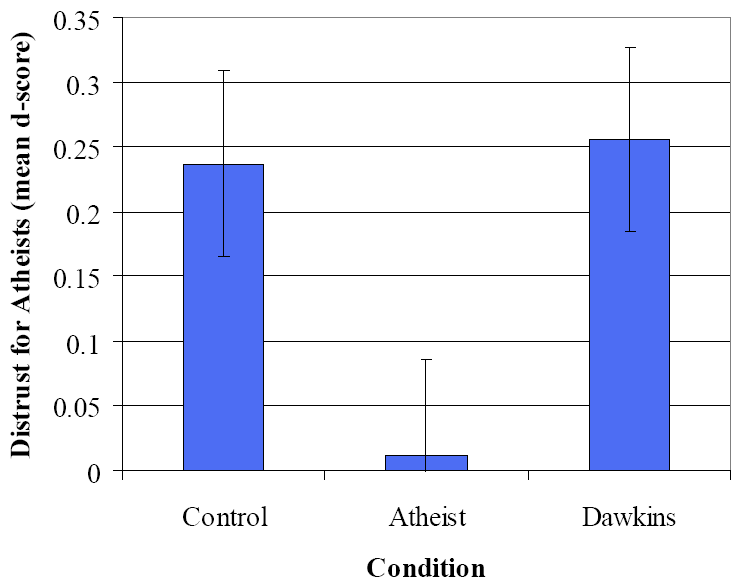
For the religious, reading that atheism was rather more common than they previously believed had a remarkable effect. It effectively abolished their distrust of atheists.
To me, this result strongly suggests that distrust of atheists is mostly due to fear of ‘others’. It suggests that the main reason for the distrust is that the subjects had not realised that many of their fellow students were, in fact, atheists.
Once they learned that atheists were not a weird, alien group, but rather people just like them, they felt able to trust them. And I think this conclusion is supported by the experience of atheists in places like the UK, where overt atheism is much more prevalent and distrust of atheists is correspondingly lower.
There are two lessons here. First, it suggest that theories that religion evolved as a tool to enforce in-group trust may be wrong.
Second, it suggests that all those bus ads may well be serving a useful function, even if they’re unlikely to convert anyone. If they normalise atheism, then they should also help to change the lot of atheists in the USA from social pariahs to trusted community members.
By the way, if you’re interested in group cohesion, you might be interested in an earlier post on The Hand Grenade Experiment.
_____________________________________________________________________________________
 This work by Tom Rees is licensed under a Creative Commons Attribution-Share Alike 2.0 UK: England & Wales License.
Previous Post

August 23, 2009
Is the Social Function of Religion Changing?
Next Post
September 5, 2009 By their faces you will recognize them
Browse Our Archives
Select a Category Causes of religion - evolution Causes of religion - psychological Causes of religion - social Demographics Digest Effects of religion - health Effects of religion - psychological Effects of religion - social Notifications Politics Uncategorized
Select a Month March 2016 February 2016 January 2016 December 2015 November 2015 October 2015 September 2015 August 2015 July 2015 June 2015 May 2015 April 2015 March 2015 February 2015 January 2015 December 2014 November 2014 October 2014 September 2014 August 2014 July 2014 June 2014 May 2014 April 2014 March 2014 February 2014 January 2014 December 2013 November 2013 October 2013 September 2013 August 2013 July 2013 June 2013 May 2013 April 2013 March 2013 February 2013 January 2013 December 2012 November 2012 October 2012 September 2012 August 2012 July 2012 June 2012 May 2012 April 2012 March 2012 February 2012 January 2012 December 2011 November 2011 October 2011 September 2011 August 2011 July 2011 June 2011 May 2011 April 2011 March 2011 February 2011 January 2011 December 2010 November 2010 October 2010 September 2010 August 2010 July 2010 June 2010 May 2010 April 2010 March 2010 February 2010 January 2010 December 2009 November 2009 October 2009 September 2009 August 2009 July 2009 June 2009 May 2009 April 2009 March 2009 February 2009 January 2009 December 2008 November 2008 October 2008 September 2008 August 2008 July 2008 June 2008 May 2008 April 2008 March 2008 February 2008 January 2008 December 2007 November 2007 October 2007
Follow Us!
TAKE THE
Religious Wisdom Quiz
What did Esther risk by approaching the king without being summoned?
Select your answer to see how you score.
Her reputation Her life Her citizenship Her fortune
Related posts from Epiphenom

Do social crises lead to religious revivals? Nah!

What kind of woman would pray for health...

Can you use religion to change attitudes towards...

Dogmatic atheism and fundamentalist Christianity: creating certainty in...
TRENDING AT PATHEOS Nonreligious

Dethroning Jesus and Enthroning Yourself
Jesus Never Asked to Be Worshipped. He Asked to Be Understood. Christianity...

Why Most Christians are Really Paulians and Jobians
I Don't Care, But It Matters Let's get this out of the...

Essential Tips to Successfully Navigate the Selling Process
Selling a house can feel overwhelming, but it doesn’t have to be....

To Make Remote Work Effective, Think About Others
The COVID-19 pandemic forced many companies to rapidly transition to remote work....

Flexibility Is Key to Solving Problems of Tomorrow
The world of work is undergoing a dramatic transformation. The COVID-19 pandemic...
view all Nonreligious blogs
Ad-Free & Subscriber Log-In Subscription Support
- About Us
- 2026 Calendar
- Videos
- Podcasts
- Library of World Religions
- Faith In Media Tracker
- Advertise With Us
- Write for Us
- Privacy Policy
- Terms of Service
- Do Not Sell My Data
- Contact Us
- Radiant Digital
- Manage Newsletter Subscriptions
- Unsubscribe From Notifications
- Sitemap
Copyright 2008-2026, Patheos. All rights reserved.
Subscription Support Ad-Free & Subscriber Log-In
Follow Patheos