
BuddhistCatholicContemplativeEvangelicalGeneral ChristianHinduJewishLatter-day SaintMuslimNew VisionsProgressive Christian
Beliefs
- Buddhist
- Catholic
- Contemplative
- Evangelical
- General Christian
- Hindu
- Jewish
- Latter-day Saint
- More Voices
- Muslim
- New Visions
- Pagan
- Progressive Christian
Topics
- Religion News
- Food and Religion
- Sports and Religion
- Religious Art
- Religious Music and Entertainment
- Religious Events
- History and Religion
- Style and Religion
- Politics and Religion
- Women in Religion
- Recreation Outdoors and Religion
- Business Finance and Religion
- Careers Workplace and Religion
- Education and Religion
- Family Parenting and Religion
- Health Fitness and Religion
- Home and Religion
- Relationships and Religion
- Technology and Religion
- Travel and Religion
Columnists
- Buddhist Columnists
- Business Finance and Religion Columnists
- Careers Workplace and Religion Columnists
- Catholic Columnists
- Contemplative Columnists
- Education and Religion Columnists
- Evangelists Columnists
- Family Parenting and Religion Columnists
- General Christian Columnists
- Health Fitness and Religion Columnists
- Hindu Columnists
- History and Religion Columnists
- Home and Religion Columnists
- Jewish Columnists
- More Voices Columnists
- Latter Day Columnists
- Muslim Columnists
- New Visions Columnists
- Nonreligious Columnists
- Pagan Columnists
- Politics and Religion Columnists
- Progressive Columnists
- Recreation Outdoors and Religion Columnists
- Relationships and Religion Columnists
- Religion News Columnists
- Religious Art Columnists
- Religious Events Columnists
- Religious Music and Entertainment Columnists
- Sports and Religion Columnists
- Style and Religion Columnists
- Technology and Religion Columnists
- Travel and Religion Columnists
- Women in Religion Columnists
Resource Library
- 2026 Calendar
- Library of World Religions
- The 100 Most Holy Places on Earth
- Patheos Answers
- Podcasts
- Videos
- Faith Leaders Database
- Anglican Episcopalian
- Bahai
- Baptist
- Buddhism
- Christianity
- Confucianism
- Eastern Orthodoxy
- Hinduism
- Holiness and Pentecostal
- ISKCON
- Islam
- Judaism
- Lutheran
- Methodist
- The Church of Jesus Christ of Latter-day Saints
- New Age
- Paganism
- Presbytarian and Reformed
- Protestantism
- Religion Behind the Scenes
- Roman Catholic
- Scientology
- Shia Islam
- Sikhism
- Sufism
- Sunni Islam
- Taoism
- Zen
- See all religions
Research Tools
 Ad-Free & Subscriber Log-In Subscription Support
Ad-Free & Subscriber Log-In Subscription Support
Follow Patheos 

- Trending:
- Forgiveness
- |
- Marriage
- |
- Consciousness
- |
- Death Penalty
- |
- Election
- |
- Halloween
 Epiphenom
- Home
- Nonreligious
- Why some countries are more religious than others
Why some countries are more religious than others
Last updated on: March 29, 2015 at 10:03 pm by Epiphenom
Why some countries are more religious than others 2015-03-29T22:03:23+01:00 Epiphenom
Patheos Explore the world's faith through different perspectives on religion and spirituality! Patheos has the views of the prevalent religions and spiritualities of the world.
After nearly two years of blogging on other people’s peer-reviewed studies, it’s a refreshing change to now be blogging on one of my own! My paper, Is Personal Insecurity a Cause of Cross-National Differences in the Intensity of Religious Belief?, is now out in the Journal of Religion and Society (pdf).
The paper is a statistical analysis of the causes of religiosity at a national level (in other words, the core characteristics of a country that help to explain how religious its population is). The motivation for this was triggered by a couple of conundrums.
Firstly, studies done looking at people within a single country generally conclude that religious people are more pro-social. But back in 2005, Gregory S Paul published a study which seemed to show that, at the national level, the opposite happens. The more religious a country is, the worse is its ‘Societal Health’.
Secondly, although it’s commonly assumed (at least by atheists) that increasing wealth and all that goes with it (science, education, communication) is gradually eroding religion, there are some glaring anomalies. The most spectacular is the USA, which is both one of the wealthiest large nations and also one of the most religious.
Could these two be connected? They would be if societal ill health is an important factor in making people more religious, and if wealthy nations are not equally effective in improving the lot of their citizens.
There were some intriguing hints already out there. As I explained in an earlier post, it was already known that nations with higher welfare spending and lower income inequality were less religious.
So I set out to test whether this idea really could compete with the conventional theories on why nations differ in their religiosity. Here’s the two hypotheses that the paper tests:
- Are the worst societies really more religious? And if so, is income inequality a thread that ties together the markers of societal health? If it does, then income inequality can be used as a kind of overall measure of societal health in the next step of the analysis.
- The second step was to work out how important income inequality is as an cause of religiosity, compared with the standard theories.
I should explain here that by religiosity I mean the intensity of beliefs, as measured by how often people pray, rather than how often they go to church or anything else. Religion is a complicated, multifaceted beast. So results that hold for one measure (frequency of prayer) might not hold for another.
Worse societies are more religious
I pulled together data on frequency of prayer from over 50 countries, and found that countries where people prayed more frequently had lower life expectancy and scored lower on the Peace Index. They also had higher infant mortality, homicide rates, and levels of corruption, and had more AIDS and more abortion. That’s pretty conclusive.
What’s more, countries with worse societal health also had more income inequality. In fact, the relationship between income inequality and societal health was similar to that between religiosity and societal health. Income inequality can indeed serve as a ‘barometer’ of overall societal health, as it relates to religiosity.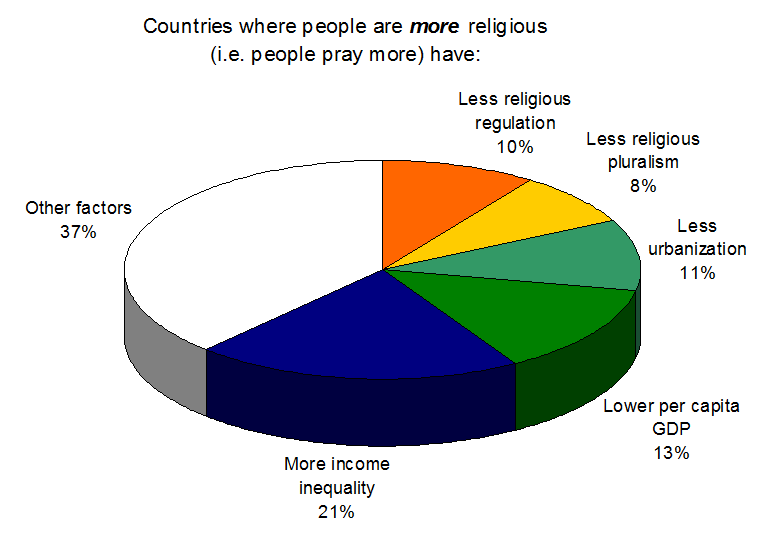
The next step was to compare the importance of income inequality as a cause of religiosity with the standard theories of why some countries are less religious. These are modernization (as measured by per capita GDP and urbanization) and regulation (both governmental and social pressures on the free expression of religious beliefs, as well as religious pluralism).
The pie chart shows the relative importance of these factors in explaining country differences in religiosity. As you can see, both modernization and societal health (income inequality) are powerful, whereas regulation is less so. Overall, about 60% of the variation between countries is explained.
 How does this map out? Well, using this model you can plot the predicted level of religiosity, based on just 5 key factors (income inequality, GDP, urbanization, religious pluralism, and government regulation) against the actual levels.
It does a pretty good job. Across a wide variety of national cultures, from the Far East to sub-Saharan Africa to Europe, most countries have pretty much the same level of religion as the model predicts. The USA is still a bit of an outlier, but that’s a topic for another post!
The take home is this. The standard theories of religion seem to work. The more you regulate religion, the more you turn people off it. The more you modernize the country, the more people abandon religion.
But there is a key missing ingredient that helps to explain why these standard theories are incomplete. And that missing ingredient is societal health.
Nations have choices over how to look after the people at the bottom of the social pile. Those nations that choose to make this a priority, which inevitably involves shifting money and resource from the rich to the poor, lower the overall levels of stress. And when you remove the stress caused by their social situation, people tend to lose interest in religion.
_______________________________________________________________________________________

Rees, TJ (2009). Is Personal Insecurity a Cause of Cross-National Differences in the Intensity of Religious Belief? Journal of Religion and Society, 11
 This work by Tom Rees is licensed under a Creative Commons Attribution-Share Alike 2.0 UK: England & Wales License.
Previous Post

July 6, 2009
Religious bidders more motivated by competition than charity
Next Post
July 11, 2009 Are American scientists getting more religious?
Browse Our Archives
Select a Category Causes of religion - evolution Causes of religion - psychological Causes of religion - social Demographics Digest Effects of religion - health Effects of religion - psychological Effects of religion - social Notifications Politics Uncategorized
Select a Month March 2016 February 2016 January 2016 December 2015 November 2015 October 2015 September 2015 August 2015 July 2015 June 2015 May 2015 April 2015 March 2015 February 2015 January 2015 December 2014 November 2014 October 2014 September 2014 August 2014 July 2014 June 2014 May 2014 April 2014 March 2014 February 2014 January 2014 December 2013 November 2013 October 2013 September 2013 August 2013 July 2013 June 2013 May 2013 April 2013 March 2013 February 2013 January 2013 December 2012 November 2012 October 2012 September 2012 August 2012 July 2012 June 2012 May 2012 April 2012 March 2012 February 2012 January 2012 December 2011 November 2011 October 2011 September 2011 August 2011 July 2011 June 2011 May 2011 April 2011 March 2011 February 2011 January 2011 December 2010 November 2010 October 2010 September 2010 August 2010 July 2010 June 2010 May 2010 April 2010 March 2010 February 2010 January 2010 December 2009 November 2009 October 2009 September 2009 August 2009 July 2009 June 2009 May 2009 April 2009 March 2009 February 2009 January 2009 December 2008 November 2008 October 2008 September 2008 August 2008 July 2008 June 2008 May 2008 April 2008 March 2008 February 2008 January 2008 December 2007 November 2007 October 2007
Follow Us!
TAKE THE
Religious Wisdom Quiz
What is the meaning of "Golgotha," the place of Jesus' crucifixion?
Select your answer to see how you score.
Place of the Skull Place of Tears Valley of Death House of Sorrows
Related posts from Epiphenom

Do social crises lead to religious revivals? Nah!

America is finally losing its religion - and...
Surprisingly, belief that God is in control increases...

Churchgoing has been on the decline for decades...
TRENDING AT PATHEOS Nonreligious

Dethroning Jesus and Enthroning Yourself
Jesus Never Asked to Be Worshipped. He Asked to Be Understood. Christianity...

Why Most Christians are Really Paulians and Jobians
I Don't Care, But It Matters Let's get this out of the...

Essential Tips to Successfully Navigate the Selling Process
Selling a house can feel overwhelming, but it doesn’t have to be....

To Make Remote Work Effective, Think About Others
The COVID-19 pandemic forced many companies to rapidly transition to remote work....

Flexibility Is Key to Solving Problems of Tomorrow
The world of work is undergoing a dramatic transformation. The COVID-19 pandemic...
view all Nonreligious blogs
Ad-Free & Subscriber Log-In Subscription Support
- About Us
- 2026 Calendar
- Videos
- Podcasts
- Library of World Religions
- Faith In Media Tracker
- Advertise With Us
- Write for Us
- Privacy Policy
- Terms of Service
- Do Not Sell My Data
- Contact Us
- Radiant Digital
- Manage Newsletter Subscriptions
- Unsubscribe From Notifications
- Sitemap
Copyright 2008-2026, Patheos. All rights reserved.
Subscription Support Ad-Free & Subscriber Log-In
Follow Patheos