
BuddhistCatholicContemplativeEvangelicalGeneral ChristianHinduJewishLatter-day SaintMuslimNew VisionsProgressive Christian
Beliefs
- Buddhist
- Catholic
- Contemplative
- Evangelical
- General Christian
- Hindu
- Jewish
- Latter-day Saint
- More Voices
- Muslim
- New Visions
- Pagan
- Progressive Christian
Topics
- Religion News
- Food and Religion
- Sports and Religion
- Religious Art
- Religious Music and Entertainment
- Religious Events
- History and Religion
- Style and Religion
- Politics and Religion
- Women in Religion
- Recreation Outdoors and Religion
- Business Finance and Religion
- Careers Workplace and Religion
- Education and Religion
- Family Parenting and Religion
- Health Fitness and Religion
- Home and Religion
- Relationships and Religion
- Technology and Religion
- Travel and Religion
Columnists
- Buddhist Columnists
- Business Finance and Religion Columnists
- Careers Workplace and Religion Columnists
- Catholic Columnists
- Contemplative Columnists
- Education and Religion Columnists
- Evangelists Columnists
- Family Parenting and Religion Columnists
- General Christian Columnists
- Health Fitness and Religion Columnists
- Hindu Columnists
- History and Religion Columnists
- Home and Religion Columnists
- Jewish Columnists
- More Voices Columnists
- Latter Day Columnists
- Muslim Columnists
- New Visions Columnists
- Nonreligious Columnists
- Pagan Columnists
- Politics and Religion Columnists
- Progressive Columnists
- Recreation Outdoors and Religion Columnists
- Relationships and Religion Columnists
- Religion News Columnists
- Religious Art Columnists
- Religious Events Columnists
- Religious Music and Entertainment Columnists
- Sports and Religion Columnists
- Style and Religion Columnists
- Technology and Religion Columnists
- Travel and Religion Columnists
- Women in Religion Columnists
Resource Library
- 2026 Calendar
- Library of World Religions
- The 100 Most Holy Places on Earth
- Patheos Answers
- Podcasts
- Videos
- Faith Leaders Database
- Anglican Episcopalian
- Bahai
- Baptist
- Buddhism
- Christianity
- Confucianism
- Eastern Orthodoxy
- Hinduism
- Holiness and Pentecostal
- ISKCON
- Islam
- Judaism
- Lutheran
- Methodist
- The Church of Jesus Christ of Latter-day Saints
- New Age
- Paganism
- Presbytarian and Reformed
- Protestantism
- Religion Behind the Scenes
- Roman Catholic
- Scientology
- Shia Islam
- Sikhism
- Sufism
- Sunni Islam
- Taoism
- Zen
- See all religions
Research Tools
 Ad-Free & Subscriber Log-In Subscription Support
Ad-Free & Subscriber Log-In Subscription Support
Follow Patheos 

- Trending:
- Forgiveness
- |
- Marriage
- |
- Consciousness
- |
- Death Penalty
- |
- Election
- |
- Halloween
 Epiphenom
- Home
- Nonreligious
- Out of control: how anxiety over loss of control can increase belief in God… and government!
Out of control: how anxiety over loss of control can increase belief in God… and government!
Last updated on: December 6, 2014 at 2:22 am by Epiphenom
Out of control: how anxiety over loss of control can increase belief in God… and government! 2014-12-06T02:22:29+01:00 Epiphenom
Patheos Explore the world's faith through different perspectives on religion and spirituality! Patheos has the views of the prevalent religions and spiritualities of the world.
The recent meeting of the Convention of the Association for Psychological Science had a session on the cognitive science of religion. One of the presentations was from Kristin Laurin on work by her and Aaron C Kay at the University of Waterloo in Ontario.
I didn’t see the session, but I have dug up the papers describing their work, and it’s corking stuff.
What they set out to investigate was whether people who feel like they are not in control of their lives, and feel anxious as a result, turn to external supports to reduce their anxiety. In fact, what they suggest is that everybody has a preferred level of control that makes them feel comfortable. To reach that point, you can either convince yourself that you are in control, or you can convince yourself that the something else (God, perhaps, or a benevolent government) is in control.
If they’re right, then making people feel like they aren’t in control should increase their belief in and support for a benevolent God or government.
They’ve put together quite body of work in support of this. In the first paper they published last year, they showed in a bundle of related studies that this seems to be the case. For example:
They showed that making people think about events they had no control over radically increased their belief in God, but only when that God was presented as a controlling God. What’s more, this happened because people who were made to feel like they had no control actually increased their belief that the Universe was not actually random.
The subjects compensated for their loss of personal control by increasing their belief that something else (God, in this case) was in control.
Kay and his colleagues also looked at data from the World Values Survey and showed that people who think they have no real control over their lives also think that governments should take more responsibility. Interestingly, the effect disappears in countries with corrupt governments.
Making people feel like they have no control also makes people resistant to change (but only for people who trust the government).
What’s more, it also works in the other direction. Reducing trust in the government make people more likely to think that they personally can have control over their lives.
They sat subjects in front of a computer, where they had to press a key to make a green circle appear. If they had first shown them a video portraying the government as incompetent at keeping order, then the subjects were more likely to report that they were in control of the circle (in fact, none of them were).
 In the second paper, they take these ideas a bit further. What they wanted to show was that the anxiety only leads to an increase in God if your sense of personal control was threatened.
What they did was ask their subjects to visualise an anxiety-inducing story – something about being alone at night and pursued. For half, they story ended with them saving themselves by their own actions – they phoned the police. For the other half, the police just turned up. This was the group that had their sense of personal control threatened.
What they found is shown in this graph. People in the low personal control group who felt anxious after the story were much more religious than people shown the same story but who didn’t feel anxious.
For people who were made to feel in control, it didn’t matter whether the story made them anxious or not. It didn’t change their belief in God.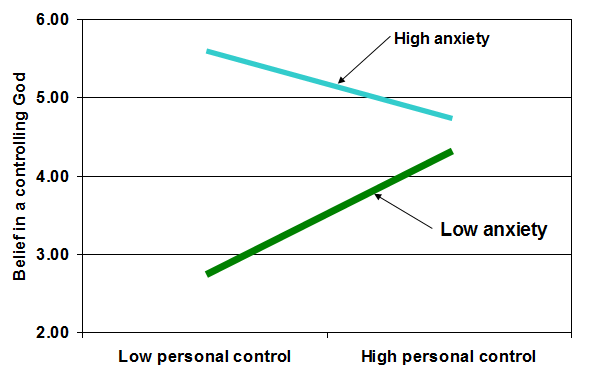 But there’s something interesting when you look closer at these results. You can see it easier if you change the x-variable. That’s what I’ve done in this second graph. Same data, just presented differently.
You can see that what seems to be happening is that anxiety does indeed seem to increase religiosity in the low control group. But the striking thing is the very low level of religiosity in the non-anxious members of the low control group.
What could be causing this? Maybe it’s that the people who have the lowest levels of belief in god are those who stay chilled even when made to think about a scary story!
_______________________________________________________________________________________
 Kay, A., Gaucher, D., Napier, J., Callan, M., & Laurin, K. (2008). God and the government: Testing a compensatory control mechanism for the support of external systems. Journal of Personality and Social Psychology, 95 (1), 18-35 DOI: 10.1037/0022-3514.95.1.18
LAURIN, K., KAY, A., & MOSCOVITCH, D. (2008). On the belief in God: Towards an understanding of the emotional substrates of compensatory control Journal of Experimental Social Psychology, 44 (6), 1559-1562 DOI: 10.1016/j.jesp.2008.07.007
 This work by Tom Rees is licensed under a Creative Commons Attribution-Share Alike 2.0 UK: England & Wales License.
Previous Post

June 9, 2009
Why Theos wants us all to think more about death
Browse Our Archives
Select a Category Causes of religion - evolution Causes of religion - psychological Causes of religion - social Demographics Digest Effects of religion - health Effects of religion - psychological Effects of religion - social Notifications Politics Uncategorized
Select a Month March 2016 February 2016 January 2016 December 2015 November 2015 October 2015 September 2015 August 2015 July 2015 June 2015 May 2015 April 2015 March 2015 February 2015 January 2015 December 2014 November 2014 October 2014 September 2014 August 2014 July 2014 June 2014 May 2014 April 2014 March 2014 February 2014 January 2014 December 2013 November 2013 October 2013 September 2013 August 2013 July 2013 June 2013 May 2013 April 2013 March 2013 February 2013 January 2013 December 2012 November 2012 October 2012 September 2012 August 2012 July 2012 June 2012 May 2012 April 2012 March 2012 February 2012 January 2012 December 2011 November 2011 October 2011 September 2011 August 2011 July 2011 June 2011 May 2011 April 2011 March 2011 February 2011 January 2011 December 2010 November 2010 October 2010 September 2010 August 2010 July 2010 June 2010 May 2010 April 2010 March 2010 February 2010 January 2010 December 2009 November 2009 October 2009 September 2009 August 2009 July 2009 June 2009 May 2009 April 2009 March 2009 February 2009 January 2009 December 2008 November 2008 October 2008 September 2008 August 2008 July 2008 June 2008 May 2008 April 2008 March 2008 February 2008 January 2008 December 2007 November 2007 October 2007
Follow Us!
TAKE THE
Religious Wisdom Quiz
How many books is the Book of Psalms divided into?
Select your answer to see how you score.
Ten Seven Three Five
Related posts from Epiphenom

Do social crises lead to religious revivals? Nah!

What kind of woman would pray for health...

Can you use religion to change attitudes towards...

Dogmatic atheism and fundamentalist Christianity: creating certainty in...
TRENDING AT PATHEOS Nonreligious

Dethroning Jesus and Enthroning Yourself
Jesus Never Asked to Be Worshipped. He Asked to Be Understood. Christianity...

Why Most Christians are Really Paulians and Jobians
I Don't Care, But It Matters Let's get this out of the...

Essential Tips to Successfully Navigate the Selling Process
Selling a house can feel overwhelming, but it doesn’t have to be....

To Make Remote Work Effective, Think About Others
The COVID-19 pandemic forced many companies to rapidly transition to remote work....

Flexibility Is Key to Solving Problems of Tomorrow
The world of work is undergoing a dramatic transformation. The COVID-19 pandemic...
view all Nonreligious blogs
Ad-Free & Subscriber Log-In Subscription Support
- About Us
- 2026 Calendar
- Videos
- Podcasts
- Library of World Religions
- Faith In Media Tracker
- Advertise With Us
- Write for Us
- Privacy Policy
- Terms of Service
- Do Not Sell My Data
- Contact Us
- Radiant Digital
- Manage Newsletter Subscriptions
- Unsubscribe From Notifications
- Sitemap
Copyright 2008-2026, Patheos. All rights reserved.
Subscription Support Ad-Free & Subscriber Log-In
Follow Patheos