
BuddhistCatholicContemplativeEvangelicalGeneral ChristianHinduJewishLatter-day SaintMuslimNew VisionsProgressive Christian
Beliefs
- Buddhist
- Catholic
- Contemplative
- Evangelical
- General Christian
- Hindu
- Jewish
- Latter-day Saint
- More Voices
- Muslim
- New Visions
- Pagan
- Progressive Christian
Topics
- Religion News
- Food and Religion
- Sports and Religion
- Religious Art
- Religious Music and Entertainment
- Religious Events
- History and Religion
- Style and Religion
- Politics and Religion
- Women in Religion
- Recreation Outdoors and Religion
- Business Finance and Religion
- Careers Workplace and Religion
- Education and Religion
- Family Parenting and Religion
- Health Fitness and Religion
- Home and Religion
- Relationships and Religion
- Technology and Religion
- Travel and Religion
Columnists
- Buddhist Columnists
- Business Finance and Religion Columnists
- Careers Workplace and Religion Columnists
- Catholic Columnists
- Contemplative Columnists
- Education and Religion Columnists
- Evangelists Columnists
- Family Parenting and Religion Columnists
- General Christian Columnists
- Health Fitness and Religion Columnists
- Hindu Columnists
- History and Religion Columnists
- Home and Religion Columnists
- Jewish Columnists
- More Voices Columnists
- Latter Day Columnists
- Muslim Columnists
- New Visions Columnists
- Nonreligious Columnists
- Pagan Columnists
- Politics and Religion Columnists
- Progressive Columnists
- Recreation Outdoors and Religion Columnists
- Relationships and Religion Columnists
- Religion News Columnists
- Religious Art Columnists
- Religious Events Columnists
- Religious Music and Entertainment Columnists
- Sports and Religion Columnists
- Style and Religion Columnists
- Technology and Religion Columnists
- Travel and Religion Columnists
- Women in Religion Columnists
Resource Library
- 2026 Calendar
- Library of World Religions
- The 100 Most Holy Places on Earth
- Patheos Answers
- Podcasts
- Videos
- Faith Leaders Database
- Anglican Episcopalian
- Bahai
- Baptist
- Buddhism
- Christianity
- Confucianism
- Eastern Orthodoxy
- Hinduism
- Holiness and Pentecostal
- ISKCON
- Islam
- Judaism
- Lutheran
- Methodist
- The Church of Jesus Christ of Latter-day Saints
- New Age
- Paganism
- Presbytarian and Reformed
- Protestantism
- Religion Behind the Scenes
- Roman Catholic
- Scientology
- Shia Islam
- Sikhism
- Sufism
- Sunni Islam
- Taoism
- Zen
- See all religions
Research Tools
 Ad-Free & Subscriber Log-In Subscription Support
Ad-Free & Subscriber Log-In Subscription Support
Follow Patheos 

- Trending:
- Forgiveness
- |
- Marriage
- |
- Consciousness
- |
- Death Penalty
- |
- Election
- |
- Halloween
 Epiphenom
- Home
- Nonreligious
- Are religious people more co-operative? How to prove what you want by careful experimental design
Are religious people more co-operative? How to prove what you want by careful experimental design
Last updated on: December 6, 2014 at 2:21 am by Epiphenom
Are religious people more co-operative? How to prove what you want by careful experimental design 2014-12-06T02:21:02+01:00 Epiphenom
Patheos Explore the world's faith through different perspectives on religion and spirituality! Patheos has the views of the prevalent religions and spiritualities of the world.
Two new studies have looked into the question of whether religious people are more co-operative and come to opposite conclusions. Put together, they show very nicely just how complicated this seemingly simple question really is – and they also shine some light onto what effects religion really has on behaviour.
The best thing about them is that they were both done by the same guy, Ali Ahmed at Växjö University in Sweden.
Both studies used the same basic setup. He got people to play the ‘Public Goods’ game, which is a standard game used to test co-operativeness. The basic idea is that you get put in a group of three and everyone is given some money, which they can either stick in a common pot or keep to themselves. Everything that gets put in the pot gets increased by 50%, and then shared back equally.
The tricky bit is that this is all done in complete anonymity. Now, the rational thing to do in this game is to keep all your money for yourself. That’s the strategy that gives the best payout on average.
But in fact that’s not what people tend to do. They tend to put at least some money in. Quite why they do that no-one really knows. It might be simply that our minds aren’t geared up for this kind of artificial, one-shot, anonymous transaction. It’s the cognitive equivalent of a visual illusion.
If you’re religious, though, the calculation shifts. Nothing that a religious person does is truly anonymous. Since they often believe they’ll get a supernatural reward for good behaviour, it makes sense for them to contribute to the pot, even if they don’t get back as much as they put in.
Well, that’s the theory at least. Ahmed set out to test it.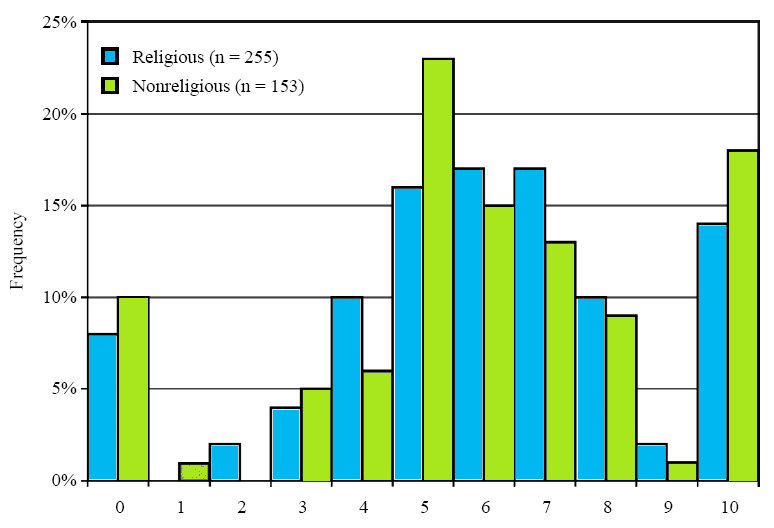 In the first study, he ran the experiment with groups of economics students in Mexico, Sweden and India – culturally Catholic, Protestant, and Hindu. A good cultural cross section.
In all three places, there was absolutely no difference between the religious and the non-religious students. You can see in the graph what happened (the numbers at the bottom refer to the numbers of tokens contributed – they got to convert them to money at the end of the experiment).
The second experiment was done in India only, but compared two different groups of students. The first group were social science students, but the second group were ‘imams in training’ from the local madrasahs.
This time there was a clear difference. The religious students were more co-operative than the secular students. They contributed more on average, and hardly any religious students contributed zero (2%, versus 15% for the secular students).
So why the big difference? There are a few possible reasons.
It could be that people who sign up to religious schools are different to religious people in general. Maybe people who want to make a career out of it are more generous than average. However, other studies consistently find no difference between religious and non-religious people in these kinds of economics games.
But there’s another factor that’s been shown to make a big difference. The religious students were actually tested in their religious schools. It might be that this environment, rather than their beliefs, made them contribute more.
The simple act of flicking up subliminal flashes of religious words can make people co-operate more, even if they are not religious. There’s some fascinating new evidence that religious environments can make people more co-operative, but that the effects are short-lived (more on that in another post).
What’s more, the religious students knew that their co-players were also from the same religious school. One effect of religion seems to be to increase in-group bonding (and out-group hostility) – see The Hand Grenade Experiment, for example. They might give more because they felt a closer affinity and loyalty to the other players.
So there is still research to be done on this. But what these studies does is add to the body of work showing the same thing. That simple belief in supernatural rewards (or punishment) doesn’t actually seem to have any effect on behaviour.
Religion can, it seems, change behaviour, but the reasons are not at all straightforward.
__________________________________________________________________________________

Ahmed, A., & Salas, O. (2009). Is the hand of God involved in human cooperation? International Journal of Social Economics, 36 (1/2), 70-80 DOI: 10.1108/03068290910921190
Ahmed, A. (2009). Are Religious People More Prosocial? A Quasi-Experimental Study with Pupils in a Rural Community in India. Journal for the Scientific Study of Religion, 48 (2), 368-374 DOI: 10.1111/j.1468-5906.2009.01452.x
 This work by Tom Rees is licensed under a Creative Commons Attribution-Share Alike 2.0 UK: England & Wales License.
Next Post

June 18, 2009 Atheists also have a sense of awe and wonder
Browse Our Archives
Select a Category Causes of religion - evolution Causes of religion - psychological Causes of religion - social Demographics Digest Effects of religion - health Effects of religion - psychological Effects of religion - social Notifications Politics Uncategorized
Select a Month March 2016 February 2016 January 2016 December 2015 November 2015 October 2015 September 2015 August 2015 July 2015 June 2015 May 2015 April 2015 March 2015 February 2015 January 2015 December 2014 November 2014 October 2014 September 2014 August 2014 July 2014 June 2014 May 2014 April 2014 March 2014 February 2014 January 2014 December 2013 November 2013 October 2013 September 2013 August 2013 July 2013 June 2013 May 2013 April 2013 March 2013 February 2013 January 2013 December 2012 November 2012 October 2012 September 2012 August 2012 July 2012 June 2012 May 2012 April 2012 March 2012 February 2012 January 2012 December 2011 November 2011 October 2011 September 2011 August 2011 July 2011 June 2011 May 2011 April 2011 March 2011 February 2011 January 2011 December 2010 November 2010 October 2010 September 2010 August 2010 July 2010 June 2010 May 2010 April 2010 March 2010 February 2010 January 2010 December 2009 November 2009 October 2009 September 2009 August 2009 July 2009 June 2009 May 2009 April 2009 March 2009 February 2009 January 2009 December 2008 November 2008 October 2008 September 2008 August 2008 July 2008 June 2008 May 2008 April 2008 March 2008 February 2008 January 2008 December 2007 November 2007 October 2007
Follow Us!
TAKE THE
Religious Wisdom Quiz
What does "Beersheba" mean in Hebrew?
Select your answer to see how you score.
Place of Bread Dwelling of the Lord Well of the Oath City of Peace
Related posts from Epiphenom

Do social crises lead to religious revivals? Nah!

What kind of woman would pray for health...

Can you use religion to change attitudes towards...

Dogmatic atheism and fundamentalist Christianity: creating certainty in...
TRENDING AT PATHEOS Nonreligious

Dethroning Jesus and Enthroning Yourself
Jesus Never Asked to Be Worshipped. He Asked to Be Understood. Christianity...

Why Most Christians are Really Paulians and Jobians
I Don't Care, But It Matters Let's get this out of the...

Essential Tips to Successfully Navigate the Selling Process
Selling a house can feel overwhelming, but it doesn’t have to be....

To Make Remote Work Effective, Think About Others
The COVID-19 pandemic forced many companies to rapidly transition to remote work....

Flexibility Is Key to Solving Problems of Tomorrow
The world of work is undergoing a dramatic transformation. The COVID-19 pandemic...
view all Nonreligious blogs
Ad-Free & Subscriber Log-In Subscription Support
- About Us
- 2026 Calendar
- Videos
- Podcasts
- Library of World Religions
- Faith In Media Tracker
- Advertise With Us
- Write for Us
- Privacy Policy
- Terms of Service
- Do Not Sell My Data
- Contact Us
- Radiant Digital
- Manage Newsletter Subscriptions
- Unsubscribe From Notifications
- Sitemap
Copyright 2008-2026, Patheos. All rights reserved.
Subscription Support Ad-Free & Subscriber Log-In
Follow Patheos