
BuddhistCatholicContemplativeEvangelicalGeneral ChristianHinduJewishLatter-day SaintMuslimNew VisionsProgressive Christian
Beliefs
- Buddhist
- Catholic
- Contemplative
- Evangelical
- General Christian
- Hindu
- Jewish
- Latter-day Saint
- More Voices
- Muslim
- New Visions
- Pagan
- Progressive Christian
Topics
- Religion News
- Food and Religion
- Sports and Religion
- Religious Art
- Religious Music and Entertainment
- Religious Events
- History and Religion
- Style and Religion
- Politics and Religion
- Women in Religion
- Recreation Outdoors and Religion
- Business Finance and Religion
- Careers Workplace and Religion
- Education and Religion
- Family Parenting and Religion
- Health Fitness and Religion
- Home and Religion
- Relationships and Religion
- Technology and Religion
- Travel and Religion
Columnists
- Buddhist Columnists
- Business Finance and Religion Columnists
- Careers Workplace and Religion Columnists
- Catholic Columnists
- Contemplative Columnists
- Education and Religion Columnists
- Evangelists Columnists
- Family Parenting and Religion Columnists
- General Christian Columnists
- Health Fitness and Religion Columnists
- Hindu Columnists
- History and Religion Columnists
- Home and Religion Columnists
- Jewish Columnists
- More Voices Columnists
- Latter Day Columnists
- Muslim Columnists
- New Visions Columnists
- Nonreligious Columnists
- Pagan Columnists
- Politics and Religion Columnists
- Progressive Columnists
- Recreation Outdoors and Religion Columnists
- Relationships and Religion Columnists
- Religion News Columnists
- Religious Art Columnists
- Religious Events Columnists
- Religious Music and Entertainment Columnists
- Sports and Religion Columnists
- Style and Religion Columnists
- Technology and Religion Columnists
- Travel and Religion Columnists
- Women in Religion Columnists
Resource Library
- 2026 Calendar
- Library of World Religions
- The 100 Most Holy Places on Earth
- Patheos Answers
- Podcasts
- Videos
- Faith Leaders Database
- Anglican Episcopalian
- Bahai
- Baptist
- Buddhism
- Christianity
- Confucianism
- Eastern Orthodoxy
- Hinduism
- Holiness and Pentecostal
- ISKCON
- Islam
- Judaism
- Lutheran
- Methodist
- The Church of Jesus Christ of Latter-day Saints
- New Age
- Paganism
- Presbytarian and Reformed
- Protestantism
- Religion Behind the Scenes
- Roman Catholic
- Scientology
- Shia Islam
- Sikhism
- Sufism
- Sunni Islam
- Taoism
- Zen
- See all religions
Research Tools
 Ad-Free & Subscriber Log-In Subscription Support
Ad-Free & Subscriber Log-In Subscription Support
Follow Patheos 

- Trending:
- Forgiveness
- |
- Marriage
- |
- Consciousness
- |
- Death Penalty
- |
- Election
- |
- Halloween
 Epiphenom
- Home
- Nonreligious
- Religious solidarity: the hand-grenade experiment
Religious solidarity: the hand-grenade experiment
Last updated on: December 6, 2014 at 2:34 am by Epiphenom
Religious solidarity: the hand-grenade experiment 2014-12-06T02:34:38+01:00 Epiphenom
Patheos Explore the world's faith through different perspectives on religion and spirituality! Patheos has the views of the prevalent religions and spiritualities of the world.
 So, you’re in your bunker, and a hand grenade lands. Do you fall on it, smother the blast, and sacrifice yourself for the group? What if they were co-religionists? Wouldn’t you like to find out if that makes a difference?
Unfortunately, doing that actual study is considered unethical in today’s PC world. So here’s a study that uses the next best thing: financial, rather than bodily self-sacrifice.
What Joseph Bulbulia and Andrew Mahoney, of Wellington University in New Zealand, set out to discover was whether Christians reward other Christians who they observe making a sacrifice for ‘the team’. They did this by asking a group of local Christians to play a two-stage online game with a similar group of Christians located in Manitoba, Canada.
In the first part of the game, the New Zealand Christians offered a fixed $5 sum to the Canadians, who could accept all, none, or part of what was offered. Whatever was accepted was doubled and shared between the two. So if the Canadian accepted $3, then at the end of round 1 she would have $3 and the New Zealander would have $8.
In round 2, the New Zealander could send any amount out of their takings from stage 1 to the Canadian. So if the same New Zealander as above offered $4, then at the end of the game the Canadian would have $7 and the New Zealander would have $4.
Essentially, the Canadian could punish the New Zealander in round 1, and the New Zealander could reward the Canadian in round 2.
Now there was a ruse, of course. All these kinds of games have a ruse. In this experiment there were two. Firstly, the Canadian was lied to – they were told that the New Zealander was not a Christian. The New Zealander was told about the experimenter’s lie.
The second ruse was simply that the Canadians didn’t actually exist. The New Zealanders weren’t told about that one.
In fact, whatever the New Zealander offered, the computer was set up to reject it, explaining that it was rejecting the offer on the grounds that the New Zealander was not a Christian.
Think about that. You are told that the Christian on the end of the line has turned down your offer – hurting both you and him – for no other reason than his (misinformed) belief that you are not a Christian! How do you react?
Well, before answering that you need to know that there was a control group. The control group was treated in exactly the same way, except they were just an ad hoc selection of New Zealander students. These subjects were told that the other player was a New Zealander located on the North Island, who rejected their offer on the grounds that player 1 (the human!) was a foreigner.
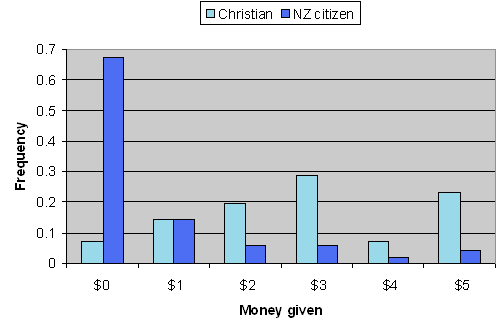
The comparison between the two groups is shown in the figure. Overwhelmingly, players in the control game – about nationalism, gave back nothing in round 2. They chose not to reward their partner, who had punished them for not being a New Zealander.
But look at the Christians. Most of them gave something, and 20% of them gave the most they could. It seems that they were rewarding their fellow chrisitians, who were prepared to make the not-quite-ultimate sacrifice for the good of the group.
I’m not entirely happy with that conclusion, though it’s the one drawn by Bulbulia and Mahoney. I wonder whether these Christians were actually demonstrating forgiveness and love, showing the other side the only way they could how a true Christian behaves. After all, the money was sent to the Canadian accompanied by the words “The New Zealand player really is a Christian and has decided to give $X.” I would think many of the players would regard it as unchristian to punish and not forgive.
This could’ve been tested with a third group – facing a Canadian player who was not a Christian. That setup would’ve sat uncomfortably with the deceptive nature of the study, however.
There are other caveats. New Zealander Christians are a minority group – New Zealand is one of the most secular countries in the world. That may generate especially strong feelings of group solidarity, especially in a setting where their religious identity was heavily primed (they knew, presumably, that they had been selected because they were Christians, and the Christian group identity was regularly reinforced during the experiment).
Notwithstanding all that, this study does clearly show that Christianity can trigger altruistic sacrifice, for whatever reason, for fellow Christians. On that basis alone, religion does seem to be a powerful tool for generating group cohesion.
In a world of competing groups, this might give the more religious ones a competitive edge.
_______________________________________________________________________________________
 Bulbulia, J., & Mahoney, A. (2008). Religious Solidarity: The Hand Grenade Experiment Journal of Cognition and Culture, 8 (3), 295-320 DOI: 10.1163/156853708X358191
 This work by Tom Rees is licensed under a Creative Commons Attribution-Share Alike 2.0 UK: England & Wales License.
Previous Post

May 18, 2009
Scientia Pro Publica #4 at Primate Diaries
Next Post
May 22, 2009 A leaflet from my friendly neighbourhood fascists
Browse Our Archives
Select a Category Causes of religion - evolution Causes of religion - psychological Causes of religion - social Demographics Digest Effects of religion - health Effects of religion - psychological Effects of religion - social Notifications Politics Uncategorized
Select a Month March 2016 February 2016 January 2016 December 2015 November 2015 October 2015 September 2015 August 2015 July 2015 June 2015 May 2015 April 2015 March 2015 February 2015 January 2015 December 2014 November 2014 October 2014 September 2014 August 2014 July 2014 June 2014 May 2014 April 2014 March 2014 February 2014 January 2014 December 2013 November 2013 October 2013 September 2013 August 2013 July 2013 June 2013 May 2013 April 2013 March 2013 February 2013 January 2013 December 2012 November 2012 October 2012 September 2012 August 2012 July 2012 June 2012 May 2012 April 2012 March 2012 February 2012 January 2012 December 2011 November 2011 October 2011 September 2011 August 2011 July 2011 June 2011 May 2011 April 2011 March 2011 February 2011 January 2011 December 2010 November 2010 October 2010 September 2010 August 2010 July 2010 June 2010 May 2010 April 2010 March 2010 February 2010 January 2010 December 2009 November 2009 October 2009 September 2009 August 2009 July 2009 June 2009 May 2009 April 2009 March 2009 February 2009 January 2009 December 2008 November 2008 October 2008 September 2008 August 2008 July 2008 June 2008 May 2008 April 2008 March 2008 February 2008 January 2008 December 2007 November 2007 October 2007
Follow Us!
TAKE THE
Religious Wisdom Quiz
Where was Jesus praying the night before He was crucified?
Select your answer to see how you score.
Galilee The Garden of Gethsemane Antioch Tarsus
Related posts from Epiphenom

Do social crises lead to religious revivals? Nah!

What kind of woman would pray for health...

Can you use religion to change attitudes towards...

Dogmatic atheism and fundamentalist Christianity: creating certainty in...
TRENDING AT PATHEOS Nonreligious

Dethroning Jesus and Enthroning Yourself
Jesus Never Asked to Be Worshipped. He Asked to Be Understood. Christianity...

Why Most Christians are Really Paulians and Jobians
I Don't Care, But It Matters Let's get this out of the...

Essential Tips to Successfully Navigate the Selling Process
Selling a house can feel overwhelming, but it doesn’t have to be....

To Make Remote Work Effective, Think About Others
The COVID-19 pandemic forced many companies to rapidly transition to remote work....

Flexibility Is Key to Solving Problems of Tomorrow
The world of work is undergoing a dramatic transformation. The COVID-19 pandemic...
view all Nonreligious blogs
Ad-Free & Subscriber Log-In Subscription Support
- About Us
- 2026 Calendar
- Videos
- Podcasts
- Library of World Religions
- Faith In Media Tracker
- Advertise With Us
- Write for Us
- Privacy Policy
- Terms of Service
- Do Not Sell My Data
- Contact Us
- Radiant Digital
- Manage Newsletter Subscriptions
- Unsubscribe From Notifications
- Sitemap
Copyright 2008-2026, Patheos. All rights reserved.
Subscription Support Ad-Free & Subscriber Log-In
Follow Patheos