
BuddhistCatholicContemplativeEvangelicalGeneral ChristianHinduJewishLatter-day SaintMuslimNew VisionsProgressive Christian
Beliefs
- Buddhist
- Catholic
- Contemplative
- Evangelical
- General Christian
- Hindu
- Jewish
- Latter-day Saint
- More Voices
- Muslim
- New Visions
- Pagan
- Progressive Christian
Topics
- Religion News
- Food and Religion
- Sports and Religion
- Religious Art
- Religious Music and Entertainment
- Religious Events
- History and Religion
- Style and Religion
- Politics and Religion
- Women in Religion
- Recreation Outdoors and Religion
- Business Finance and Religion
- Careers Workplace and Religion
- Education and Religion
- Family Parenting and Religion
- Health Fitness and Religion
- Home and Religion
- Relationships and Religion
- Technology and Religion
- Travel and Religion
Columnists
- Buddhist Columnists
- Business Finance and Religion Columnists
- Careers Workplace and Religion Columnists
- Catholic Columnists
- Contemplative Columnists
- Education and Religion Columnists
- Evangelists Columnists
- Family Parenting and Religion Columnists
- General Christian Columnists
- Health Fitness and Religion Columnists
- Hindu Columnists
- History and Religion Columnists
- Home and Religion Columnists
- Jewish Columnists
- More Voices Columnists
- Latter Day Columnists
- Muslim Columnists
- New Visions Columnists
- Nonreligious Columnists
- Pagan Columnists
- Politics and Religion Columnists
- Progressive Columnists
- Recreation Outdoors and Religion Columnists
- Relationships and Religion Columnists
- Religion News Columnists
- Religious Art Columnists
- Religious Events Columnists
- Religious Music and Entertainment Columnists
- Sports and Religion Columnists
- Style and Religion Columnists
- Technology and Religion Columnists
- Travel and Religion Columnists
- Women in Religion Columnists
Resource Library
- 2026 Calendar
- Library of World Religions
- The 100 Most Holy Places on Earth
- Patheos Answers
- Podcasts
- Videos
- Faith Leaders Database
- Anglican Episcopalian
- Bahai
- Baptist
- Buddhism
- Christianity
- Confucianism
- Eastern Orthodoxy
- Hinduism
- Holiness and Pentecostal
- ISKCON
- Islam
- Judaism
- Lutheran
- Methodist
- The Church of Jesus Christ of Latter-day Saints
- New Age
- Paganism
- Presbytarian and Reformed
- Protestantism
- Religion Behind the Scenes
- Roman Catholic
- Scientology
- Shia Islam
- Sikhism
- Sufism
- Sunni Islam
- Taoism
- Zen
- See all religions
Research Tools
 Ad-Free & Subscriber Log-In Subscription Support
Ad-Free & Subscriber Log-In Subscription Support
Follow Patheos 

- Trending:
- Forgiveness
- |
- Marriage
- |
- Consciousness
- |
- Death Penalty
- |
- Election
- |
- Halloween
 Epiphenom
- Home
- Nonreligious
- A new, integrated theory of the social factors that make people religious
A new, integrated theory of the social factors that make people religious
Last updated on: December 6, 2014 at 2:31 am by Epiphenom
A new, integrated theory of the social factors that make people religious 2014-12-06T02:31:39+01:00 Epiphenom
Patheos Explore the world's faith through different perspectives on religion and spirituality! Patheos has the views of the prevalent religions and spiritualities of the world.
 This one’s new out in the British Journal of Sociology. There’s no shortage of ideas about why religion is more important to some people, and some regions of the world. All of them have a certain amount of evidence to back them up, but none is really comprehensive.
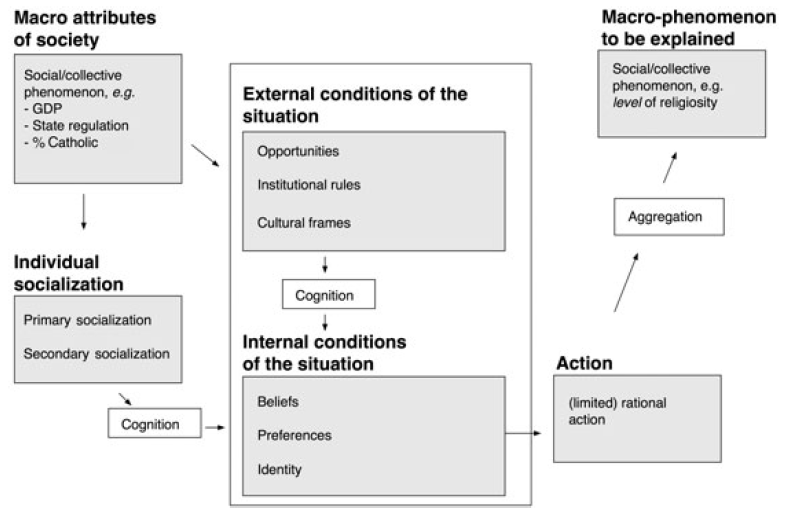
Jörg Stolz, at Lausanne University, has put forward a model that integrates most of the major strands of thought regarding how culture creates individual religiosity.
Essentially, what the model assumes is that a person’s environment – the society they live in, as well as their more immediate environment (the attitudes of their parents, for example) – create individual situations, which in turn generate an individuals actions.
This is a broad model, and all of the factors that are conventionally used to explain differences in religiosity can be incorporated within it. So how well does it work? Stolz tested it by looking at the relationship between macro and individual factors across Swiss cantons.
What he found broadly supported the role of individual factors in generating religiosity. Having a religious upbringing had the strongest effect, perhaps unsurprisingly. This was based on parent church going, whether both parents were of the same denomination, whether the individual had undergone the rite of confirmation, and the number of years of religious education.
A less significant factor was ‘regulation of demand’. This was derived from how urban the place was where the individual lives, and how many religious people live there. If you live in a secular town, you’re less likely to be religious yourself.
Also playing minor roles were education and wealth, and ethnicity (immigrants are slightly more religious).
The macro-level variables didn’t have much effect at all. Importantly, regulation of religion (i.e. local laws restricting or promoting particular religions) had no effect, contradicting one of the major current theories. Neither did state spending on ‘secular culture’ (museums, art galleries and the like), which in theory might tempt people away from religion.
What did make quite a difference was the religious culture – people living in Catholic cantons were more religious than those living in Protestant ones.
Stolz also looked at what might explain ‘alternative’ religiosity – the sorts of New Age religions and mysticisms. Only wealth had any detectable effect (poorer people were more mystic).
And a final interesting nugget from this study was the significant effect of age (for Christianity, although not alternative religion). It’s well know that older people are more likely to be religious, but there’s ongoing controversy about whether this is simply because they were more likely to have been brought up religious.
Well, this study controls for that, and still finds an effect of age. This suggests that there really is something to being older that increases religious feelings. It could be an effect of facing up to your own mortality, or it could be that older people are often not as wealthy (perhaps they gain more from a religious community). Or it could even be cognitive decline. Or perhaps some mixture of all three!
_______________________________________________________________________________________
 Jörg Stolz (2009). Explaining religiosity: towards a unified theoretical model British Journal of Sociology, 60 (2), 345-376 DOI: 10.1111/j.1468-4446.2009.01234.x
 This work by Tom Rees is licensed under a Creative Commons Attribution-Share Alike 2.0 UK: England & Wales License.
Previous Post

May 22, 2009
A leaflet from my friendly neighbourhood fascists
Next Post
May 28, 2009 Do religious immigrants send more money home?
Browse Our Archives
Select a Category Causes of religion - evolution Causes of religion - psychological Causes of religion - social Demographics Digest Effects of religion - health Effects of religion - psychological Effects of religion - social Notifications Politics Uncategorized
Select a Month March 2016 February 2016 January 2016 December 2015 November 2015 October 2015 September 2015 August 2015 July 2015 June 2015 May 2015 April 2015 March 2015 February 2015 January 2015 December 2014 November 2014 October 2014 September 2014 August 2014 July 2014 June 2014 May 2014 April 2014 March 2014 February 2014 January 2014 December 2013 November 2013 October 2013 September 2013 August 2013 July 2013 June 2013 May 2013 April 2013 March 2013 February 2013 January 2013 December 2012 November 2012 October 2012 September 2012 August 2012 July 2012 June 2012 May 2012 April 2012 March 2012 February 2012 January 2012 December 2011 November 2011 October 2011 September 2011 August 2011 July 2011 June 2011 May 2011 April 2011 March 2011 February 2011 January 2011 December 2010 November 2010 October 2010 September 2010 August 2010 July 2010 June 2010 May 2010 April 2010 March 2010 February 2010 January 2010 December 2009 November 2009 October 2009 September 2009 August 2009 July 2009 June 2009 May 2009 April 2009 March 2009 February 2009 January 2009 December 2008 November 2008 October 2008 September 2008 August 2008 July 2008 June 2008 May 2008 April 2008 March 2008 February 2008 January 2008 December 2007 November 2007 October 2007
Follow Us!
TAKE THE
Religious Wisdom Quiz
True or False: Absalom was David's son who led a rebellion against him.
Select your answer to see how you score.
TRUE FALSE
Related posts from Epiphenom

Do social crises lead to religious revivals? Nah!

What kind of woman would pray for health...

Can you use religion to change attitudes towards...

Dogmatic atheism and fundamentalist Christianity: creating certainty in...
TRENDING AT PATHEOS Nonreligious

Dethroning Jesus and Enthroning Yourself
Jesus Never Asked to Be Worshipped. He Asked to Be Understood. Christianity...

Why Most Christians are Really Paulians and Jobians
I Don't Care, But It Matters Let's get this out of the...

Essential Tips to Successfully Navigate the Selling Process
Selling a house can feel overwhelming, but it doesn’t have to be....

To Make Remote Work Effective, Think About Others
The COVID-19 pandemic forced many companies to rapidly transition to remote work....

Flexibility Is Key to Solving Problems of Tomorrow
The world of work is undergoing a dramatic transformation. The COVID-19 pandemic...
view all Nonreligious blogs
Ad-Free & Subscriber Log-In Subscription Support
- About Us
- 2026 Calendar
- Videos
- Podcasts
- Library of World Religions
- Faith In Media Tracker
- Advertise With Us
- Write for Us
- Privacy Policy
- Terms of Service
- Do Not Sell My Data
- Contact Us
- Radiant Digital
- Manage Newsletter Subscriptions
- Unsubscribe From Notifications
- Sitemap
Copyright 2008-2026, Patheos. All rights reserved.
Subscription Support Ad-Free & Subscriber Log-In
Follow Patheos