
BuddhistCatholicContemplativeEvangelicalGeneral ChristianHinduJewishLatter-day SaintMuslimNew VisionsProgressive Christian
Beliefs
- Buddhist
- Catholic
- Contemplative
- Evangelical
- General Christian
- Hindu
- Jewish
- Latter-day Saint
- More Voices
- Muslim
- New Visions
- Pagan
- Progressive Christian
Topics
- Religion News
- Food and Religion
- Sports and Religion
- Religious Art
- Religious Music and Entertainment
- Religious Events
- History and Religion
- Style and Religion
- Politics and Religion
- Women in Religion
- Recreation Outdoors and Religion
- Business Finance and Religion
- Careers Workplace and Religion
- Education and Religion
- Family Parenting and Religion
- Health Fitness and Religion
- Home and Religion
- Relationships and Religion
- Technology and Religion
- Travel and Religion
Columnists
- Buddhist Columnists
- Business Finance and Religion Columnists
- Careers Workplace and Religion Columnists
- Catholic Columnists
- Contemplative Columnists
- Education and Religion Columnists
- Evangelists Columnists
- Family Parenting and Religion Columnists
- General Christian Columnists
- Health Fitness and Religion Columnists
- Hindu Columnists
- History and Religion Columnists
- Home and Religion Columnists
- Jewish Columnists
- More Voices Columnists
- Latter Day Columnists
- Muslim Columnists
- New Visions Columnists
- Nonreligious Columnists
- Pagan Columnists
- Politics and Religion Columnists
- Progressive Columnists
- Recreation Outdoors and Religion Columnists
- Relationships and Religion Columnists
- Religion News Columnists
- Religious Art Columnists
- Religious Events Columnists
- Religious Music and Entertainment Columnists
- Sports and Religion Columnists
- Style and Religion Columnists
- Technology and Religion Columnists
- Travel and Religion Columnists
- Women in Religion Columnists
Resource Library
- 2026 Calendar
- Library of World Religions
- The 100 Most Holy Places on Earth
- Patheos Answers
- Podcasts
- Videos
- Faith Leaders Database
- Anglican Episcopalian
- Bahai
- Baptist
- Buddhism
- Christianity
- Confucianism
- Eastern Orthodoxy
- Hinduism
- Holiness and Pentecostal
- ISKCON
- Islam
- Judaism
- Lutheran
- Methodist
- The Church of Jesus Christ of Latter-day Saints
- New Age
- Paganism
- Presbytarian and Reformed
- Protestantism
- Religion Behind the Scenes
- Roman Catholic
- Scientology
- Shia Islam
- Sikhism
- Sufism
- Sunni Islam
- Taoism
- Zen
- See all religions
Research Tools
 Ad-Free & Subscriber Log-In Subscription Support
Ad-Free & Subscriber Log-In Subscription Support
Follow Patheos 

- Trending:
- Forgiveness
- |
- Marriage
- |
- Consciousness
- |
- Death Penalty
- |
- Election
- |
- Halloween
 Epiphenom
- Home
- Nonreligious
- Can choosing the right god reduce anxiety and other psychosis?
Can choosing the right god reduce anxiety and other psychosis?
Last updated on: December 7, 2014 at 5:23 am by Epiphenom
Can choosing the right god reduce anxiety and other psychosis? 2014-12-07T05:23:05+01:00 Epiphenom
Patheos Explore the world's faith through different perspectives on religion and spirituality! Patheos has the views of the prevalent religions and spiritualities of the world.
 Religion and mental health seems to be a double-edged sword. Religion features in a lot of psychotic delusions, but there’s also a lot of evidence linking religious belief to better mental health. There’s some new research which suggests that part of the problem in teasing out the relationships is that it’s not belief itself, but rather the type of god that you believe in, that matters.
The data came from a 2004 US survey on religion and health, which included measures of what people thought about god, and also a variety of health measures including some standard psychiatric scales.
The researchers took out all those who said they had no religion (just 3%). What’s more they found no effect of how religious people said they were, or how often they went to church. So this is not a study comparing religion with non belief.
The essence of what they found is shown in the graph. They looked at whether people agreed with each of three statements describing god: Close and Loving, Approving and Forgiving, and Creating and Judging.
Believers in a close and loving god had the lowest incidence of a range of psychoses, especially anxiety. Belief in a creator/judge god had the opposite effect.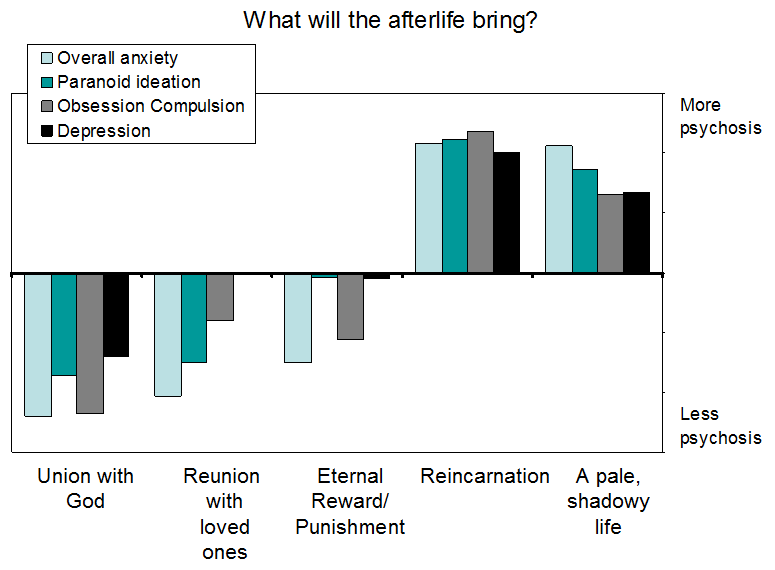 Last year they also showed that there is a similar relationship between beliefs about the afterlife and mental health. People who believed that the afterlife will bring nice things, like union with god, peace and tranquillity, reunion with loved ones, or paradise, were less psychotic. Those who thought that there is no afterlife, or that the afterlife is just a pale and shadowy life, or even those that it would bring reincarnation or the possibility of punishment had more psychoses.
So what’s going on? Of course there’s a significant chicken and egg problem here. Is it that particular religious beliefs making people less psychotic, or is it simply that psychotic people have negative opinions of both other people and of god?
But Kevin Flannelly, the lead researcher, has a theory to explain these results. He suggests that there is a system in the brain that’s specifically designed to alert you to threats in the environment around you (the Evolutionary Threat Assessment System, or ETAS).
Dysfunction of this system, he believes, underpins a lot of mental health problems. The idea is that activation of the ETAS causes a decrease in the sense of security and also an increase in psychiatric symptoms.
Flannelly thinks that belief in a close and loving god (i.e. a protective one that’s looking out for you) decreases activation of the ETAS.
To be sure, alternative theories abound – in particular attachment theory, which suggests that God acts as a surrogate parent. But this doesn’t explain why belief in a loving god does not reduce somatisation.
Whatever the cause, Flannelly’s results are further evidence that positive beliefs about God are linked to less psychosis, especially anxiety-related psychosis (see also Xanax of the people)
_____________________________________________________________________________________
 Flannelly, K., Galek, K., Ellison, C., & Koenig, H. (2009). Beliefs about God, Psychiatric Symptoms, and Evolutionary Psychiatry Journal of Religion and Health DOI: 10.1007/s10943-009-9244-z
Flannelly, K., & Galek, K. (2009). Religion, Evolution, and Mental Health: Attachment Theory and ETAS Theory Journal of Religion and Health DOI: 10.1007/s10943-009-9247-9
Previous Post

April 7, 2009
Paleolithic graffiti and the mismeasurement of religion
Next Post
April 12, 2009 Doing what you're told: how ritual behaviour and beliefs can be inherited
Browse Our Archives
Select a Category Causes of religion - evolution Causes of religion - psychological Causes of religion - social Demographics Digest Effects of religion - health Effects of religion - psychological Effects of religion - social Notifications Politics Uncategorized
Select a Month March 2016 February 2016 January 2016 December 2015 November 2015 October 2015 September 2015 August 2015 July 2015 June 2015 May 2015 April 2015 March 2015 February 2015 January 2015 December 2014 November 2014 October 2014 September 2014 August 2014 July 2014 June 2014 May 2014 April 2014 March 2014 February 2014 January 2014 December 2013 November 2013 October 2013 September 2013 August 2013 July 2013 June 2013 May 2013 April 2013 March 2013 February 2013 January 2013 December 2012 November 2012 October 2012 September 2012 August 2012 July 2012 June 2012 May 2012 April 2012 March 2012 February 2012 January 2012 December 2011 November 2011 October 2011 September 2011 August 2011 July 2011 June 2011 May 2011 April 2011 March 2011 February 2011 January 2011 December 2010 November 2010 October 2010 September 2010 August 2010 July 2010 June 2010 May 2010 April 2010 March 2010 February 2010 January 2010 December 2009 November 2009 October 2009 September 2009 August 2009 July 2009 June 2009 May 2009 April 2009 March 2009 February 2009 January 2009 December 2008 November 2008 October 2008 September 2008 August 2008 July 2008 June 2008 May 2008 April 2008 March 2008 February 2008 January 2008 December 2007 November 2007 October 2007
Follow Us!
TAKE THE
Religious Wisdom Quiz
Who said: "Little children, keep yourselves from idols"?
Select your answer to see how you score.
John Peter Paul James
Related posts from Epiphenom

Do social crises lead to religious revivals? Nah!

What kind of woman would pray for health...

Can you use religion to change attitudes towards...

Dogmatic atheism and fundamentalist Christianity: creating certainty in...
TRENDING AT PATHEOS Nonreligious

Dethroning Jesus and Enthroning Yourself
Jesus Never Asked to Be Worshipped. He Asked to Be Understood. Christianity...

Why Most Christians are Really Paulians and Jobians
I Don't Care, But It Matters Let's get this out of the...

Essential Tips to Successfully Navigate the Selling Process
Selling a house can feel overwhelming, but it doesn’t have to be....

To Make Remote Work Effective, Think About Others
The COVID-19 pandemic forced many companies to rapidly transition to remote work....

Flexibility Is Key to Solving Problems of Tomorrow
The world of work is undergoing a dramatic transformation. The COVID-19 pandemic...
view all Nonreligious blogs
Ad-Free & Subscriber Log-In Subscription Support
- About Us
- 2026 Calendar
- Videos
- Podcasts
- Library of World Religions
- Faith In Media Tracker
- Advertise With Us
- Write for Us
- Privacy Policy
- Terms of Service
- Do Not Sell My Data
- Contact Us
- Radiant Digital
- Manage Newsletter Subscriptions
- Unsubscribe From Notifications
- Sitemap
Copyright 2008-2026, Patheos. All rights reserved.
Subscription Support Ad-Free & Subscriber Log-In
Follow Patheos