
BuddhistCatholicContemplativeEvangelicalGeneral ChristianHinduJewishLatter-day SaintMuslimNew VisionsProgressive Christian
Beliefs
- Buddhist
- Catholic
- Contemplative
- Evangelical
- General Christian
- Hindu
- Jewish
- Latter-day Saint
- More Voices
- Muslim
- New Visions
- Pagan
- Progressive Christian
Topics
- Religion News
- Food and Religion
- Sports and Religion
- Religious Art
- Religious Music and Entertainment
- Religious Events
- History and Religion
- Style and Religion
- Politics and Religion
- Women in Religion
- Recreation Outdoors and Religion
- Business Finance and Religion
- Careers Workplace and Religion
- Education and Religion
- Family Parenting and Religion
- Health Fitness and Religion
- Home and Religion
- Relationships and Religion
- Technology and Religion
- Travel and Religion
Columnists
- Buddhist Columnists
- Business Finance and Religion Columnists
- Careers Workplace and Religion Columnists
- Catholic Columnists
- Contemplative Columnists
- Education and Religion Columnists
- Evangelists Columnists
- Family Parenting and Religion Columnists
- General Christian Columnists
- Health Fitness and Religion Columnists
- Hindu Columnists
- History and Religion Columnists
- Home and Religion Columnists
- Jewish Columnists
- More Voices Columnists
- Latter Day Columnists
- Muslim Columnists
- New Visions Columnists
- Nonreligious Columnists
- Pagan Columnists
- Politics and Religion Columnists
- Progressive Columnists
- Recreation Outdoors and Religion Columnists
- Relationships and Religion Columnists
- Religion News Columnists
- Religious Art Columnists
- Religious Events Columnists
- Religious Music and Entertainment Columnists
- Sports and Religion Columnists
- Style and Religion Columnists
- Technology and Religion Columnists
- Travel and Religion Columnists
- Women in Religion Columnists
Resource Library
- 2026 Calendar
- Library of World Religions
- The 100 Most Holy Places on Earth
- Patheos Answers
- Podcasts
- Videos
- Faith Leaders Database
- Anglican Episcopalian
- Bahai
- Baptist
- Buddhism
- Christianity
- Confucianism
- Eastern Orthodoxy
- Hinduism
- Holiness and Pentecostal
- ISKCON
- Islam
- Judaism
- Lutheran
- Methodist
- The Church of Jesus Christ of Latter-day Saints
- New Age
- Paganism
- Presbytarian and Reformed
- Protestantism
- Religion Behind the Scenes
- Roman Catholic
- Scientology
- Shia Islam
- Sikhism
- Sufism
- Sunni Islam
- Taoism
- Zen
- See all religions
Research Tools
 Ad-Free & Subscriber Log-In Subscription Support
Ad-Free & Subscriber Log-In Subscription Support
Follow Patheos 

- Trending:
- Forgiveness
- |
- Marriage
- |
- Consciousness
- |
- Death Penalty
- |
- Election
- |
- Halloween
 Epiphenom
- Home
- Nonreligious
- Does Dawkins work?
Does Dawkins work?
Last updated on: December 7, 2014 at 5:31 am by Epiphenom
Does Dawkins work? 2014-12-07T05:31:05+01:00 Epiphenom
Patheos Explore the world's faith through different perspectives on religion and spirituality! Patheos has the views of the prevalent religions and spiritualities of the world.
It seems that cracks are opening in the religious veneer of the US – demographic data are showing that people are increasingly likely to tell pollsters that they are atheists or agnostics (see previous two posts). This much seems clear. The question then is: why?
The shift really seems to have happened in the current decade, and it’s a decade that’s seen some pretty seismic political events. There was 9/11 and subsequent media frenzy about religious violence. Then there was the plummeting popularity of Bush, whose administration was closely aligned to the religious evangelicals.
And then there’s the Dawkins phenomenon.
Has the enormous popularity of Richard Dawkins’ book, The God Delusion, contributed to the shifting beliefs of the American people? That’s certainly what Dawkins hoped for:
If this book works as I intend, religious readers who open it will be atheists when they put it down. (The God Delusion)
On the other hand, critics of Dawkins have argued that his strident, take-no-prisoners style has done more harm than good. Madeleine Bunting, writing in the Guardian, goes so far as to demand proof that anyone at all has been converted.
Well, proof is hard to come by but there is good evidence that Dawkins’ prose really can change beliefs, at least in the short term. This evidence comes from a study published last year by psychologist Azim Shariff and colleagues at the University of British Columbia (Shariff is the guy who co-wrote the review last year on the pro-social effects of religion).
What they did was give some students a couple of paragraphs from an essay that Dawkins wrote way back in 1994 that succinctly made his case. They don’t quote the passage directly, but I’ve tracked it down and this is it (it was published in the electronic newsletter Nullifidian):
The great beauty of Darwin’s theory of evolution is that it explains how complex, difficult to understand things could have arisen step by plausible step, from simple, easy to understand beginnings. We start our explanation from almost infinitely simple beginnings: pure hydrogen and a huge amount of energy. Our scientific, Darwinian explanations carry us through a series of well-understood gradual steps to all the spectacular beauty and complexity of life.
The alternative hypothesis, that it was all started by a supernatural creator, is not only superfluous, it is also highly improbable. It falls foul of the very argument that was originally put forward in its favour. This is because any God worthy of the name must have been a being of colossal intelligence, a supermind, an entity of extremely low probability – a very improbable being indeed.
Afterwards they were asked to summarize their feelings about Dawkins’ argument. A control group was asked to write about their favourite food.
Then they did a distraction task, and then filled in a number of questionnaires, including one about their religiosity. According to this survey, their religiosity dropped by a small, but significant amount. Score 1 point to Dawkins.
But hang on, there’s a number of reasons that people might change what they put in a questionnaire that have nothing to do with their actual opinions. It might simply be that they were inhibited from answering truthfully before. Or it might be that they are now inhibited. In other words, people are affected by what they judge to be the questioners’ expectations.
So an objective test is needed. What Shariff & co used was a version of the Implicit Association Test. The gist of this is that images (or, in this case, words) are flashed up on the screen, and you have to sort them according to whether they are true or false. The cunning bit is that you are told whether to answer true or false. The test comes not in which ones you get right, but in how fast you react.
The theory is that if the instructions on how to sort into ‘true’ or ‘false’ go against your implicit beliefs, then you’ll need more time to sort them. If they fit with your prejudice, you’ll fly through. It’s an objective measure of your real ‘gut feelings’.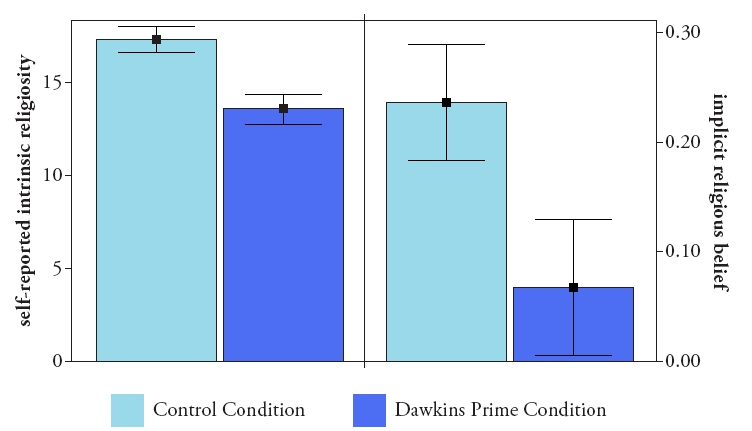 Anyway, here are the results. The left hand pair of bars show the results from the questionnaire. The right hand pair of bars show the results from the implicit association test.
Both show a decrease in religiosity in those who read the piece by Dawkins, but the implicit test shows a rather striking drop. It seems that Dawkins really can change deeply held beliefs.
OK so this was only a short term study. Once these people got back out into the real world, with the constant barrage of pro-religious sentiments, they no doubt rapidly lapsed. But what happens if the Dawkins message is louder and more regular? Could that really change attitudes in the long-term?
I would like to think so!
____________________________________________________________________
 Azim F. A Shariff, Adam B. Cohen, Ara ANorenzayan (2008). The Devil’s Advocate: Secular Arguments Diminish both Implicit and Explicit Religious Belief Journal of Cognition and Culture, 8 (3), 417-423 DOI: 10.1163/156853708X358245
Next Post

March 5, 2009 Religion: Xanax of the people?
Browse Our Archives
Select a Category Causes of religion - evolution Causes of religion - psychological Causes of religion - social Demographics Digest Effects of religion - health Effects of religion - psychological Effects of religion - social Notifications Politics Uncategorized
Select a Month March 2016 February 2016 January 2016 December 2015 November 2015 October 2015 September 2015 August 2015 July 2015 June 2015 May 2015 April 2015 March 2015 February 2015 January 2015 December 2014 November 2014 October 2014 September 2014 August 2014 July 2014 June 2014 May 2014 April 2014 March 2014 February 2014 January 2014 December 2013 November 2013 October 2013 September 2013 August 2013 July 2013 June 2013 May 2013 April 2013 March 2013 February 2013 January 2013 December 2012 November 2012 October 2012 September 2012 August 2012 July 2012 June 2012 May 2012 April 2012 March 2012 February 2012 January 2012 December 2011 November 2011 October 2011 September 2011 August 2011 July 2011 June 2011 May 2011 April 2011 March 2011 February 2011 January 2011 December 2010 November 2010 October 2010 September 2010 August 2010 July 2010 June 2010 May 2010 April 2010 March 2010 February 2010 January 2010 December 2009 November 2009 October 2009 September 2009 August 2009 July 2009 June 2009 May 2009 April 2009 March 2009 February 2009 January 2009 December 2008 November 2008 October 2008 September 2008 August 2008 July 2008 June 2008 May 2008 April 2008 March 2008 February 2008 January 2008 December 2007 November 2007 October 2007
Follow Us!
TAKE THE
Religious Wisdom Quiz
How did Moses' mother save him as a baby?
Select your answer to see how you score.
Dressed him as a girl Placed him in a basket on the river Sent him to another city Hid him in a cave
Related posts from Epiphenom

Do social crises lead to religious revivals? Nah!

What kind of woman would pray for health...

Can you use religion to change attitudes towards...

Dogmatic atheism and fundamentalist Christianity: creating certainty in...
TRENDING AT PATHEOS Nonreligious

Dethroning Jesus and Enthroning Yourself
Jesus Never Asked to Be Worshipped. He Asked to Be Understood. Christianity...

Why Most Christians are Really Paulians and Jobians
I Don't Care, But It Matters Let's get this out of the...

Essential Tips to Successfully Navigate the Selling Process
Selling a house can feel overwhelming, but it doesn’t have to be....

To Make Remote Work Effective, Think About Others
The COVID-19 pandemic forced many companies to rapidly transition to remote work....

Flexibility Is Key to Solving Problems of Tomorrow
The world of work is undergoing a dramatic transformation. The COVID-19 pandemic...
view all Nonreligious blogs
Ad-Free & Subscriber Log-In Subscription Support
- About Us
- 2026 Calendar
- Videos
- Podcasts
- Library of World Religions
- Faith In Media Tracker
- Advertise With Us
- Write for Us
- Privacy Policy
- Terms of Service
- Do Not Sell My Data
- Contact Us
- Radiant Digital
- Manage Newsletter Subscriptions
- Unsubscribe From Notifications
- Sitemap
Copyright 2008-2026, Patheos. All rights reserved.
Subscription Support Ad-Free & Subscriber Log-In
Follow Patheos