
BuddhistCatholicContemplativeEvangelicalGeneral ChristianHinduJewishLatter-day SaintMuslimNew VisionsProgressive Christian
Beliefs
- Buddhist
- Catholic
- Contemplative
- Evangelical
- General Christian
- Hindu
- Jewish
- Latter-day Saint
- More Voices
- Muslim
- New Visions
- Pagan
- Progressive Christian
Topics
- Religion News
- Food and Religion
- Sports and Religion
- Religious Art
- Religious Music and Entertainment
- Religious Events
- History and Religion
- Style and Religion
- Politics and Religion
- Women in Religion
- Recreation Outdoors and Religion
- Business Finance and Religion
- Careers Workplace and Religion
- Education and Religion
- Family Parenting and Religion
- Health Fitness and Religion
- Home and Religion
- Relationships and Religion
- Technology and Religion
- Travel and Religion
Columnists
- Buddhist Columnists
- Business Finance and Religion Columnists
- Careers Workplace and Religion Columnists
- Catholic Columnists
- Contemplative Columnists
- Education and Religion Columnists
- Evangelists Columnists
- Family Parenting and Religion Columnists
- General Christian Columnists
- Health Fitness and Religion Columnists
- Hindu Columnists
- History and Religion Columnists
- Home and Religion Columnists
- Jewish Columnists
- More Voices Columnists
- Latter Day Columnists
- Muslim Columnists
- New Visions Columnists
- Nonreligious Columnists
- Pagan Columnists
- Politics and Religion Columnists
- Progressive Columnists
- Recreation Outdoors and Religion Columnists
- Relationships and Religion Columnists
- Religion News Columnists
- Religious Art Columnists
- Religious Events Columnists
- Religious Music and Entertainment Columnists
- Sports and Religion Columnists
- Style and Religion Columnists
- Technology and Religion Columnists
- Travel and Religion Columnists
- Women in Religion Columnists
Resource Library
- 2026 Calendar
- Library of World Religions
- The 100 Most Holy Places on Earth
- Patheos Answers
- Podcasts
- Videos
- Faith Leaders Database
- Anglican Episcopalian
- Bahai
- Baptist
- Buddhism
- Christianity
- Confucianism
- Eastern Orthodoxy
- Hinduism
- Holiness and Pentecostal
- ISKCON
- Islam
- Judaism
- Lutheran
- Methodist
- The Church of Jesus Christ of Latter-day Saints
- New Age
- Paganism
- Presbytarian and Reformed
- Protestantism
- Religion Behind the Scenes
- Roman Catholic
- Scientology
- Shia Islam
- Sikhism
- Sufism
- Sunni Islam
- Taoism
- Zen
- See all religions
Research Tools
 Ad-Free & Subscriber Log-In Subscription Support
Ad-Free & Subscriber Log-In Subscription Support
Follow Patheos 

- Trending:
- Forgiveness
- |
- Marriage
- |
- Consciousness
- |
- Death Penalty
- |
- Election
- |
- Halloween
 Epiphenom
- Home
- Nonreligious
- Why be good? Imitation and migration might explain it
Why be good? Imitation and migration might explain it
Last updated on: December 7, 2014 at 5:38 am by Epiphenom
Why be good? Imitation and migration might explain it 2014-12-07T05:38:35+01:00 Epiphenom
Patheos Explore the world's faith through different perspectives on religion and spirituality! Patheos has the views of the prevalent religions and spiritualities of the world.
 Just before Christmas, the American Humanist Association ran bus ads with the slogan ‘Just be good for goodness sake’.
Yeah right.
From an evolutionary standpoint, pure selfless altruism – doing something that costs you but only benefits someone else – doesn’t make sense. Altruism is usually explained by kinship, or because it enhances reputation, or because it avoids punishment. People are good because they get something out of it.
But what about anonymous encounters? Say if I were to meet you in a dark alleyway. I’m never going to meet you again, and nobody will ever know what I did. Evolution says that the sensible thing for me to do is to mug you and steal your money.
Of course, sometimes that’s exactly what does happen (not with me, I hasten to add!). But usually it doesn’t. Explaining this so-called ‘pure altruism’ is tricky. Often, it’s explained as some kind of aberration – in the real world you can’t ever be sure that what you do is truly anonymous, so we are driven to err on the side of altruism.
But maybe there is a better explanation. Maybe co-operation is a successful strategy even when individual transactions are anonymous. There’s a new study that sheds light on how that might happen.
What the researchers (two social scientists based in Zurich) did was run a computer simulation based on the classic ‘prisoner’s dilemma’. This is basically a two-way gambling game where co-operation by both players gives the greatest rewards, but the worst outcome is if you co-operate and the other guy defects. If it’s just an anonymous two player game, then the best strategy is always to defect. Trying to co-operate just means you get taken for a sucker.
So what they did was broaden it out a bit. They stuck their computer ‘agents’, who played the game, in a grid with vacant squares. The agents could either be co-operators or defectors in trades with next-door agents, and they could swap their role either by copying those around them or by random chance.
Also – and crucially – the agents could look around their neighbourhood and see if there were any vacant spots where they might get a better deal. If there were, they could move.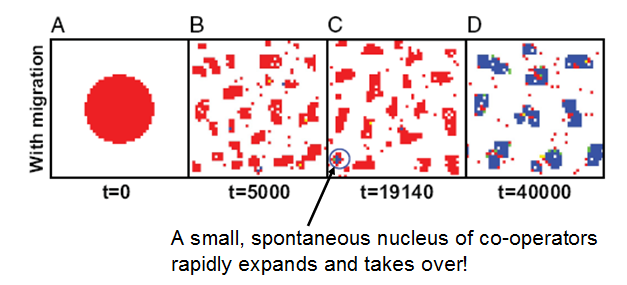 Now, the agents all had amnesia – no memory of how the other agents had behaved. But they could tell if neighbourhoods were filled with co-operators or defectors. And look what happened.
The figure shows the results of one experiment that started off with a group of pure defectors (in red). Time passed and the agents moved around. Some individuals tried out the co-operate strategy, but they were rapidly taken advantage of, and so turned back to being defectors.
But then, and purely by chance, a small group of co-operators happened to come together. And they were so successful that the other agents started to copy them. Sure, defectors tried to invade the co-operating groups, but whenever they did that the group collapsed and the agents migrated somewhere better. What they ended up with is a dynamic pattern of groups of co-operators with parasitic defectors living on the margins.
They ran the simulations with added noise – to simulate the reality that real-life decisions are often imperfect – and found the same thing. It’s a pretty stable result. Here’s what they conclude:
Our results help to explain why cooperation can be frequent even if individuals would behave selfishly in the vast majority of interactions. Although one may think that migration would weaken social ties and cooperation, there is another side of it that helps to establish cooperation in the first place, without the need to modify the payoff structure. We suggest that, besides the ability for strategic interactions and learning, the ability to move has played a crucial role for the evolution of large-scale cooperation and social behavior.
In other words, the implication is that if we can choose the kind of neighbourhood we live in, then even pure altruism can be explained by simple evolutionary dynamics. Of course, the other explanations of altruism probably still dominate. But this study seems to go some way to explaining why we are good even when we don’t seem to be getting anything obvious out of it.
 D. Helbing, W. Yu (2009). The outbreak of cooperation among success-driven individuals under noisy conditions Proceedings of the National Academy of Sciences DOI: 10.1073/pnas.0811503106
Previous Post

February 24, 2009
If religion makes you healthy, how come it doesn't?
Next Post
February 28, 2009 "God does not exist." Error: does not compute!
Browse Our Archives
Select a Category Causes of religion - evolution Causes of religion - psychological Causes of religion - social Demographics Digest Effects of religion - health Effects of religion - psychological Effects of religion - social Notifications Politics Uncategorized
Select a Month March 2016 February 2016 January 2016 December 2015 November 2015 October 2015 September 2015 August 2015 July 2015 June 2015 May 2015 April 2015 March 2015 February 2015 January 2015 December 2014 November 2014 October 2014 September 2014 August 2014 July 2014 June 2014 May 2014 April 2014 March 2014 February 2014 January 2014 December 2013 November 2013 October 2013 September 2013 August 2013 July 2013 June 2013 May 2013 April 2013 March 2013 February 2013 January 2013 December 2012 November 2012 October 2012 September 2012 August 2012 July 2012 June 2012 May 2012 April 2012 March 2012 February 2012 January 2012 December 2011 November 2011 October 2011 September 2011 August 2011 July 2011 June 2011 May 2011 April 2011 March 2011 February 2011 January 2011 December 2010 November 2010 October 2010 September 2010 August 2010 July 2010 June 2010 May 2010 April 2010 March 2010 February 2010 January 2010 December 2009 November 2009 October 2009 September 2009 August 2009 July 2009 June 2009 May 2009 April 2009 March 2009 February 2009 January 2009 December 2008 November 2008 October 2008 September 2008 August 2008 July 2008 June 2008 May 2008 April 2008 March 2008 February 2008 January 2008 December 2007 November 2007 October 2007
Follow Us!
TAKE THE
Religious Wisdom Quiz
I am a day when tongues of fire appeared and people spoke in languages they had never learned. Three thousand believed that day. What am I?
Select your answer to see how you score.
The Day of Atonement Pentecost Passover Easter
Related posts from Epiphenom

Do social crises lead to religious revivals? Nah!

What kind of woman would pray for health...

Can you use religion to change attitudes towards...

Dogmatic atheism and fundamentalist Christianity: creating certainty in...
TRENDING AT PATHEOS Nonreligious

Dethroning Jesus and Enthroning Yourself
Jesus Never Asked to Be Worshipped. He Asked to Be Understood. Christianity...

Why Most Christians are Really Paulians and Jobians
I Don't Care, But It Matters Let's get this out of the...

Essential Tips to Successfully Navigate the Selling Process
Selling a house can feel overwhelming, but it doesn’t have to be....

To Make Remote Work Effective, Think About Others
The COVID-19 pandemic forced many companies to rapidly transition to remote work....

Flexibility Is Key to Solving Problems of Tomorrow
The world of work is undergoing a dramatic transformation. The COVID-19 pandemic...
view all Nonreligious blogs
Ad-Free & Subscriber Log-In Subscription Support
- About Us
- 2026 Calendar
- Videos
- Podcasts
- Library of World Religions
- Faith In Media Tracker
- Advertise With Us
- Write for Us
- Privacy Policy
- Terms of Service
- Do Not Sell My Data
- Contact Us
- Radiant Digital
- Manage Newsletter Subscriptions
- Unsubscribe From Notifications
- Sitemap
Copyright 2008-2026, Patheos. All rights reserved.
Subscription Support Ad-Free & Subscriber Log-In
Follow Patheos