
BuddhistCatholicContemplativeEvangelicalGeneral ChristianHinduJewishLatter-day SaintMuslimNew VisionsProgressive Christian
Beliefs
- Buddhist
- Catholic
- Contemplative
- Evangelical
- General Christian
- Hindu
- Jewish
- Latter-day Saint
- More Voices
- Muslim
- New Visions
- Pagan
- Progressive Christian
Topics
- Religion News
- Food and Religion
- Sports and Religion
- Religious Art
- Religious Music and Entertainment
- Religious Events
- History and Religion
- Style and Religion
- Politics and Religion
- Women in Religion
- Recreation Outdoors and Religion
- Business Finance and Religion
- Careers Workplace and Religion
- Education and Religion
- Family Parenting and Religion
- Health Fitness and Religion
- Home and Religion
- Relationships and Religion
- Technology and Religion
- Travel and Religion
Columnists
- Buddhist Columnists
- Business Finance and Religion Columnists
- Careers Workplace and Religion Columnists
- Catholic Columnists
- Contemplative Columnists
- Education and Religion Columnists
- Evangelists Columnists
- Family Parenting and Religion Columnists
- General Christian Columnists
- Health Fitness and Religion Columnists
- Hindu Columnists
- History and Religion Columnists
- Home and Religion Columnists
- Jewish Columnists
- More Voices Columnists
- Latter Day Columnists
- Muslim Columnists
- New Visions Columnists
- Nonreligious Columnists
- Pagan Columnists
- Politics and Religion Columnists
- Progressive Columnists
- Recreation Outdoors and Religion Columnists
- Relationships and Religion Columnists
- Religion News Columnists
- Religious Art Columnists
- Religious Events Columnists
- Religious Music and Entertainment Columnists
- Sports and Religion Columnists
- Style and Religion Columnists
- Technology and Religion Columnists
- Travel and Religion Columnists
- Women in Religion Columnists
Resource Library
- 2026 Calendar
- Library of World Religions
- The 100 Most Holy Places on Earth
- Patheos Answers
- Podcasts
- Videos
- Faith Leaders Database
- Anglican Episcopalian
- Bahai
- Baptist
- Buddhism
- Christianity
- Confucianism
- Eastern Orthodoxy
- Hinduism
- Holiness and Pentecostal
- ISKCON
- Islam
- Judaism
- Lutheran
- Methodist
- The Church of Jesus Christ of Latter-day Saints
- New Age
- Paganism
- Presbytarian and Reformed
- Protestantism
- Religion Behind the Scenes
- Roman Catholic
- Scientology
- Shia Islam
- Sikhism
- Sufism
- Sunni Islam
- Taoism
- Zen
- See all religions
Research Tools
 Ad-Free & Subscriber Log-In Subscription Support
Ad-Free & Subscriber Log-In Subscription Support
Follow Patheos 

- Trending:
- Forgiveness
- |
- Marriage
- |
- Consciousness
- |
- Death Penalty
- |
- Election
- |
- Halloween
 Epiphenom
- Home
- Nonreligious
- Religious services, not belief, make you want to kill strangers
Religious services, not belief, make you want to kill strangers
Last updated on: December 7, 2014 at 5:40 am by Epiphenom
Religious services, not belief, make you want to kill strangers 2014-12-07T05:40:39+01:00 Epiphenom
Patheos Explore the world's faith through different perspectives on religion and spirituality! Patheos has the views of the prevalent religions and spiritualities of the world.
Suppose you’re lost in a strange town and it’s late at night and you see a group of men coming towards you. Do you feel more safe or less safe on knowing they’ve just come from a prayer meeting?
Christopher Hitchens was famously challenged with this question – and swiftly replied that it would be no reassurance to him at all (citing “Mr Paisley’s Martyrs Memorial church in Belfast or a Party of God soiree in Beirut or to the Greater Serbia Church in downtown Belgrade” as examples). There’s a gut feeling here that getting groups of people together to celebrate their religion might not have the great consequences that religious leaders like to believe it has!
But is that so? Religion has been linked with both pacifism and violence in a number of contexts. In the modern world, there’s an urgent need to unravel the apparent links between suicide attacks and Islam. There’s a substantial minority of opinion that says that this link is due to something special about Islam. It’s supposed to be a particularly violent religion.
New research from Jeremy Ginges at The New School in New York pretty convincingly shows that religious beliefs probably have little or nothing to do with it. In fact, it’s all about religious attendance.
In collaboration with Ara Norenzayan at the University of British Columbia, Ginges conducted four studies trying to figure out whether it was beliefs or participation that was most closely linked to support for suicide bombings. In the first two studies, they simply analysed data from existing surveys conducted among Palestinian Muslims. In both studies, frequency of praying wasn’t linked to attitudes to the bombers. But those who attended a mosque every day were roughly twice as likely to support suicide attacks.
This is interesting, but it might just be circumstantial. So next they tried something rather more clever. They switched their focus to Jewish settlers, rather than Arabs. They phoned up a random selection of people, and asked them about their support for a specific event – the attack by Baruch Goldstein in 1994 in Hebron, which killed 29 muslims. Was this act ‘extremely heroic’ they asked.
 Now for the clever bit. For one-third of the sample, they just asked the question straight. For another third, they first asked ‘How often do you go to the synagogue?’ The other third they first asked ‘How often do you pray?’ In other words, they surreptitiously planted in the minds of these people the idea either of attending religious service or going to church.
It’s a simple thing, but it had a dramatic effect. Priming people with thoughts of prayer reduced their support for suicide attacks. But priming people with thoughts of going to a religious service increased it. There was a four-fold difference between the two conditions.
Do these results also hold for people living outside the Palestinian conflict zone? It seems they do. Ginges & co then looked at data from an international survey on religion. This didn’t ask about support for suicide bombers, but it did ask about the feelings towards ‘in-group’ (“I would be willing to die for my God”) and out-group (“I blame people of other religious faiths for much of the trouble in this world”). They called this ‘parochial altruism’ – the idea of sacrificing yourself for your neighbours.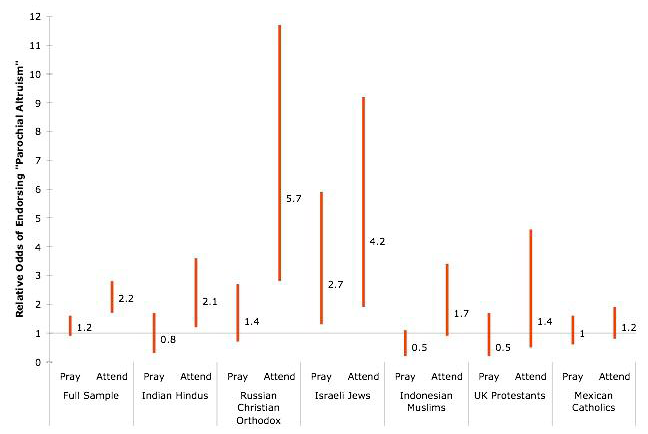 Across the six countries they surveyed (including Hindus, Christians and Muslims and Jews), frequent attendance at religious services doubled the support for parochial altruism. Although prayer increased parochial altruism in some countries, overall it had no effect.
What these results are saying is that going to Church, or to a Mosque, Synagogue or Temple creates a ‘coalitional commitment’. On the face of it, this isn’t too surprising. After all, we’re always being told that religion acts to ‘strengthen the community’. And it does. Religious attendance seems to help people to live longer, and to reduce the risk of suicide – presumably by helping them feel part of a special group.
But here we’re seeing the nasty flip-side to group cohesion. Religion also helps people to do all the nasty things that they do as groups. If you want to stop society splitting into ‘us’ and ‘them’, then the first thing you need to do is to reduce – not increase – support for religious groups.
 Jeremy Ginges, Ian Hansen, Ara Norenzayan (2009). Religion and Support for Suicide Attacks Psychological Science, 20 (2), 224-230 DOI: 10.1111/j.1467-9280.2009.02270.x
Previous Post

February 19, 2009
Why adults don't believe in god... perhaps!
Next Post
February 22, 2009 Big questions in the social science of religion? How to get it wrong...
Browse Our Archives
Select a Category Causes of religion - evolution Causes of religion - psychological Causes of religion - social Demographics Digest Effects of religion - health Effects of religion - psychological Effects of religion - social Notifications Politics Uncategorized
Select a Month March 2016 February 2016 January 2016 December 2015 November 2015 October 2015 September 2015 August 2015 July 2015 June 2015 May 2015 April 2015 March 2015 February 2015 January 2015 December 2014 November 2014 October 2014 September 2014 August 2014 July 2014 June 2014 May 2014 April 2014 March 2014 February 2014 January 2014 December 2013 November 2013 October 2013 September 2013 August 2013 July 2013 June 2013 May 2013 April 2013 March 2013 February 2013 January 2013 December 2012 November 2012 October 2012 September 2012 August 2012 July 2012 June 2012 May 2012 April 2012 March 2012 February 2012 January 2012 December 2011 November 2011 October 2011 September 2011 August 2011 July 2011 June 2011 May 2011 April 2011 March 2011 February 2011 January 2011 December 2010 November 2010 October 2010 September 2010 August 2010 July 2010 June 2010 May 2010 April 2010 March 2010 February 2010 January 2010 December 2009 November 2009 October 2009 September 2009 August 2009 July 2009 June 2009 May 2009 April 2009 March 2009 February 2009 January 2009 December 2008 November 2008 October 2008 September 2008 August 2008 July 2008 June 2008 May 2008 April 2008 March 2008 February 2008 January 2008 December 2007 November 2007 October 2007
Follow Us!
TAKE THE
Religious Wisdom Quiz
Which Christian group is known for practicing strict nonviolence?
Select your answer to see how you score.
Mennonites Lutherans Methodists Presbyterians
Related posts from Epiphenom

Do social crises lead to religious revivals? Nah!

What kind of woman would pray for health...

Can you use religion to change attitudes towards...

Dogmatic atheism and fundamentalist Christianity: creating certainty in...
TRENDING AT PATHEOS Nonreligious

Dethroning Jesus and Enthroning Yourself
Jesus Never Asked to Be Worshipped. He Asked to Be Understood. Christianity...

Why Most Christians are Really Paulians and Jobians
I Don't Care, But It Matters Let's get this out of the...

Essential Tips to Successfully Navigate the Selling Process
Selling a house can feel overwhelming, but it doesn’t have to be....

To Make Remote Work Effective, Think About Others
The COVID-19 pandemic forced many companies to rapidly transition to remote work....

Flexibility Is Key to Solving Problems of Tomorrow
The world of work is undergoing a dramatic transformation. The COVID-19 pandemic...
view all Nonreligious blogs
Ad-Free & Subscriber Log-In Subscription Support
- About Us
- 2026 Calendar
- Videos
- Podcasts
- Library of World Religions
- Faith In Media Tracker
- Advertise With Us
- Write for Us
- Privacy Policy
- Terms of Service
- Do Not Sell My Data
- Contact Us
- Radiant Digital
- Manage Newsletter Subscriptions
- Unsubscribe From Notifications
- Sitemap
Copyright 2008-2026, Patheos. All rights reserved.
Subscription Support Ad-Free & Subscriber Log-In
Follow Patheos