
BuddhistCatholicContemplativeEvangelicalGeneral ChristianHinduJewishLatter-day SaintMuslimNew VisionsProgressive Christian
Beliefs
- Buddhist
- Catholic
- Contemplative
- Evangelical
- General Christian
- Hindu
- Jewish
- Latter-day Saint
- More Voices
- Muslim
- New Visions
- Pagan
- Progressive Christian
Topics
- Religion News
- Food and Religion
- Sports and Religion
- Religious Art
- Religious Music and Entertainment
- Religious Events
- History and Religion
- Style and Religion
- Politics and Religion
- Women in Religion
- Recreation Outdoors and Religion
- Business Finance and Religion
- Careers Workplace and Religion
- Education and Religion
- Family Parenting and Religion
- Health Fitness and Religion
- Home and Religion
- Relationships and Religion
- Technology and Religion
- Travel and Religion
Columnists
- Buddhist Columnists
- Business Finance and Religion Columnists
- Careers Workplace and Religion Columnists
- Catholic Columnists
- Contemplative Columnists
- Education and Religion Columnists
- Evangelists Columnists
- Family Parenting and Religion Columnists
- General Christian Columnists
- Health Fitness and Religion Columnists
- Hindu Columnists
- History and Religion Columnists
- Home and Religion Columnists
- Jewish Columnists
- More Voices Columnists
- Latter Day Columnists
- Muslim Columnists
- New Visions Columnists
- Nonreligious Columnists
- Pagan Columnists
- Politics and Religion Columnists
- Progressive Columnists
- Recreation Outdoors and Religion Columnists
- Relationships and Religion Columnists
- Religion News Columnists
- Religious Art Columnists
- Religious Events Columnists
- Religious Music and Entertainment Columnists
- Sports and Religion Columnists
- Style and Religion Columnists
- Technology and Religion Columnists
- Travel and Religion Columnists
- Women in Religion Columnists
Resource Library
- 2026 Calendar
- Library of World Religions
- The 100 Most Holy Places on Earth
- Patheos Answers
- Podcasts
- Videos
- Faith Leaders Database
- Anglican Episcopalian
- Bahai
- Baptist
- Buddhism
- Christianity
- Confucianism
- Eastern Orthodoxy
- Hinduism
- Holiness and Pentecostal
- ISKCON
- Islam
- Judaism
- Lutheran
- Methodist
- The Church of Jesus Christ of Latter-day Saints
- New Age
- Paganism
- Presbytarian and Reformed
- Protestantism
- Religion Behind the Scenes
- Roman Catholic
- Scientology
- Shia Islam
- Sikhism
- Sufism
- Sunni Islam
- Taoism
- Zen
- See all religions
Research Tools
 Ad-Free & Subscriber Log-In Subscription Support
Ad-Free & Subscriber Log-In Subscription Support
Follow Patheos 

- Trending:
- Forgiveness
- |
- Marriage
- |
- Consciousness
- |
- Death Penalty
- |
- Election
- |
- Halloween
 Epiphenom
- Home
- Nonreligious
- How religion generates social conservatism
How religion generates social conservatism
Last updated on: December 7, 2014 at 5:45 am by Epiphenom
How religion generates social conservatism 2014-12-07T05:45:12+01:00 Epiphenom
Patheos Explore the world's faith through different perspectives on religion and spirituality! Patheos has the views of the prevalent religions and spiritualities of the world.
You could make a reasonable case that pencils have a purpose, but pencil shavings just exist. But what about elephants? Religious people and children are, of course, more likely than non-religious adults to say that animals exist for a purpose.
But what about men and women? Black people and whites? Rich and poor? Arab and Jew? Do these exist for a purpose? And is it possible for one to become another? Gil Diesdendruck and Lital Haber of Bar-Ilan University in Israel decided to find out what children think.
They tested 64 Jewish girls and boys aged 7-12 years. Public education in Israel is heavily segregated, and they took half their sample from a secular school and half from an orthodox school. Each child was shown a series of picture pairs – animals (elephants and lions), artefacts (chairs and tables), ethnicity (Arabs and Jews), sex (men and women), race (black and white), and wealth (rich and poor).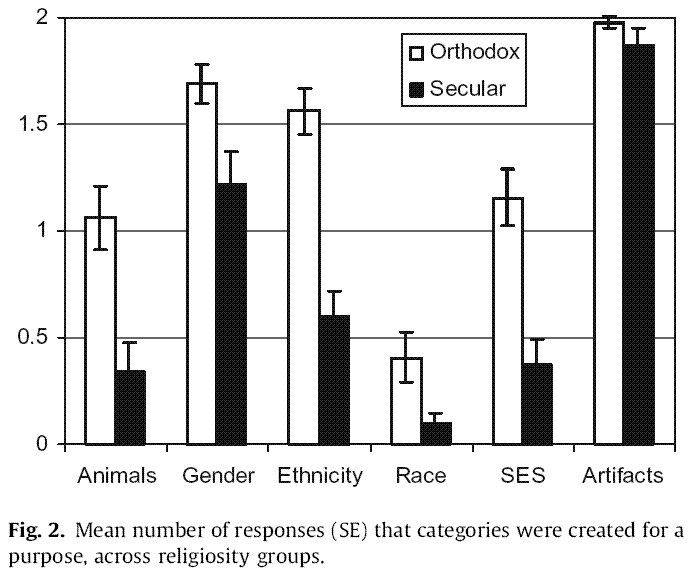 They were then shown a little story, in which two dolls discussed whether these different categories exist for a purpose, e.g., ‘‘Danny says that rich people exist for a purpose. Yossi says that rich people exist for no purpose, they just exist”. The children were then asked who was right.
There were big differences between the two groups, shown in the figure here. Orthodox kids were much more likely to say that Arabs and Jews exist for a specific purpose, as do blacks and whites and, revealingly, rich and poor.
In other words, they think that all these types exist because they have a specific role to play, usually mandated by god. You can see here the seed of adult-life social conservatism.
They also asked the kids whether it was possible for one type to become another. Whether an Arab could become a Jew, or a poor person become rich. While they broadly agreed on animals, artefacts, and wealth, orthodox kids were more likely to say that sex, race and ethnicity are fixed (they have ‘essential’ properties).
These differences become even more stark when you split the kids not according to whether they were orthodox or secular, but according to whether they thought that God had created each of the categories in question. Of course, orthodox kids were more likely to think this, but not all of them did (and, conversely, some secular kids did).
The kids who thought that god created race, ethnicity, and gender were significantly more likely to think that this categories were created for a purpose and also that they were stable (you can’t change from one to another). Although they thought that socio-economic status and animals were also created for a purpose, but weren’t more likely to think that these categories were stable.
Here’s what Diesendruck and Haber conclude:
… our findings indicate that children’s essentialist beliefs about animals, and their teleological construal of artifacts, come to them intuitively and independently of creationism. In turn, children’s extension of essentialism to particular social categories, and teleology to both social categories and animals, are reflective, and result from the communication of a culturally constituted belief system – i.e., creationism.
In other words, if you teach kids creationism – not just about animals, but about people – you train them to think that they have a specific purpose (in the same way that secular kids think about artefacts such as pencils, tables and chairs).
It’s no wonder, then, that they grow up to be social conservatives – fearing women and gay rights, accepting wide differences in social equality, and reinforcing the ethnic schisms within society.
 G DIESENDRUCK, L HABER (2009). God’s categories: The effect of religiosity on children’s teleological and essentialist beliefs about categories. Cognition, 110 (1), 100-114. DOI: 10.1016/j.cognition.2008.11.001
Previous Post

February 11, 2009
US Protestants have low brand loyalty
Next Post
February 17, 2009 Religious fundamentalism is in the genes
Browse Our Archives
Select a Category Causes of religion - evolution Causes of religion - psychological Causes of religion - social Demographics Digest Effects of religion - health Effects of religion - psychological Effects of religion - social Notifications Politics Uncategorized
Select a Month March 2016 February 2016 January 2016 December 2015 November 2015 October 2015 September 2015 August 2015 July 2015 June 2015 May 2015 April 2015 March 2015 February 2015 January 2015 December 2014 November 2014 October 2014 September 2014 August 2014 July 2014 June 2014 May 2014 April 2014 March 2014 February 2014 January 2014 December 2013 November 2013 October 2013 September 2013 August 2013 July 2013 June 2013 May 2013 April 2013 March 2013 February 2013 January 2013 December 2012 November 2012 October 2012 September 2012 August 2012 July 2012 June 2012 May 2012 April 2012 March 2012 February 2012 January 2012 December 2011 November 2011 October 2011 September 2011 August 2011 July 2011 June 2011 May 2011 April 2011 March 2011 February 2011 January 2011 December 2010 November 2010 October 2010 September 2010 August 2010 July 2010 June 2010 May 2010 April 2010 March 2010 February 2010 January 2010 December 2009 November 2009 October 2009 September 2009 August 2009 July 2009 June 2009 May 2009 April 2009 March 2009 February 2009 January 2009 December 2008 November 2008 October 2008 September 2008 August 2008 July 2008 June 2008 May 2008 April 2008 March 2008 February 2008 January 2008 December 2007 November 2007 October 2007
Follow Us!
TAKE THE
Religious Wisdom Quiz
Who was King Saul's father?
Select your answer to see how you score.
Methuselah Kish Job Rehoboam
Related posts from Epiphenom

Do social crises lead to religious revivals? Nah!

What kind of woman would pray for health...

Can you use religion to change attitudes towards...

Dogmatic atheism and fundamentalist Christianity: creating certainty in...
TRENDING AT PATHEOS Nonreligious

Dethroning Jesus and Enthroning Yourself
Jesus Never Asked to Be Worshipped. He Asked to Be Understood. Christianity...

Why Most Christians are Really Paulians and Jobians
I Don't Care, But It Matters Let's get this out of the...

Essential Tips to Successfully Navigate the Selling Process
Selling a house can feel overwhelming, but it doesn’t have to be....

To Make Remote Work Effective, Think About Others
The COVID-19 pandemic forced many companies to rapidly transition to remote work....

Flexibility Is Key to Solving Problems of Tomorrow
The world of work is undergoing a dramatic transformation. The COVID-19 pandemic...
view all Nonreligious blogs
Ad-Free & Subscriber Log-In Subscription Support
- About Us
- 2026 Calendar
- Videos
- Podcasts
- Library of World Religions
- Faith In Media Tracker
- Advertise With Us
- Write for Us
- Privacy Policy
- Terms of Service
- Do Not Sell My Data
- Contact Us
- Radiant Digital
- Manage Newsletter Subscriptions
- Unsubscribe From Notifications
- Sitemap
Copyright 2008-2026, Patheos. All rights reserved.
Subscription Support Ad-Free & Subscriber Log-In
Follow Patheos