
BuddhistCatholicContemplativeEvangelicalGeneral ChristianHinduJewishLatter-day SaintMuslimNew VisionsProgressive Christian
Beliefs
- Buddhist
- Catholic
- Contemplative
- Evangelical
- General Christian
- Hindu
- Jewish
- Latter-day Saint
- More Voices
- Muslim
- New Visions
- Pagan
- Progressive Christian
Topics
- Religion News
- Food and Religion
- Sports and Religion
- Religious Art
- Religious Music and Entertainment
- Religious Events
- History and Religion
- Style and Religion
- Politics and Religion
- Women in Religion
- Recreation Outdoors and Religion
- Business Finance and Religion
- Careers Workplace and Religion
- Education and Religion
- Family Parenting and Religion
- Health Fitness and Religion
- Home and Religion
- Relationships and Religion
- Technology and Religion
- Travel and Religion
Columnists
- Buddhist Columnists
- Business Finance and Religion Columnists
- Careers Workplace and Religion Columnists
- Catholic Columnists
- Contemplative Columnists
- Education and Religion Columnists
- Evangelists Columnists
- Family Parenting and Religion Columnists
- General Christian Columnists
- Health Fitness and Religion Columnists
- Hindu Columnists
- History and Religion Columnists
- Home and Religion Columnists
- Jewish Columnists
- More Voices Columnists
- Latter Day Columnists
- Muslim Columnists
- New Visions Columnists
- Nonreligious Columnists
- Pagan Columnists
- Politics and Religion Columnists
- Progressive Columnists
- Recreation Outdoors and Religion Columnists
- Relationships and Religion Columnists
- Religion News Columnists
- Religious Art Columnists
- Religious Events Columnists
- Religious Music and Entertainment Columnists
- Sports and Religion Columnists
- Style and Religion Columnists
- Technology and Religion Columnists
- Travel and Religion Columnists
- Women in Religion Columnists
Resource Library
- 2026 Calendar
- Library of World Religions
- The 100 Most Holy Places on Earth
- Patheos Answers
- Podcasts
- Videos
- Faith Leaders Database
- Anglican Episcopalian
- Bahai
- Baptist
- Buddhism
- Christianity
- Confucianism
- Eastern Orthodoxy
- Hinduism
- Holiness and Pentecostal
- ISKCON
- Islam
- Judaism
- Lutheran
- Methodist
- The Church of Jesus Christ of Latter-day Saints
- New Age
- Paganism
- Presbytarian and Reformed
- Protestantism
- Religion Behind the Scenes
- Roman Catholic
- Scientology
- Shia Islam
- Sikhism
- Sufism
- Sunni Islam
- Taoism
- Zen
- See all religions
Research Tools
 Ad-Free & Subscriber Log-In Subscription Support
Ad-Free & Subscriber Log-In Subscription Support
Follow Patheos 

- Trending:
- Forgiveness
- |
- Marriage
- |
- Consciousness
- |
- Death Penalty
- |
- Election
- |
- Halloween
 Epiphenom
- Home
- Nonreligious
- Revenge is not so sweet
Revenge is not so sweet
Last updated on: December 7, 2014 at 5:53 am by Epiphenom
Revenge is not so sweet 2014-12-07T05:53:11+01:00 Epiphenom
Patheos Explore the world's faith through different perspectives on religion and spirituality! Patheos has the views of the prevalent religions and spiritualities of the world.
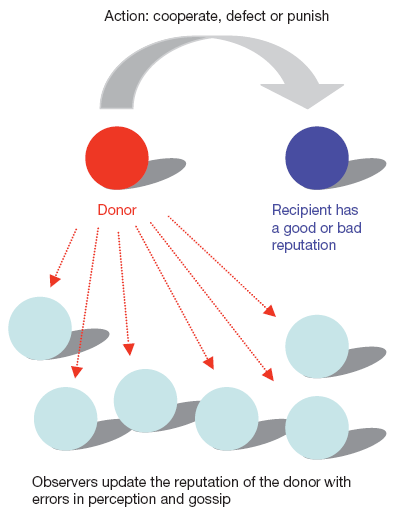 What to to do if someone you know behaves badly? Turn the other cheek, or take your revenge? According to Martin Nowak’s latest game-theory based analysis, turning the cheek is the strategy that’s most likely to reward you in the long run.
Nowak (Professor of Biology and of Mathematics at Harvard University) is interested in something called the repeated prisoner’s dilemma, a popular model of social interactions. In the game, you’re paired up with another person and have a choice of either co-operating (in which case your partner benefits but you don’t) or defecting (in which case you benefit but your partner loses). The payouts in the game are set such that it’s best if you both co-operate, but there is a strong incentive for you as an individual to cheat – if you can get away with it!
In a study published in early 2008, Nowak and colleagues looked at what happened if you were also allowed to punish defectors – this is so-called ‘costly punishment’, which costs you a bit but inflicts a greater cost on your victim. Now, you might think that strategies in which you can punish cheaters can bring them back into line, and so increase your payout.
In fact, that wasn’t what happened. They showed that people who were quicker to use punishment tended to lose out overall, and that the best results were achieved by people who responded to defectors simply by defecting themselves (i.e. refusing to co-operate).
In reality, life is a little more complicated than this simple two-way interaction. We’ve evolved to live in groups, and most of our interactions are with people who we’ve watched in action, and so we’ve formed an opinion of what they’re like. Reputation is important.
In a new paper, Nowak looks at whether the reputation you earn can make punishment a more effective strategy. This time they used a mathematical model to explore all the options, rather than real people.
What the model assumes is that your actions are watched by a group of observers, who assign you a reputation according to your actions and whether the recipient of your action has either a good or a bad reputation (see figure above). They then treat you according to the opinion they’ve formed of you. It’s called ‘indirect reciprocity’, as opposed to the direct reciprocity of the two-person game.
To make the simulation realistic, they also assumed that the watchers could make mistakes about your reputation, and also that they talked to each other (they gossip!).
What they found was that if the watchers were poor in assessing your reputation, then defection was the best strategy (you might as well defect, since the watchers are pretty clueless). If they were good at it, then you should co-operate with good people and defect with bad.
But there were hardly any circumstances in which you benefit from being in a group that believes in punishing those who are bad.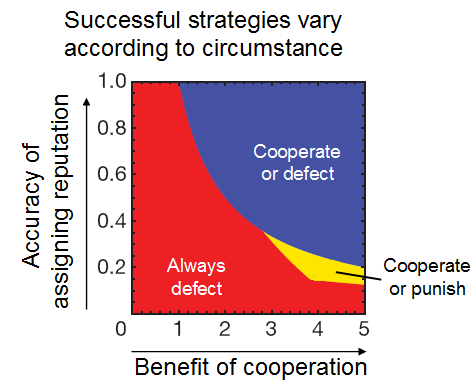 You can get a flavour for what this means in practice from this figure, which shows how varying two of the parameters affects the best strategy.
If individuals are poor at assessing reputation, or if co-operation is not that beneficial, then the best strategy is to always defect. But if reputations are meaningful and co-operation is valuable, then you should co-operate with agents with a good reputation, and defect with those with a bad reputation (‘cooperate or defect’).
There’s only a very small patch (‘cooperate or punish’) when punishing those who are bad is the best strategy. It occurs when assigning reputation is pretty inaccurate, and the benefits of co-operation are very high.
Tweaking other parameters changes this landscape somewhat, but the general picture is always the same – there’s only a small window where ‘cooperate or punish’ is a good strategy.
So why did punishment as a strategy ever evolve? Well, this is a model, not reality. The agents are simple, and the model assumes that everyone has the same attitudes to crime and punishment.
But perhaps the reason that punishment is popular is not that it increases overall good, but that it brings fewer negative effects to the punisher than to everyone else. For example, punishment could evolve if it is a way of establishing social dominance. Nowak explains in his 2008 paper:
We conclude that costly punishment might have evolved for reasons other than promoting cooperation, such as coercing individuals into submission and establishing dominance hierarchies. Punishment might enable a group to exert control over individual behaviour. A stronger individual could use punishment to dominate weaker ones. People engage in conflicts and know that conflicts can carry costs. Costly punishment serves to escalate conflicts, not to moderate them. Costly punishment might force people to submit, but not to cooperate. It could be that costly punishment is beneficial in these other games, but the use of costly punishment in games of cooperation seems to be maladaptive. We have shown that in the framework of direct reciprocity, winners do not use costly punishment, whereas losers punish and perish.
In other words, the winners in costly punishment games don’t do well – they simply do less badly than everyone else.

Hisashi Ohtsuki, Yoh Iwasa, Martin A. Nowak (2009). Indirect reciprocity provides only a narrow margin of efficiency for costly punishment Nature, 457 (7225), 79-82 DOI: 10.1038/nature07601
Anna Dreber, David G. Rand, Drew Fudenberg, Martin A. Nowak (2008). Winners don’t punish Nature, 452 (7185), 348-351 DOI: 10.1038/nature06723
Previous Post

January 14, 2009
A cup of coffee to raise the dead
Next Post
January 16, 2009 Faith healers sabotage vaccination efforts
Browse Our Archives
Select a Category Causes of religion - evolution Causes of religion - psychological Causes of religion - social Demographics Digest Effects of religion - health Effects of religion - psychological Effects of religion - social Notifications Politics Uncategorized
Select a Month March 2016 February 2016 January 2016 December 2015 November 2015 October 2015 September 2015 August 2015 July 2015 June 2015 May 2015 April 2015 March 2015 February 2015 January 2015 December 2014 November 2014 October 2014 September 2014 August 2014 July 2014 June 2014 May 2014 April 2014 March 2014 February 2014 January 2014 December 2013 November 2013 October 2013 September 2013 August 2013 July 2013 June 2013 May 2013 April 2013 March 2013 February 2013 January 2013 December 2012 November 2012 October 2012 September 2012 August 2012 July 2012 June 2012 May 2012 April 2012 March 2012 February 2012 January 2012 December 2011 November 2011 October 2011 September 2011 August 2011 July 2011 June 2011 May 2011 April 2011 March 2011 February 2011 January 2011 December 2010 November 2010 October 2010 September 2010 August 2010 July 2010 June 2010 May 2010 April 2010 March 2010 February 2010 January 2010 December 2009 November 2009 October 2009 September 2009 August 2009 July 2009 June 2009 May 2009 April 2009 March 2009 February 2009 January 2009 December 2008 November 2008 October 2008 September 2008 August 2008 July 2008 June 2008 May 2008 April 2008 March 2008 February 2008 January 2008 December 2007 November 2007 October 2007
Follow Us!
TAKE THE
Religious Wisdom Quiz
Which Christian group practices foot washing as an ordinance?
Select your answer to see how you score.
Methodists Catholics Baptists Anabaptists
Related posts from Epiphenom

Do social crises lead to religious revivals? Nah!

What kind of woman would pray for health...

Can you use religion to change attitudes towards...

Dogmatic atheism and fundamentalist Christianity: creating certainty in...
TRENDING AT PATHEOS Nonreligious

Dethroning Jesus and Enthroning Yourself
Jesus Never Asked to Be Worshipped. He Asked to Be Understood. Christianity...

Why Most Christians are Really Paulians and Jobians
I Don't Care, But It Matters Let's get this out of the...

Essential Tips to Successfully Navigate the Selling Process
Selling a house can feel overwhelming, but it doesn’t have to be....

To Make Remote Work Effective, Think About Others
The COVID-19 pandemic forced many companies to rapidly transition to remote work....

Flexibility Is Key to Solving Problems of Tomorrow
The world of work is undergoing a dramatic transformation. The COVID-19 pandemic...
view all Nonreligious blogs
Ad-Free & Subscriber Log-In Subscription Support
- About Us
- 2026 Calendar
- Videos
- Podcasts
- Library of World Religions
- Faith In Media Tracker
- Advertise With Us
- Write for Us
- Privacy Policy
- Terms of Service
- Do Not Sell My Data
- Contact Us
- Radiant Digital
- Manage Newsletter Subscriptions
- Unsubscribe From Notifications
- Sitemap
Copyright 2008-2026, Patheos. All rights reserved.
Subscription Support Ad-Free & Subscriber Log-In
Follow Patheos