
BuddhistCatholicContemplativeEvangelicalGeneral ChristianHinduJewishLatter-day SaintMuslimNew VisionsProgressive Christian
Beliefs
- Buddhist
- Catholic
- Contemplative
- Evangelical
- General Christian
- Hindu
- Jewish
- Latter-day Saint
- More Voices
- Muslim
- New Visions
- Pagan
- Progressive Christian
Topics
- Religion News
- Food and Religion
- Sports and Religion
- Religious Art
- Religious Music and Entertainment
- Religious Events
- History and Religion
- Style and Religion
- Politics and Religion
- Women in Religion
- Recreation Outdoors and Religion
- Business Finance and Religion
- Careers Workplace and Religion
- Education and Religion
- Family Parenting and Religion
- Health Fitness and Religion
- Home and Religion
- Relationships and Religion
- Technology and Religion
- Travel and Religion
Columnists
- Buddhist Columnists
- Business Finance and Religion Columnists
- Careers Workplace and Religion Columnists
- Catholic Columnists
- Contemplative Columnists
- Education and Religion Columnists
- Evangelists Columnists
- Family Parenting and Religion Columnists
- General Christian Columnists
- Health Fitness and Religion Columnists
- Hindu Columnists
- History and Religion Columnists
- Home and Religion Columnists
- Jewish Columnists
- More Voices Columnists
- Latter Day Columnists
- Muslim Columnists
- New Visions Columnists
- Nonreligious Columnists
- Pagan Columnists
- Politics and Religion Columnists
- Progressive Columnists
- Recreation Outdoors and Religion Columnists
- Relationships and Religion Columnists
- Religion News Columnists
- Religious Art Columnists
- Religious Events Columnists
- Religious Music and Entertainment Columnists
- Sports and Religion Columnists
- Style and Religion Columnists
- Technology and Religion Columnists
- Travel and Religion Columnists
- Women in Religion Columnists
Resource Library
- 2026 Calendar
- Library of World Religions
- The 100 Most Holy Places on Earth
- Patheos Answers
- Podcasts
- Videos
- Faith Leaders Database
- Anglican Episcopalian
- Bahai
- Baptist
- Buddhism
- Christianity
- Confucianism
- Eastern Orthodoxy
- Hinduism
- Holiness and Pentecostal
- ISKCON
- Islam
- Judaism
- Lutheran
- Methodist
- The Church of Jesus Christ of Latter-day Saints
- New Age
- Paganism
- Presbytarian and Reformed
- Protestantism
- Religion Behind the Scenes
- Roman Catholic
- Scientology
- Shia Islam
- Sikhism
- Sufism
- Sunni Islam
- Taoism
- Zen
- See all religions
Research Tools
 Ad-Free & Subscriber Log-In Subscription Support
Ad-Free & Subscriber Log-In Subscription Support
Follow Patheos 

- Trending:
- Forgiveness
- |
- Marriage
- |
- Consciousness
- |
- Death Penalty
- |
- Election
- |
- Halloween
 Epiphenom
- Home
- Nonreligious
- Religion and spiritual beliefs do not make happy children: friends and values do
Religion and spiritual beliefs do not make happy children: friends and values do
Last updated on: December 7, 2014 at 5:56 am by Epiphenom
Religion and spiritual beliefs do not make happy children: friends and values do 2014-12-07T05:56:53+01:00 Epiphenom
Patheos Explore the world's faith through different perspectives on religion and spirituality! Patheos has the views of the prevalent religions and spiritualities of the world.
Here’s a study that’s been reported badly in the press (e.g. Washington Times), because what psychologists mean by the term spirituality is not the same as what ordinary people mean by it. It doesn’t mean quite what most people think it does.
So when a study reports that children’s happiness is linked to their spirituality, it only begs the question ‘what do they mean?’ And here’s where it gets interesting.
In the study in question, by Mark Holder and colleagues at the University of British Columbia, they used a standard questionnaire-based measure of spirituality, the Spiritual Well-Being Questionnaire (SWBQ). This has four components:
- Personal (meaning and value in one’s own life)
- Communal (quality and depth of inter-personal relationships)
- Environmental (sense of awe for nature)
- Transcendental (faith in and relationship with someone or something beyond the human level)
You can see that only the last one, Transcendental, means anything like the conventional meaning of the term ‘spiritual’.
They gave this questionnaire to 320 children aged 8-12 from a mix of state and faith schools. They also gave them a questionnaire on their religiousness (which measured their beliefs and practices) and a battery of three questionnaires on their happiness.
What they found was that there was no correlation between happiness and religiousness, and that the correlation with transcendental spirituality was weak and inconsistent. Environmental spirituality was stronger, but the strongest correlation was with personal and communal spirituality.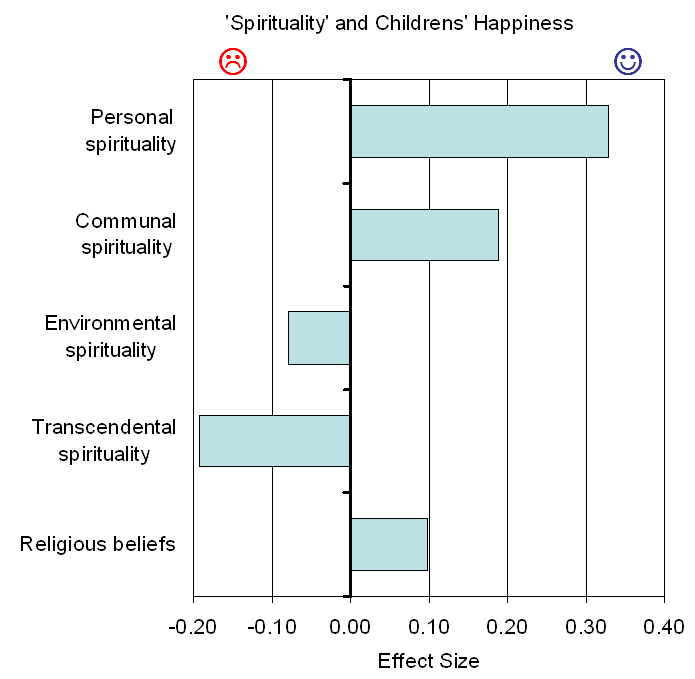 But there is a problem. Happiness was also linked to personality. If personality and spirituality are connected, then that would skew the results (if, for example, shy children are more spiritual). So they did a hierarchical regression, which corrected for personality and also for sex and type of school.
The results for one of the happiness measures are shown in the figure. The others are pretty much the same – but this is the only one in which transcendental spirituality reached statistical significance.
You can see that personal and communal ‘spirituality’ is really important. They each account for about 5% and 2% of the variation in happiness – which may not sound much but is actually quite a lot by the standards of these kinds of studies. Religion also has a positive effect, but it is small (<0.05%) and probably just a chance effect (it’s not ‘statistically’ significant).
But look at ‘transcendental’ spirituality! It is significant, and the effect is to reduce happiness! The exact opposite of what the news reports would leave you thinking!
So what to make of this? Well, the first lesson is not to trust news reports about studies on ‘spirituality’. Journalists and psychologists mean different things by them.
Secondly, we are starting to get a good grasp on what makes for happy children (all the factors together explain over 20% of the variation in happiness between children). And the answer won’t be a surprise to humanists.
To make children happier, we may need to encourage them to develop a strong sense of personal worth, according to Dr. Mark Holder from the University of British Columbia in Canada and his colleagues Dr. Ben Coleman and Judi Wallace. Their research shows that children who feel that their lives have meaning and value and who develop deep, quality relationships – both measures of spirituality – are happier. It would appear, however, that their religious practices have little effect on their happiness. (ScienceDaily)
Happy children are ones who are loved and valued, who have a strong sense of community and friendship, and who are shielded from excessive spiritual mumbo jumbo.

Mark D. Holder, Ben Coleman, Judi M. Wallace (2008). Spirituality, Religiousness, and Happiness in Children Aged 8–12 Years Journal of Happiness Studies DOI: 10.1007/s10902-008-9126-1
Previous Post

January 10, 2009
Religion and self-control: the junk science version
Next Post
January 14, 2009 A cup of coffee to raise the dead
Browse Our Archives
Select a Category Causes of religion - evolution Causes of religion - psychological Causes of religion - social Demographics Digest Effects of religion - health Effects of religion - psychological Effects of religion - social Notifications Politics Uncategorized
Select a Month March 2016 February 2016 January 2016 December 2015 November 2015 October 2015 September 2015 August 2015 July 2015 June 2015 May 2015 April 2015 March 2015 February 2015 January 2015 December 2014 November 2014 October 2014 September 2014 August 2014 July 2014 June 2014 May 2014 April 2014 March 2014 February 2014 January 2014 December 2013 November 2013 October 2013 September 2013 August 2013 July 2013 June 2013 May 2013 April 2013 March 2013 February 2013 January 2013 December 2012 November 2012 October 2012 September 2012 August 2012 July 2012 June 2012 May 2012 April 2012 March 2012 February 2012 January 2012 December 2011 November 2011 October 2011 September 2011 August 2011 July 2011 June 2011 May 2011 April 2011 March 2011 February 2011 January 2011 December 2010 November 2010 October 2010 September 2010 August 2010 July 2010 June 2010 May 2010 April 2010 March 2010 February 2010 January 2010 December 2009 November 2009 October 2009 September 2009 August 2009 July 2009 June 2009 May 2009 April 2009 March 2009 February 2009 January 2009 December 2008 November 2008 October 2008 September 2008 August 2008 July 2008 June 2008 May 2008 April 2008 March 2008 February 2008 January 2008 December 2007 November 2007 October 2007
Follow Us!
TAKE THE
Religious Wisdom Quiz
True or False: Hebrews states that it is appointed for men to die once, and after this comes judgment.
Select your answer to see how you score.
FALSE TRUE
Related posts from Epiphenom

Do social crises lead to religious revivals? Nah!

What kind of woman would pray for health...

Can you use religion to change attitudes towards...

Dogmatic atheism and fundamentalist Christianity: creating certainty in...
TRENDING AT PATHEOS Nonreligious

Dethroning Jesus and Enthroning Yourself
Jesus Never Asked to Be Worshipped. He Asked to Be Understood. Christianity...

Why Most Christians are Really Paulians and Jobians
I Don't Care, But It Matters Let's get this out of the...

Essential Tips to Successfully Navigate the Selling Process
Selling a house can feel overwhelming, but it doesn’t have to be....

To Make Remote Work Effective, Think About Others
The COVID-19 pandemic forced many companies to rapidly transition to remote work....

Flexibility Is Key to Solving Problems of Tomorrow
The world of work is undergoing a dramatic transformation. The COVID-19 pandemic...
view all Nonreligious blogs
Ad-Free & Subscriber Log-In Subscription Support
- About Us
- 2026 Calendar
- Videos
- Podcasts
- Library of World Religions
- Faith In Media Tracker
- Advertise With Us
- Write for Us
- Privacy Policy
- Terms of Service
- Do Not Sell My Data
- Contact Us
- Radiant Digital
- Manage Newsletter Subscriptions
- Unsubscribe From Notifications
- Sitemap
Copyright 2008-2026, Patheos. All rights reserved.
Subscription Support Ad-Free & Subscriber Log-In
Follow Patheos