
BuddhistCatholicContemplativeEvangelicalGeneral ChristianHinduJewishLatter-day SaintMuslimNew VisionsProgressive Christian
Beliefs
- Buddhist
- Catholic
- Contemplative
- Evangelical
- General Christian
- Hindu
- Jewish
- Latter-day Saint
- More Voices
- Muslim
- New Visions
- Pagan
- Progressive Christian
Topics
- Religion News
- Food and Religion
- Sports and Religion
- Religious Art
- Religious Music and Entertainment
- Religious Events
- History and Religion
- Style and Religion
- Politics and Religion
- Women in Religion
- Recreation Outdoors and Religion
- Business Finance and Religion
- Careers Workplace and Religion
- Education and Religion
- Family Parenting and Religion
- Health Fitness and Religion
- Home and Religion
- Relationships and Religion
- Technology and Religion
- Travel and Religion
Columnists
- Buddhist Columnists
- Business Finance and Religion Columnists
- Careers Workplace and Religion Columnists
- Catholic Columnists
- Contemplative Columnists
- Education and Religion Columnists
- Evangelists Columnists
- Family Parenting and Religion Columnists
- General Christian Columnists
- Health Fitness and Religion Columnists
- Hindu Columnists
- History and Religion Columnists
- Home and Religion Columnists
- Jewish Columnists
- More Voices Columnists
- Latter Day Columnists
- Muslim Columnists
- New Visions Columnists
- Nonreligious Columnists
- Pagan Columnists
- Politics and Religion Columnists
- Progressive Columnists
- Recreation Outdoors and Religion Columnists
- Relationships and Religion Columnists
- Religion News Columnists
- Religious Art Columnists
- Religious Events Columnists
- Religious Music and Entertainment Columnists
- Sports and Religion Columnists
- Style and Religion Columnists
- Technology and Religion Columnists
- Travel and Religion Columnists
- Women in Religion Columnists
Resource Library
- 2026 Calendar
- Library of World Religions
- The 100 Most Holy Places on Earth
- Patheos Answers
- Podcasts
- Videos
- Faith Leaders Database
- Anglican Episcopalian
- Bahai
- Baptist
- Buddhism
- Christianity
- Confucianism
- Eastern Orthodoxy
- Hinduism
- Holiness and Pentecostal
- ISKCON
- Islam
- Judaism
- Lutheran
- Methodist
- The Church of Jesus Christ of Latter-day Saints
- New Age
- Paganism
- Presbytarian and Reformed
- Protestantism
- Religion Behind the Scenes
- Roman Catholic
- Scientology
- Shia Islam
- Sikhism
- Sufism
- Sunni Islam
- Taoism
- Zen
- See all religions
Research Tools
 Ad-Free & Subscriber Log-In Subscription Support
Ad-Free & Subscriber Log-In Subscription Support
Follow Patheos 

- Trending:
- Forgiveness
- |
- Marriage
- |
- Consciousness
- |
- Death Penalty
- |
- Election
- |
- Halloween
 Epiphenom
- Home
- Nonreligious
- The childish beliefs of Dr Justin Barrett
The childish beliefs of Dr Justin Barrett
Last updated on: December 7, 2014 at 6:04 am by Epiphenom
The childish beliefs of Dr Justin Barrett 2014-12-07T06:04:38+01:00 Epiphenom
Patheos Explore the world's faith through different perspectives on religion and spirituality! Patheos has the views of the prevalent religions and spiritualities of the world.
Justin Barrett is a Senior Researcher at the University of Oxford’s Centre for Anthropology and Mind and a lecturer in the Institute of Cognitive and Evolutionary Anthropology. He’s also a devout Christian who believes that we have an inbuilt predisposition to believe not just in superstitious stuff, but also in a monotheistic god. And he takes this as evidence that god is real, and not invented.
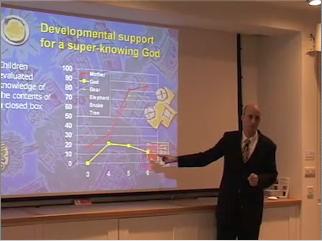
Back in November, he gave a talk at the Faraday Institute for Science and Religion in Cambridge in which he said a few things (such as: “You have to indoctrinate someone into being an atheist”) that got AC Grayling’s blood boiling (Grayling is a Professor of Philosophy at the University of London). Here’s what Grayling had to say about it:
Barrett and friends infer from the first half of these unexceptionable facts that children are hardwired to believe in a supreme being. Not only does this ignore the evidence from developmental psychology about the second stage of cognitive maturation, but is in itself a very big – and obviously hopeful – jump indeed. Moreover it ignores the fact that large tracts of humankind (the Chinese for a numerous example) have no beliefs in a supreme being, innate or learned, and that most primitive religion is animistic
Barrett responded by complaining:
Had Grayling attended the seminar as Brown did (or read my book, Why Would Anyone Believe in God?), he would know that I do not say that religion is “hardwired” or “innate” – rather that children have propensities to believe in gods because of how their minds naturally work.
Well, luckily a video of the talk is archived at the Faraday Institute, (listed under Brain/Psychology). So we can see for ourselves what all the fuss is about.
The first 20 minutes or so is stuff we’ve heard before from the likes of Scott Atran and Pascal Boyer – children seem to be programmed to see intention and design, rather than happenstance and random chance. Of course, this is true of adults too. Humans in general tend to err on the side of seeing patterns where there are none. But it’s especially true of young children.
The more interesting bit starts at around 21 minutes, when Barrett starts discussing his own work on infant understanding of the mental states of other people.
What he shows is that 3-year-olds think that their parents have god like omniscience – they know everything that the child knows. And when you ask them about god, they think the same. It’s not till kids reach 5 years that they understand that their parents do not know what’s going on inside their own head, and that there are things that only they know.
But, when you ask 5 year olds about god, well, they still think that god knows everything (as do adult believers, of course). Barrett takes this as evidence that kids come with a ‘correct’ knowledge of god built in. Young kids get god right, and mum wrong, and he says of 5 year olds: “They are not dumbing down god, they are smarting up mom” (30 minutes).
Now these facts are indisputable. It’s the interpretation that’s open to question. As Barrett says in the Q&A; session: “What we do with the interpretation, depending on our worldview, is a completely different issue. But at least we can agree on what the science is starting to show.”
So whose interpretation is right? Is Barrett right that belief in an omniscient god is built in, and we have to be persuaded otherwise? Or is Grayling right that very young kids just aren’t smart enough to figure out how minds work. And that when they learn that others can’t actually read their mind, then they would extrapolate that to god too if it weren’t for cultural indoctrination?
My money is on Grayling. I think it’s pretty clear what’s happening here. Young kids, like animals such as monkeys, simply don’t have a theory of mind. They think that others know what’s in their head, and of course when they are told about this invisible person called ‘God’ they extend these misconceptions to it.
As kids grow up they figure out that the people around them do not, in fact, know what’s going on inside their heads. They have plenty of evidence from observing how people behave, and employ their increasing brain power to work out the truth.
Of course, they can’t do this for God, because God is a fictional entity. All they have to go on is what adults are telling them. And so, following the lead of the adults around them, they continue to accept that God is omniscient. Many kids have similar beliefs about Santa Claus, and for the same reason.
Barrett says that young kids ‘get god right’. But the only reason they do this is that god is an extension into the adult world of childish understanding of how the world works. This isn’t too surprising, of course. The Judaeo-Christian concept of god is a unabashed imaginary father figure. Adults attribute to it the superhuman powers they once believed that their own fathers had.
So the reason young kids ‘get god right’ is that their brains aren’t fully developed. The reason older kids and adults ‘get god right’ is that god is their imaginary friend.
But what Barrett wants to know is “Why did these beliefs and not others?”. So, is there any evidence that these beliefs are what you get if you start to degrade the adult brain’s ability to reason about the world? Well yes there is.
Tania Lombrozo, Professor of Psychology at the Concepts and Cognition lab at Berkeley, has done similar experiments to those described by Barrett, but in Alzheimer’s patients rather than young kids. And it turns out that, just like kids, Alzheimer’s patients tend to see design everywhere. This is an excerpt from an article on her work in Berkeley Science Review:
Unlike children, most educated adults know that clouds form because water condenses, and that mountains exist because of plate tectonics. However, Lombrozo was interested in whether adults would fall back on teleological reasoning in the absence of background knowledge. To address this question, she and her colleagues Deborah Kelemen and Deborah Zaitchik examined a group of adults whose background beliefs were compromised, but who had otherwise developed normally: Alzheimer’s patients.
“Alzheimer’s patients have some characteristics of adults and some characteristics of children,” says Lombrozo. “Like adults, they have undergone normal development and have presumably gotten rid of any reasoning strategies associated only with children. But like pre-school children, they might not have access to the kinds of rich causal beliefs that adults typically have access to.”
In her study, subjects were asked to identify the most appropriate answers to a series of “why” questions. For example, for the question “Why does the earth have trees?” they could choose between “because they grow from tree seeds,” or “so that animals can have shade.” Lombrozo found that like young children, Alzheimer’s patients were much more likely than age-matched control subjects to prefer teleological explanations, picking the teleological choice about twice as often as their healthy counterparts.
So kids are like adults but with an important bit of their brain missing. And that’s why they ‘get god right’!
Previous Post

January 3, 2009
The power of evolutionary psychology
Next Post
January 5, 2009 Hello Humanists4Science and Epiphenom
Browse Our Archives
Select a Category Causes of religion - evolution Causes of religion - psychological Causes of religion - social Demographics Digest Effects of religion - health Effects of religion - psychological Effects of religion - social Notifications Politics Uncategorized
Select a Month March 2016 February 2016 January 2016 December 2015 November 2015 October 2015 September 2015 August 2015 July 2015 June 2015 May 2015 April 2015 March 2015 February 2015 January 2015 December 2014 November 2014 October 2014 September 2014 August 2014 July 2014 June 2014 May 2014 April 2014 March 2014 February 2014 January 2014 December 2013 November 2013 October 2013 September 2013 August 2013 July 2013 June 2013 May 2013 April 2013 March 2013 February 2013 January 2013 December 2012 November 2012 October 2012 September 2012 August 2012 July 2012 June 2012 May 2012 April 2012 March 2012 February 2012 January 2012 December 2011 November 2011 October 2011 September 2011 August 2011 July 2011 June 2011 May 2011 April 2011 March 2011 February 2011 January 2011 December 2010 November 2010 October 2010 September 2010 August 2010 July 2010 June 2010 May 2010 April 2010 March 2010 February 2010 January 2010 December 2009 November 2009 October 2009 September 2009 August 2009 July 2009 June 2009 May 2009 April 2009 March 2009 February 2009 January 2009 December 2008 November 2008 October 2008 September 2008 August 2008 July 2008 June 2008 May 2008 April 2008 March 2008 February 2008 January 2008 December 2007 November 2007 October 2007
Follow Us!
TAKE THE
Religious Wisdom Quiz
What does Paul, as a spiritual father of the Corinthians, beseech them to do?
Select your answer to see how you score.
Eat Be Followers of Him Pray Send Paul Money
Related posts from Epiphenom

Do social crises lead to religious revivals? Nah!

What kind of woman would pray for health...

Can you use religion to change attitudes towards...

Dogmatic atheism and fundamentalist Christianity: creating certainty in...
TRENDING AT PATHEOS Nonreligious

Dethroning Jesus and Enthroning Yourself
Jesus Never Asked to Be Worshipped. He Asked to Be Understood. Christianity...

Why Most Christians are Really Paulians and Jobians
I Don't Care, But It Matters Let's get this out of the...

Essential Tips to Successfully Navigate the Selling Process
Selling a house can feel overwhelming, but it doesn’t have to be....

To Make Remote Work Effective, Think About Others
The COVID-19 pandemic forced many companies to rapidly transition to remote work....

Flexibility Is Key to Solving Problems of Tomorrow
The world of work is undergoing a dramatic transformation. The COVID-19 pandemic...
view all Nonreligious blogs
Ad-Free & Subscriber Log-In Subscription Support
- About Us
- 2026 Calendar
- Videos
- Podcasts
- Library of World Religions
- Faith In Media Tracker
- Advertise With Us
- Write for Us
- Privacy Policy
- Terms of Service
- Do Not Sell My Data
- Contact Us
- Radiant Digital
- Manage Newsletter Subscriptions
- Unsubscribe From Notifications
- Sitemap
Copyright 2008-2026, Patheos. All rights reserved.
Subscription Support Ad-Free & Subscriber Log-In
Follow Patheos