
BuddhistCatholicContemplativeEvangelicalGeneral ChristianHinduJewishLatter-day SaintMuslimNew VisionsProgressive Christian
Beliefs
- Buddhist
- Catholic
- Contemplative
- Evangelical
- General Christian
- Hindu
- Jewish
- Latter-day Saint
- More Voices
- Muslim
- New Visions
- Pagan
- Progressive Christian
Topics
- Religion News
- Food and Religion
- Sports and Religion
- Religious Art
- Religious Music and Entertainment
- Religious Events
- History and Religion
- Style and Religion
- Politics and Religion
- Women in Religion
- Recreation Outdoors and Religion
- Business Finance and Religion
- Careers Workplace and Religion
- Education and Religion
- Family Parenting and Religion
- Health Fitness and Religion
- Home and Religion
- Relationships and Religion
- Technology and Religion
- Travel and Religion
Columnists
- Buddhist Columnists
- Business Finance and Religion Columnists
- Careers Workplace and Religion Columnists
- Catholic Columnists
- Contemplative Columnists
- Education and Religion Columnists
- Evangelists Columnists
- Family Parenting and Religion Columnists
- General Christian Columnists
- Health Fitness and Religion Columnists
- Hindu Columnists
- History and Religion Columnists
- Home and Religion Columnists
- Jewish Columnists
- More Voices Columnists
- Latter Day Columnists
- Muslim Columnists
- New Visions Columnists
- Nonreligious Columnists
- Pagan Columnists
- Politics and Religion Columnists
- Progressive Columnists
- Recreation Outdoors and Religion Columnists
- Relationships and Religion Columnists
- Religion News Columnists
- Religious Art Columnists
- Religious Events Columnists
- Religious Music and Entertainment Columnists
- Sports and Religion Columnists
- Style and Religion Columnists
- Technology and Religion Columnists
- Travel and Religion Columnists
- Women in Religion Columnists
Resource Library
- 2026 Calendar
- Library of World Religions
- The 100 Most Holy Places on Earth
- Patheos Answers
- Podcasts
- Videos
- Faith Leaders Database
- Anglican Episcopalian
- Bahai
- Baptist
- Buddhism
- Christianity
- Confucianism
- Eastern Orthodoxy
- Hinduism
- Holiness and Pentecostal
- ISKCON
- Islam
- Judaism
- Lutheran
- Methodist
- The Church of Jesus Christ of Latter-day Saints
- New Age
- Paganism
- Presbytarian and Reformed
- Protestantism
- Religion Behind the Scenes
- Roman Catholic
- Scientology
- Shia Islam
- Sikhism
- Sufism
- Sunni Islam
- Taoism
- Zen
- See all religions
Research Tools
 Ad-Free & Subscriber Log-In Subscription Support
Ad-Free & Subscriber Log-In Subscription Support
Follow Patheos 

- Trending:
- Forgiveness
- |
- Marriage
- |
- Consciousness
- |
- Death Penalty
- |
- Election
- |
- Halloween
 Witch at the Crossroads
- Home
- Pagan
- Top 10 Tarot Questions I Am Asked
Top 10 Tarot Questions I Am Asked
Last updated on: December 15, 2020 at 9:26 am by Katrina Rasbold
Top 10 Tarot Questions I Am Asked 2020-12-15T09:26:33-08:00 Katrina Rasbold
Patheos Explore the world's faith through different perspectives on religion and spirituality! Patheos has the views of the prevalent religions and spiritualities of the world.
The Tarot has been a part of my life since 1983 when I purchased my first deck of Rider-Waite cards, now more appropriately known as the Smith-Waite deck to commemorate the artist, Pamela Coleman Smith. I began reading cards professionally in 1990 and teaching Tarot to aspiring readers and the Tarot-curious in 1995. In 2013, I wrote the book, Tarot For Real People, available on Amazon.com. I also offer a six class online course in the Tarot here.
These days, I still read cards professionally and also co-host a weekly Facebook Live broadcast called “Witches At The Crossroads Hour” where two of my Witch friends and I give free Tarot and oracle card readings every Thursday night at 7:00 pm Pacific Time. You can find us at www.facebook.com/crossroadsoccult. Warning: we swear a good bit. I offer remote Tarot readings by email through our shop at www.crossroadsoccult.com. When we are not experiencing Love in the Time of COVID, I offer in-person readings as well. This is not to start off the blog post with an infomercial, but to establish my credentials and experience, as well as to let you know where to find me if you wish to continue the conversation.
Throughout my ongoing dance with the Tarot, there are ten questions that frequently surface and I thought to share them with you here. These are in no particular order.
What are your favorite Tarot decks?
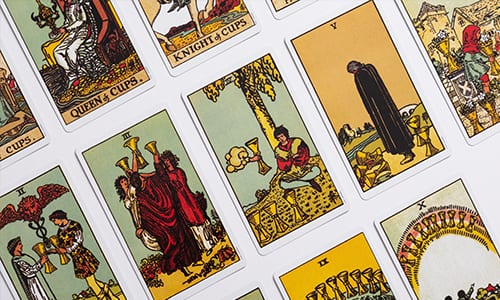
My standby since 1990 has been the Morgan Greer Tarot. As of its release in 2017, I also cling hard to the Borderless Smith-Waite deck. Lately, I have often used The Original Tarot Deck. For imagery, my current preference is the Heaven and Earth Tarot. For deeper, more thoughtful readings, I enjoy the After Tarot, Before Tarot, In Between Tarot, and Tarot of the New Vision. New Era Elements Tarot is a recent favorite and I use it a good bit. My current collection is down to probably 50 or so decks (I pared down considerably). Those listed here are the ones that I use most often for readings. I favor the borderless decks because I feel the card imagery interacts better in the spread without borders blocking the energy.
What is the difference in a Tarot deck and an oracle deck?
I did not use oracle decks until approximately two years ago and now I use them all the time. A classic Tarot deck has seventy-eight cards and that number is usually fairly consistent. In the new Smith-Waite deck of 2017, there are four extra cards that illustrate additional artwork by Pamela Coleman Smith. I assigned consistent meanings of my own to these cards and now incorporate them into my readings. Oracle decks may have any number of cards.
The primary difference in Tarot and oracle decks is now they work. Tarot is an established system of divination. A person should learn the classic, traditional interpretations of the cards and incorporate their own interpretations into their reading process as well. Oracle cards ignite your own intuitive processes. They usually have a word or image intended to invoke a feeling or string of intuitive information. I think of it as a zip file of intuition. Oracle cards are not based on any standardized structure.
How can I determine the timing of a situation using the Tarot?
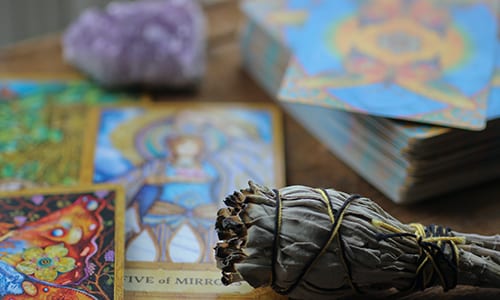
This is a tricky process because the energies we access when reading the Tarot do not acknowledge or relate to our human concept of time. A future event is in constant flux, based on the ongoing influences and factors that continually push it forward or pull it closer. When we read the Tarot, we freeze that moment in time and say, “If nothing changes, this is what we can expect.” Of course, things change every day and what seems like an unrelated and insignificant experience or choice can dramatically alter when or if a future event will occur.
There are a few timing tricks I use, only because clients demand to have some idea of when an event will occur. The first is to focus on the question and then pull a card. Look at the background of the card. Does it give you feelings of Summer, Winter, Spring, or Fall? This can guide you to the season.
Ask to be shown the month an event will occur and pull a card. If you get a non-court card from the Minor Arcana, use the card’s number to identify how many months into the future the event will occur. (Ace is one month, 8 is eight months, and so on)
Psychic Corbie Mitleid uses a brilliant technique to identify the month in which an event will happen. She focuses on the event as she shuffles, then lays out a card for this month, next month, the month after, etc. She then looks for the cards that best support the occurrence of the event. This tells if the energies for love or getting a new job are strong in one month, three months, etc.
Do you use a reading cloth?
A reading cloth is a cloth dedicated to Tarot use onto which the cards are thrown when reading a spread. I use a reading cloth if I am reading on an unfamiliar surface to protect the cards from the unknown energies of that surface. If I am reading on my work table, I do not use a reading cloth and throw the spread directly onto the table.
Do you read reversals?
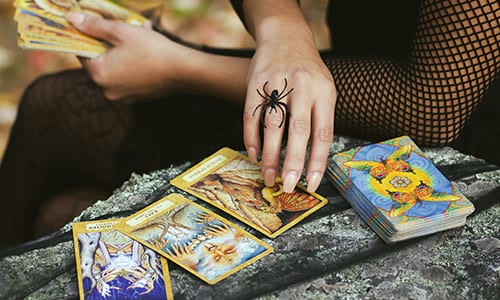
Reversals are cards that present upside down in the reading. Some readers contrive to reverse cards during the shuffle to double the number of interpretations available to them. Most reversed cards read as an opposite or lesser interpretation of the upright version of the card.
Before I read for a client, I go through the entire deck and put all of the cards upright. This clears the deck of any residual energies from the previous reading. I then hand the deck to the client and ask them to shuffle in the way that feels more organic and correct to them, cutting the deck if they wish, after which, they hand the cards back to me. I pick up the deck so the cards are facing me in the same direction they were facing the client.
When you reveal each card, you must turn the card side to side, as if turning the pages of a book, rather than flipping the card from the top or bottom. This preserves the integrity of the direction the card faces. If any cards naturally come up reversed, I read them as reversed, but I do not insist that the client shuffle in such a way that will reverse some of the cards. I do not feel I have ever had a message the Tarot needed to convey that could not come forward in the seventy-eight upright positions.
Do I have to wait to be gifted a Tarot deck or can I buy one?
If we all waited for someone to give us a Tarot deck, US Games would go out of business. Of the (literally) hundreds of Tarot decks I have owned in my life, I would guess less than 10% were gifts to me and the only ill effects I suffered was in spending far too much money on Tarot decks. On the contrary, I feel it is better to purchase your own Tarot deck so you know what speaks to you. There are elaborate, beautiful decks that do not communicate with me and simple decks that jabber like magpies. Each person has their own relationship and connection with a deck and no matter how much you know someone, that affinity is almost impossible to predict. Buy your own deck. Get the ones you love, but don’t be afraid to pass them on if you find one that does not connect to your spirit.
What decks are good for a new reader?
Just as many languages derive from Latin, most Tarot decks draw from the imagery of the original Pamela Coleman Smith drawings used in the original Rider-Waite (now Smith-Waite) deck published in 1909. For that reason, I always recommend starting with a deck that uses something very close to those images. The Smith-Waite Deck, The Universal Waite, The Radiant Rider-Waite Tarot, The Radiant Wise Spirit Tarot, and The Original Tarot Deck all use these images. I recommending learning on one of these decks, which will give you a strong foundation for relating to any of the hundreds of decks based on these images.
Are traditional interpretations more important than personal ones?
In my book, Tarot For Real People, available on Amazon.com in case you didn’t catch it up top, I recommend establishing your personal interpretations before learning the classic meanings of the cards. This addresses your most fundamental, intuitive response to the imagery on the cards. After you have a personal interpretation for each card, I fully recommend learning the traditional meanings. Once these interpretations are fully in place, your reading experience develops from a melding of those two disciplines. Neither is more important than the other.
How can I get a yes or no answer from the cards?
This is nearly impossible since the Tarot is not set up to answer yes or no questions, but to discuss the energies surrounding certain situations. These energies may be supportive or detrimental. This is a similar conundrum to the previously discussed issue of timing. Conditions constantly change and what is “yes” now might be “no” in an hour.
When a client insists on a yes or no answer, I use a pendulum, marking the direction the pendulum will swing for a yes response or a no response. I then ask the question and watch how it swings.
Another technique is to shuffle the cards well while focusing on the question. Turn up the cards one at a time into a pile, counting them as you go. Stop when you get to an Ace card or the thirteenth card in the stack. Repeat the process two more times so that you have three stacks of cards, either with thirteen cards or an ace on top. If your top cards reveal no aces, the answer is “no.” If there is one ace, the answer is “probably not.” If there are two aces, the answer is “probably yes” and if all three piles show aces, the answer is “yes.”
Do I have to be psychic to use the Tarot?
No, but it helps. The Tarot is as much as psychological tool as it is an intuitive one. Anyone can read the Tarot if they take the time to register their own visceral reactions to each of the seventy-eight cards and then learn the classic interpretations. That being said, a person who is psychic or intuitive has access to an even bigger box of toys to compliment the readings they give. The intuitive flow invoked by the Tarot, especially after lengthy practice, helps the reader tie the message of the cards into the energy of the client in a deeper, more personal way.

Photos by Kayla Maurais, Wyron, Kayla Maurais, and Viva Luna Studios on Unsplash

About Katrina M Rasbold
Katrina Rasbold is an author, shop owner, public speaker, blogger, professional Witch and all around bitchy old woman who literally lives in a weird house in the woods of California's El Dorado National Forest. She is the mother of six adult kids who are out there loose in the world and is married to Reiki Master and harmonics healer, Eric Rasbold. They own Crossroads Metaphysical Store in Shingle Springs, CA. You can email Katrina at [email protected]. You can read more about the author here.
Previous Post
December 7, 2020
A Yule Ritual: Celebrating the Return of the Sun
Next Post
December 23, 2020 Blessing Bottles for 2021: How to Make and Use Them
Browse Our Archives
Select a Category Astrology Book Reviews Current Events CUSP Energy Magic Energy Magic Words Kitchen Magic Magic in the Media Magical Ethics Magical Protection Meditations Modern Mythologies Pagan Commentary Pagan Humor Poetry Rituals Sabbats Spell Work Spiral of the Year Tarot Tarot Deck Reviews Uncategorized Witchcraft
Select a Month February 2021 January 2021 December 2020 November 2020 October 2020 September 2020 August 2020 July 2020 June 2020 May 2020 April 2020 March 2020 February 2020 January 2020 September 2015 August 2015 July 2015 June 2015 May 2015 April 2015 March 2015 February 2015
Follow Us!
TAKE THE
Religious Wisdom Quiz
Which prophet stood watch on a rampart to hear from God?
Select your answer to see how you score.
Joel Ezekiel Amos Habakkuk
Related posts from Witch at the Crossroads
Tarot Reviews: Dark Wood, Scorpio Sea, & Edgar...
A Tarot Adventure Through Magic: The Fool's Journey

20 Ways to Protect Your Energy As An...
TRENDING AT PATHEOS Pagan

I was recently chatting with someone on Instagram. She asked me what...

While there are many people who share their results, the end of...

On July 23, I saw Christopher Nolan's The Odyssey which is Homer’s...

As I write this two big events have just finished up. One...

Restoring the Watershed of Divine Love
Perhaps cooperation is not something we manufacture through legislation, ideology, or moral...

Many UUs don’t pray because of bad experiences in a previous religion,...
view all Pagan blogs
Ad-Free & Subscriber Log-In Subscription Support
- About Us
- 2026 Calendar
- Videos
- Podcasts
- Library of World Religions
- Faith In Media Tracker
- Advertise With Us
- Write for Us
- Privacy Policy
- Terms of Service
- Do Not Sell My Data
- Contact Us
- Radiant Digital
- Manage Newsletter Subscriptions
- Unsubscribe From Notifications
- Sitemap
Copyright 2008-2026, Patheos. All rights reserved.
Subscription Support Ad-Free & Subscriber Log-In
Follow Patheos