
BuddhistCatholicContemplativeEvangelicalGeneral ChristianHinduJewishLatter-day SaintMuslimNew VisionsProgressive Christian
Beliefs
- Buddhist
- Catholic
- Contemplative
- Evangelical
- General Christian
- Hindu
- Jewish
- Latter-day Saint
- More Voices
- Muslim
- New Visions
- Pagan
- Progressive Christian
Topics
- Religion News
- Food and Religion
- Sports and Religion
- Religious Art
- Religious Music and Entertainment
- Religious Events
- History and Religion
- Style and Religion
- Politics and Religion
- Women in Religion
- Recreation Outdoors and Religion
- Business Finance and Religion
- Careers Workplace and Religion
- Education and Religion
- Family Parenting and Religion
- Health Fitness and Religion
- Home and Religion
- Relationships and Religion
- Technology and Religion
- Travel and Religion
Columnists
- Buddhist Columnists
- Business Finance and Religion Columnists
- Careers Workplace and Religion Columnists
- Catholic Columnists
- Contemplative Columnists
- Education and Religion Columnists
- Evangelists Columnists
- Family Parenting and Religion Columnists
- General Christian Columnists
- Health Fitness and Religion Columnists
- Hindu Columnists
- History and Religion Columnists
- Home and Religion Columnists
- Jewish Columnists
- More Voices Columnists
- Latter Day Columnists
- Muslim Columnists
- New Visions Columnists
- Nonreligious Columnists
- Pagan Columnists
- Politics and Religion Columnists
- Progressive Columnists
- Recreation Outdoors and Religion Columnists
- Relationships and Religion Columnists
- Religion News Columnists
- Religious Art Columnists
- Religious Events Columnists
- Religious Music and Entertainment Columnists
- Sports and Religion Columnists
- Style and Religion Columnists
- Technology and Religion Columnists
- Travel and Religion Columnists
- Women in Religion Columnists
Resource Library
- 2026 Calendar
- Library of World Religions
- The 100 Most Holy Places on Earth
- Patheos Answers
- Podcasts
- Videos
- Faith Leaders Database
- Anglican Episcopalian
- Bahai
- Baptist
- Buddhism
- Christianity
- Confucianism
- Eastern Orthodoxy
- Hinduism
- Holiness and Pentecostal
- ISKCON
- Islam
- Judaism
- Lutheran
- Methodist
- The Church of Jesus Christ of Latter-day Saints
- New Age
- Paganism
- Presbytarian and Reformed
- Protestantism
- Religion Behind the Scenes
- Roman Catholic
- Scientology
- Shia Islam
- Sikhism
- Sufism
- Sunni Islam
- Taoism
- Zen
- See all religions
Research Tools
 Ad-Free & Subscriber Log-In Subscription Support
Ad-Free & Subscriber Log-In Subscription Support
Follow Patheos 

- Trending:
- Forgiveness
- |
- Marriage
- |
- Consciousness
- |
- Death Penalty
- |
- Election
- |
- Halloween
 Witch at the Crossroads
- Home
- Pagan
- The Solitary Wicca Guide – Book Review
The Solitary Wicca Guide – Book Review
Last updated on: August 18, 2020 at 1:59 pm by Katrina Rasbold
The Solitary Wicca Guide – Book Review 2020-08-18T13:59:43-08:00 Katrina Rasbold
Patheos Explore the world's faith through different perspectives on religion and spirituality! Patheos has the views of the prevalent religions and spiritualities of the world.
Solitary Wicca practice can be challenging, rewarding, isolative, and intense. An excellent guidebook makes a fantastic foundation on which to build a solitary practice and I write this review from that perspective.
Love Me Some Wicca
I have a special place in my heart for Wicca, even though it no longer identifies what I do in the magical world. I was Wiccan for around twenty-five years, going through training in various traditions. During that time, I read extensively and ran my own circles and covens across the country. When I married my second husband in 1997, I was halfway or so through my experience as a Wiccan. He started training with a local Gardnerian coven and found it wasn’t for him (the coven, not the practice). Shortly after he left that group, we created our own tradition layered onto the CUSP structure. Even though the CUSP tradition adapts to almost any religious path, the interpretation we used in the circle we ran together for over twenty years was eclectic Wiccan based.
After my own practice chanced so much that I no longer felt accurate in identifying specifically as Wiccan, I still taught Wicca 101 classes in my shop. I never stopped loving the pageantry, the mythology, and ritual foundation. For those who are called to it, Wicca is a gracious, sacred, and uplifting practice and I honor it as my gateway drug into the world of magic and Paganism.
Reading Was Fundamental For Me
Because I started my magical practice in the 1980s, I got to be around when all of the classic references we honor now were new and exciting. Buckland’s Complete Book of Witchcraft published in 1986. The Spiral Dance by Starhawk came out in 1979. Wicca: A Guide for the Solitary Practitioner by Scott Cunningham released in 1988 and To Ride A Silver Broomstick by Silver Ravenwolf came out in 1993. During the scope of my Wiccan practice, metaphysical books boomed from one tiny shelf of classics to Wiccan authors falling all over one another with publications. It was, frankly, a fantastic time to be Wiccan.
I worked as a library aide during that time and thanks to the Interlibrary Loan program, the good ol’ ILL, I read almost every book on magic, Witchcraft, Wicca, or the occult that I could find. This ranged from the most obscure to the most fluffy bunny rainbows and unicorn stuff. I couldn’t get enough of it. That all being said, life moved on and things changed and my spiritual needs shifted and eventually my identification with Wicca lessened although my appreciation for it did not.
The Challenge of Wiccan Writing Today
In current times, when a person writes a book about Wicca, they have big, pointy-toed shoes to fill (or Birkenstocks, depending on the tradition). The great books about Wicca are written for the most part and it is almost as though there is no longer anything new under the sun where the topic is concerned. The last Wicca books to impress me were Progressive Witchcraft by Janet Farrar and Gavin Bone published in 2004, Traditional Wicca by Thorn Mooney published in 2018, and Transformative Witchcraft by Jason Mankey, published in 2019. I am a tough sell where Wicca books are concerned because I have read most of the best. If you write a book about Wicca these days, you must have something new or innovative to say about it to impress me.
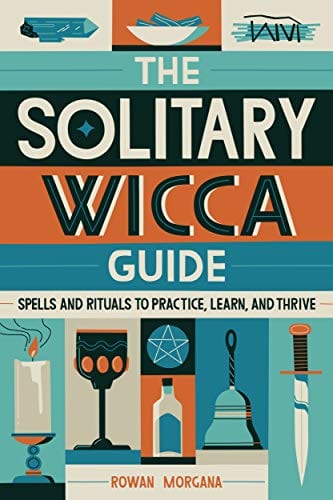 I have good things to say about the focus book for this article, The Solitary Wicca Guide: Spells and Rituals to Practice, Learn, and Thrive by Rowan Morgana.
Kudos
- Rowan Morgana is a lovely writer who can turn a phrase with magical articulation where rituals and spells are concerned. The seventy-one pages of this book dedicated to spells and rituals are absolutely beautiful and will serve any Wiccan, new or experienced, quite well. For those not given to writing their own work, this is a great go-to book.
- The book is attractive with (gasp!) color accents inside. It is rare that we find a publisher that extends the effort to make books as visually appealing on the inside as they are on the outside and this book goes the distance on that. I suspect Adobe’s stock jumped a point or two with the use of these Illustrator vector images.
- She introduces “new to me” conceptualizations of the God energy as “Hero, Lover, King, & Sorcerer” and further divides those archetypes into Dark and Light, Sun and Moon aspects. I love hearing about the ways other people engage Divine energy and the author’s discussion of this was quite interesting.
- Although she does include the obligatory trope of an altar layout design (minus a God & Goddess figure?), she does mention that the tools suggested in her “The Well-Stocked Solo Wiccan” chapter are “useful” and not “required.” This is a relief for under-funded Wiccans who once had to go mad trying to find a white handled boleen for herb cutting or else feel the hateful sting of inadequacy.
- In ritual work, we releases the circle counter-clockwise, which resonates for me since it is how I was trained.
Cringes
The challenge with this book is its packaging. Had the publishers marketed it as a Wiccan Book of Shadows rather than a comprehensive guide to solitary work, it would live up to its presentation and then some. Introducing “Solitary Wicca Guide” into the title invites unavoidable comparisons to the classic books that came before it that actually delivered what the title promised. This book misses the mark on this on several key points.
- Although the author explores new archetypes for the God energy, the Goddess energy remains as the traditional “Maiden, Mother, Crone” progression. There is no explanation for the imbalance of four faces of the God with only three faces of the Goddess or why she did not further consider new faces for the Goddess as well.
- She offers the approach that the God and Goddess are duality aspects of the “Universal Energy of The One, which gives form and life to all existence” (Page 10) without making room for the multitude of Wiccans who see their Gods and Goddesses as individual, unique beings that do not ultimately form a collective consciousness of Divinity. Might want to give that popular concept at least a mention.
- There is no, and I do mean zero, substantial discussion of the rich history of Wicca. The history section consists of a section called “The Roots of Belief” that takes up approximately three-fourths of a page with only a short paragraph within that section discussing history. Since presumably a solitary Wiccan does not mingle with other Wiccans in a coven community to pick up on historical information by osmosis or training, I would think a solitary Wicca guide would offer more than simply saying that Gerald Gardner started Wicca in the 1940s and it was really hard to find a coven back then (paraphrased). To this end, the book is marketed as a guide for solitary Wiccans while providing no information at all for what they are practicing or how it developed. In my Wicca 101 classes, we spend an entire two hour class solely on the history of Wicca. Understanding the foundation on which a belief system is created is fundamental to its practice.
- In fact, only approximately twenty pages of the book are even about Wicca. There is a brief mention of seven potential candidates for Goddess worship (no Gods mentioned), then a whopping seventy-one pages dedicated to spells and rituals, which, as previously mentioned, are excellent. Thirty-three pages are recipes for ritual food, 46 pages are apothecary recipes for powders, oils, and washes, and then three full pages are additional resources, including classic books for solitary Wiccan practitioners that do cover the above information, plus her own website.
In summary
It’s not a bad book at all, it is simply marketed in a way that creates expectations that the book cannot deliver in its current state. The information is excellent, but does not, in my opinion, meet the criteria one would expect from a guidebook for an entire practice, especially a solitary one.
PS: I do not intend all of my blog posts to be reviews. The heat and the current energetic upheaval have my thoughts in a bit of a jumble and book reviews are a safe place for me right now.

Want to contact Katrina? You can email her at [email protected]. Her shop is in Shingle Springs, California (www.crossroadsoccult.com) and she has written a ton of books available at Llewellyn Worldwide, Amazon, and Barnes & Nobel.

About Katrina Rasbold
Katrina Rasbold is an author, practicing Bruja, and professional Witch for Hire who provides magical assistance to clients from her shop, Crossroads Metaphysical Store, in Shingle Springs, California, as well as through online outreach. She is the president of North Western Circles Association, a non-profit 501(c)3 organization that hosts the PanGaia Festival in Fair Oaks, California each year to raise funds for local treat and release wildlife organizations. Katrina is also the director for PanGaia festival and actively worked for the Sacramento Pagan Pride harvest festival, the Sacramento Celtic Faerie Festival, and the Sacramento Witches’ Ball. She is the head of the Original Black Hat Society of Northern California, founded in 2009 by Gail Dettmar. Katrina and her husband, Eric founded the CUSP (Climbing Up the Spiral Pathway) spiritual tradition in 1997, which is now practiced worldwide. She has been a practicing Witch since 1983 and a working High Priestess since 1989. Katrina teaches classes on many aspects of magic both online and in person at her shop. She has six adult children and lives in a remote mountain community on the edge of the El Dorado National Forest in Central California. You can read more about the author here.
Previous Post
July 22, 2020
Llewellyn's Little Book of Yule
Next Post
September 14, 2020 Revelations: How Many Do We Need In One Year?
Browse Our Archives
Select a Category Astrology Book Reviews Current Events CUSP Energy Magic Energy Magic Words Kitchen Magic Magic in the Media Magical Ethics Magical Protection Meditations Modern Mythologies Pagan Commentary Pagan Humor Poetry Rituals Sabbats Spell Work Spiral of the Year Tarot Tarot Deck Reviews Uncategorized Witchcraft
Select a Month February 2021 January 2021 December 2020 November 2020 October 2020 September 2020 August 2020 July 2020 June 2020 May 2020 April 2020 March 2020 February 2020 January 2020 September 2015 August 2015 July 2015 June 2015 May 2015 April 2015 March 2015 February 2015
Follow Us!
TAKE THE
Religious Wisdom Quiz
How many total plagues did God send on Egypt?
Select your answer to see how you score.
Seven Twelve Five Ten
Related posts from Witch at the Crossroads
ABCs of Conjure Curios: Magical Tools for Crisis...
Soul Cleansing: 15 Ways to Clean Out Your...
Blessing Bottles for 2021: How to Make and...
A Yule Ritual: Celebrating the Return of the...
TRENDING AT PATHEOS Pagan

I was recently chatting with someone on Instagram. She asked me what...

While there are many people who share their results, the end of...

On July 23, I saw Christopher Nolan's The Odyssey which is Homer’s...

As I write this two big events have just finished up. One...

Restoring the Watershed of Divine Love
Perhaps cooperation is not something we manufacture through legislation, ideology, or moral...

Many UUs don’t pray because of bad experiences in a previous religion,...
view all Pagan blogs
Ad-Free & Subscriber Log-In Subscription Support
- About Us
- 2026 Calendar
- Videos
- Podcasts
- Library of World Religions
- Faith In Media Tracker
- Advertise With Us
- Write for Us
- Privacy Policy
- Terms of Service
- Do Not Sell My Data
- Contact Us
- Radiant Digital
- Manage Newsletter Subscriptions
- Unsubscribe From Notifications
- Sitemap
Copyright 2008-2026, Patheos. All rights reserved.
Subscription Support Ad-Free & Subscriber Log-In
Follow Patheos