
BuddhistCatholicContemplativeEvangelicalGeneral ChristianHinduJewishLatter-day SaintMuslimNew VisionsProgressive Christian
Beliefs
- Buddhist
- Catholic
- Contemplative
- Evangelical
- General Christian
- Hindu
- Jewish
- Latter-day Saint
- More Voices
- Muslim
- New Visions
- Pagan
- Progressive Christian
Topics
- Religion News
- Food and Religion
- Sports and Religion
- Religious Art
- Religious Music and Entertainment
- Religious Events
- History and Religion
- Style and Religion
- Politics and Religion
- Women in Religion
- Recreation Outdoors and Religion
- Business Finance and Religion
- Careers Workplace and Religion
- Education and Religion
- Family Parenting and Religion
- Health Fitness and Religion
- Home and Religion
- Relationships and Religion
- Technology and Religion
- Travel and Religion
Columnists
- Buddhist Columnists
- Business Finance and Religion Columnists
- Careers Workplace and Religion Columnists
- Catholic Columnists
- Contemplative Columnists
- Education and Religion Columnists
- Evangelists Columnists
- Family Parenting and Religion Columnists
- General Christian Columnists
- Health Fitness and Religion Columnists
- Hindu Columnists
- History and Religion Columnists
- Home and Religion Columnists
- Jewish Columnists
- More Voices Columnists
- Latter Day Columnists
- Muslim Columnists
- New Visions Columnists
- Nonreligious Columnists
- Pagan Columnists
- Politics and Religion Columnists
- Progressive Columnists
- Recreation Outdoors and Religion Columnists
- Relationships and Religion Columnists
- Religion News Columnists
- Religious Art Columnists
- Religious Events Columnists
- Religious Music and Entertainment Columnists
- Sports and Religion Columnists
- Style and Religion Columnists
- Technology and Religion Columnists
- Travel and Religion Columnists
- Women in Religion Columnists
Resource Library
- 2026 Calendar
- Library of World Religions
- The 100 Most Holy Places on Earth
- Patheos Answers
- Podcasts
- Videos
- Faith Leaders Database
- Anglican Episcopalian
- Bahai
- Baptist
- Buddhism
- Christianity
- Confucianism
- Eastern Orthodoxy
- Hinduism
- Holiness and Pentecostal
- ISKCON
- Islam
- Judaism
- Lutheran
- Methodist
- The Church of Jesus Christ of Latter-day Saints
- New Age
- Paganism
- Presbytarian and Reformed
- Protestantism
- Religion Behind the Scenes
- Roman Catholic
- Scientology
- Shia Islam
- Sikhism
- Sufism
- Sunni Islam
- Taoism
- Zen
- See all religions
Research Tools
 Ad-Free & Subscriber Log-In Subscription Support
Ad-Free & Subscriber Log-In Subscription Support
Follow Patheos 

- Trending:
- Forgiveness
- |
- Marriage
- |
- Consciousness
- |
- Death Penalty
- |
- Election
- |
- Halloween
 Witch at the Crossroads
- Home
- Pagan
- A Lammas Ritual
A Lammas Ritual
Last updated on: July 27, 2015 at 7:33 am by Katrina Rasbold
A Lammas Ritual 2015-07-27T07:33:30-08:00 Katrina Rasbold
Patheos Explore the world's faith through different perspectives on religion and spirituality! Patheos has the views of the prevalent religions and spiritualities of the world.
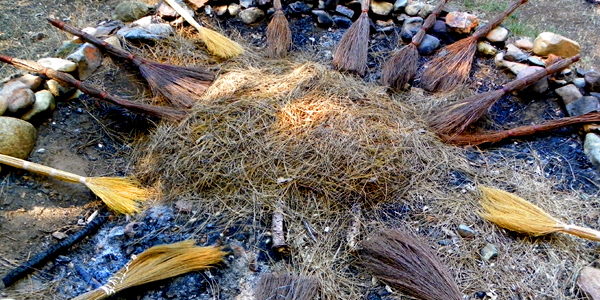
Set Up: The ritual area is decorated with sheaves of wheat, corn on the husks, fresh vegetables, and brooms. The participants make corn dollies ahead of time. Corn dollies are actually, in our limited artistic ability, more often “corn joints” than “corn dollies,” so the aesthetics are not vital to the magic. We use corn husks, purchased in the Hispanic section of the grocery store for tamale making, as the wrapper for our corn dollies, then combine aromatic herbs affiliated with each of the five elements (earth, air, fire, water and spirit) into five different potpourri blends. I recommend books like The Master Book of Herbalism by Paul Bereyl and The Encyclopedia of Magical Herbs by Scott Cunningham to determine the elemental affiliation of different herbs. Sympathetic essential oils may also be added for increased scent.
Making the Dollies: Layer two corn husks one on top of another lengthwise to make a slightly longer, doubled husk. Cup it in your hand lengthwise and fill it with the potpourri that is best in keeping with the goals you are harvesting this year. (Water – emotions/intuition, Fire – creativity/passion, Air – education/intellect/change and Earth – healing, prosperity) If more than one goal is being harvested, the herbs may either be combined into one corn dolly or more than one corn dolly can be made. After the dolly is stuffed with the potpourri, the ends are tied off with raffia or hemp twine. Participants bring their corn dolly into ritual with them.
The ceremony area should include a number of decorative brooms. This is for the Broom Dance to “turn the spiral” to the next holiday on the cycle. A fire is lit in the cauldron or fire pit.
**The Opening: “**We gather today to celebrate the coming of the First Harvest and to give thanks for the bounty we have received! Now the fruits of our own labors come forth and we see the results of our hard work through the harvest year. The work is not over and in some ways, this is the most demanding time of all, but it is a labor of love and one of instant reward as we see all that we have accomplished.”
**The Joining : “**Reach your hands out to one another to join together for the time of this ritual.” [The group touches hands, palm to palm, fingers up.]
“Pull your energy up from Mother Earth and down from Father Sky and blend with it with your own personal energy at the solar plexus. Move that energy from your solar plexus out your right hand, projecting into the left hand of the person next to you. Receive the energy through your left hand from the right hand of the person on the other side. Feel the energy as it courses hand-to-hand, person-to-person, heart-to-heart, and spirit-to-spirit, joining us together for the duration of this ceremony. See the strands of energy wrapping around one another, blending the energy of the Divine with our own personal energies into an impenetrable bond that connects us. As you lower your hands, continue to feel that we are joined together by our combined energies, even though we are no longer touching. Those who are within the circle become the circle. Those who manifest the will, become the means. The circle is cast.”
The Invitation: Invite the four elements to bless the ritual using the following chant (“The Earth, The Air, The Fire, The Water, Return):
Two circle members invite the God and Goddess, in our case, the Protector and the Mother, to bless the ritual
The Activity: Each person files past the burning cauldron and drops their corn dolly into the flames. We turn the whole circle at once so everyone is walking in a circle toward the cauldron, which is in the southern quarter. When the last person drops their corn dolly into the cauldron to burn, everyone is where they started again. As it burns, the energy of the herbs is released, blessing the circle and the harvest. This practice honors the sacrifice made by the plant for our own sustenance and as the dollies burn and the circle turns, the song “John Barleycorn Must Die” by Traffic plays.
The Release: Brooms are distributed to the group, either to each person, every other person or every 3rd – 4th person depending on how large the group happens to be and how many brooms you have. Each person faces to the right with their left hand holding the broom extended into the center of the circle like wheel spokes. The group begins to chant rhythmically and walks around the circle with the brooms still extended to the middle of the circle. We use the chant “Hoof and Horn,” written by Patheos blogger, Ian Corrigan. The brooms are a symbol of the combined efforts of Deity and humans, just as brooms are both magical and mundane tools.
At the end of the dance, everyone should end up 1/8 further around the circle than they were when they started. This signifies being another step further along the spiral of the year.
The Communion: Cornbread is the traditional Lammas bread, as well as a drink such as apple cider. No one consumes until we do so together. Everyone holds up their cornbread.
“We share this bread in joyful celebration of the bounty provided to us by the four elements: Earth, Air, Fire, and Water. We take it within us to allow their blessings to dwell in our bodies and we return a piece of the cake back to the earth to return it to the elements from which it came.” [Everyone crumbles a bit of the cornbread on the ground.]
“We share this drink in joyful celebration of the bounty provided to us by God and Goddess. We take it within us to allow their blessings to dwell in our bodies and we return a bit of the drink back to the earth to return it to the elements from which it came.” [Everyone lets a bit of the drink drip onto the ground and then everyone together says…]
As above; so below.
**The Graciousness: “**We give thanks to the earthly elements of which all things are formed and forged for blessing our ceremony and for the bounty they provide to us. We give thanks to God and Goddess for blessing our ceremony and speaking to us through the Spark of light of how we can best change our lives. May there be peace between us now and forever. So be it.”
**The Untwining: “**Reach your hands out to one another and feel the energy that still pulses between us, joining us together. Begin to gently unwind your energy strands away from those of the others in the group and pull it back into yourself. You will find that there is additional energy created by the synergistic effect of the circle. Feel the energy slow as it passes through your hands from person to person. See the strands unwinding one from another and moving back into the person from which they came. When your energy has returned to you, move your hand away from the persons next to you and touch the ground to release any residual energy. The circle is open, but unbroken.”
Previous Post

July 20, 2015
10 Favorite Witchy TV Shows & Mini Series
Next Post
July 27, 2015 Lammas: Where Did It Come From?
Browse Our Archives
Select a Category Astrology Book Reviews Current Events CUSP Energy Magic Energy Magic Words Kitchen Magic Magic in the Media Magical Ethics Magical Protection Meditations Modern Mythologies Pagan Commentary Pagan Humor Poetry Rituals Sabbats Spell Work Spiral of the Year Tarot Tarot Deck Reviews Uncategorized Witchcraft
Select a Month February 2021 January 2021 December 2020 November 2020 October 2020 September 2020 August 2020 July 2020 June 2020 May 2020 April 2020 March 2020 February 2020 January 2020 September 2015 August 2015 July 2015 June 2015 May 2015 April 2015 March 2015 February 2015
Follow Us!
TAKE THE
Religious Wisdom Quiz
What did Jesus use to feed the 5,000?
Select your answer to see how you score.
Grapes and figs A basket of quail Manna from heaven Five loaves and two fish
Related posts from Witch at the Crossroads
ABCs of Conjure Curios: Magical Tools for Crisis...
Soul Cleansing: 15 Ways to Clean Out Your...
Blessing Bottles for 2021: How to Make and...
A Yule Ritual: Celebrating the Return of the...
TRENDING AT PATHEOS Pagan

I was recently chatting with someone on Instagram. She asked me what...

While there are many people who share their results, the end of...

On July 23, I saw Christopher Nolan's The Odyssey which is Homer’s...

As I write this two big events have just finished up. One...

Restoring the Watershed of Divine Love
Perhaps cooperation is not something we manufacture through legislation, ideology, or moral...

Many UUs don’t pray because of bad experiences in a previous religion,...
view all Pagan blogs
Ad-Free & Subscriber Log-In Subscription Support
- About Us
- 2026 Calendar
- Videos
- Podcasts
- Library of World Religions
- Faith In Media Tracker
- Advertise With Us
- Write for Us
- Privacy Policy
- Terms of Service
- Do Not Sell My Data
- Contact Us
- Radiant Digital
- Manage Newsletter Subscriptions
- Unsubscribe From Notifications
- Sitemap
Copyright 2008-2026, Patheos. All rights reserved.
Subscription Support Ad-Free & Subscriber Log-In
Follow Patheos