
BuddhistCatholicContemplativeEvangelicalGeneral ChristianHinduJewishLatter-day SaintMuslimNew VisionsProgressive Christian
Beliefs
- Buddhist
- Catholic
- Contemplative
- Evangelical
- General Christian
- Hindu
- Jewish
- Latter-day Saint
- More Voices
- Muslim
- New Visions
- Pagan
- Progressive Christian
Topics
- Religion News
- Food and Religion
- Sports and Religion
- Religious Art
- Religious Music and Entertainment
- Religious Events
- History and Religion
- Style and Religion
- Politics and Religion
- Women in Religion
- Recreation Outdoors and Religion
- Business Finance and Religion
- Careers Workplace and Religion
- Education and Religion
- Family Parenting and Religion
- Health Fitness and Religion
- Home and Religion
- Relationships and Religion
- Technology and Religion
- Travel and Religion
Columnists
- Buddhist Columnists
- Business Finance and Religion Columnists
- Careers Workplace and Religion Columnists
- Catholic Columnists
- Contemplative Columnists
- Education and Religion Columnists
- Evangelists Columnists
- Family Parenting and Religion Columnists
- General Christian Columnists
- Health Fitness and Religion Columnists
- Hindu Columnists
- History and Religion Columnists
- Home and Religion Columnists
- Jewish Columnists
- More Voices Columnists
- Latter Day Columnists
- Muslim Columnists
- New Visions Columnists
- Nonreligious Columnists
- Pagan Columnists
- Politics and Religion Columnists
- Progressive Columnists
- Recreation Outdoors and Religion Columnists
- Relationships and Religion Columnists
- Religion News Columnists
- Religious Art Columnists
- Religious Events Columnists
- Religious Music and Entertainment Columnists
- Sports and Religion Columnists
- Style and Religion Columnists
- Technology and Religion Columnists
- Travel and Religion Columnists
- Women in Religion Columnists
Resource Library
- 2026 Calendar
- Library of World Religions
- The 100 Most Holy Places on Earth
- Patheos Answers
- Podcasts
- Videos
- Faith Leaders Database
- Anglican Episcopalian
- Bahai
- Baptist
- Buddhism
- Christianity
- Confucianism
- Eastern Orthodoxy
- Hinduism
- Holiness and Pentecostal
- ISKCON
- Islam
- Judaism
- Lutheran
- Methodist
- The Church of Jesus Christ of Latter-day Saints
- New Age
- Paganism
- Presbytarian and Reformed
- Protestantism
- Religion Behind the Scenes
- Roman Catholic
- Scientology
- Shia Islam
- Sikhism
- Sufism
- Sunni Islam
- Taoism
- Zen
- See all religions
Research Tools
 Ad-Free & Subscriber Log-In Subscription Support
Ad-Free & Subscriber Log-In Subscription Support
Follow Patheos 

- Trending:
- Forgiveness
- |
- Marriage
- |
- Consciousness
- |
- Death Penalty
- |
- Election
- |
- Halloween
 Witch at the Crossroads
- Home
- Pagan
- Midsummer: Purge, Protect, & Burn Stuff
Midsummer: Purge, Protect, & Burn Stuff
Last updated on: June 15, 2015 at 5:12 pm by Katrina Rasbold
Midsummer: Purge, Protect, & Burn Stuff 2015-06-15T17:12:01-08:00 Katrina Rasbold
Patheos Explore the world's faith through different perspectives on religion and spirituality! Patheos has the views of the prevalent religions and spiritualities of the world.
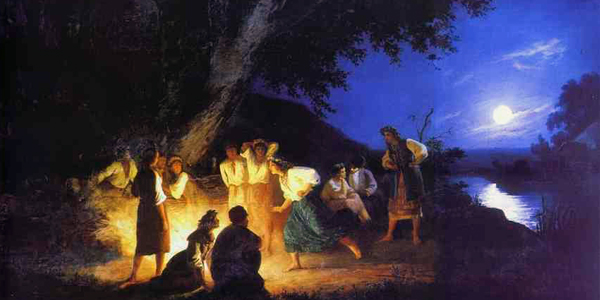
Of all of the holidays, it can be argued that most cultures at some time or another celebrated Midsummer. The Sun reigns at its full power and dominates the sky for the longest day of the year on Litha. It is commonly believed that the Faeries are most active during this time and that idea was perpetuated by William Shakespeare’s famous play, A Midsummer Night’s Dream. The power of herbs and plants is said to be strongest at this time, so many of the summer herbs are harvested on this day.
According the Celtic calendar, this was literally the middle of summer, which began at Beltane and will end with Lammas. By the time we reach Midsummer, the freezing cold of winter has completely loosened its grip and we celebrate the long, warm days. The crops are planted and now fully visible in the fields, so a collective sigh of relief goes up. Provided proper care is given and no calamity befalls, the harvest is assured.
Summer Solstice is the opposite power of Winter Solstice, the longest night. While the Moon is the dominant force for Winter Solstice and the energy is overwhelmingly feminine, at Summer Solstice, the Sun is king and masculine energy permeates all existence. This day typically falls around June 21st. Summer Solstice marks the zenith of the Sun and from this point on, the days will gradually shorten toward the call of winter yet again. The truest definition of astrological Summer Solstice is when the Sun is at its most Northern position touching the Tropic of Cancer. Just as it did at Winter Solstice, the Sun appears to stand still at the Summer Solstice, reminding us that “Sol” means “Sun” and “stice” means “to stand still.” Because of the balance it represents, it is considered extremely good luck if a Full Moon falls directly on the date of the Summer Solstice.
The Native American peoples of the Plains Tribes celebrated Midsummer with their Sun Dance, which lasted up to four days. They would ritualistically connect Heaven and earth with a “Sun Pole.” Male puberty rites took place at this time. The purpose of the ritual was for purification and renewal of themselves and of the earth.
“I know a bank where the wild thyme blows,
Where oxlips and the nodding violet grows,
Quite over-canopied with luscious woodbine,
With sweet musk-roses and with eglantine.”
― William Shakespeare, A Midsummer Night’s Dream
For the desert people of Nabta Playa of southern Egypt, determining the time of the Summer Solstice was of critical importance since it brought with it the monsoon season. In Karnak, Summer Solstice told residents that the Nile would soon flood. Some tribes assigned “Sun watchers” whose sacred duty it was to keep track of the position of the Sun and chart the solstices and equinoxes. The Sun watchers recognized the time of the solstice when the Sun remained in the same place for four consecutive days.
Following the idea of the immediate, but gradual, waning of the Sun’s power at Midsummer, Chinese Taoists honor the Summer Solstice as the birth of the divine female principle: the yin. Winter Solstice heralds the birth of the yang¸ the divine male principle.
Purging is a main theme of Litha and you have likely sensed a theme in how those ancient Europeans liked to celebrate during these festivals. They lit stuff on fire. Truly, there is not a single holiday where the Europeans did not set giant piles of things on fire into huge conflagrations, so expect to see that during each of our holiday discussions. Bonfires burned throughout Europe as the Midsummer was celebrated. The fires were set so that the fields were downwind and the smoke carried over the crops to bless them. Torches were lit from the fires and taken into homes to and around the cattle areas to bless and protect them. This tremendously significant because now that the harvest was visible in the fields, growing strong and proud, there was an urgency to protect it from blight, weather disasters, or disease.
After the Ice Age was over, the nomadic groups who created the villages of which we speak gathered around areas where there was still plenty of water. With the Sun hot in the sky and the days are long, the water supply that is their salvation shrank and became stagnant, which is the perfect breeding ground for disease-carrying bugs. The smoke from the fires helped to keep down the bug population and prevent disease.
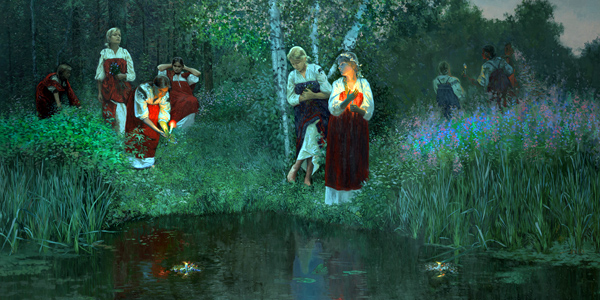
Since the power of summer herbs was considered heightened at this time, St. John’s wort, vervain, lavender, calendula, mugwort, and mistletoe were harvested during this time and brought into the home for protection. An interesting point about mistletoe is that at Winter Solstice, the plant has berries and promotes fertility. Mistletoe is also believed, in fact, to have the power to open locks. At Summer Solstice, there are no berries and the properties shift to protection. Amulets of mistletoe were woven for protection and boughs of rowan were affixed over stables and barns to keep livestock safe. A fun piece of lore says that fern seed collected at Midsummer has the ability to render a person invisible. The trick is that ferns are not flowering plants and therefore, do not have seeds. They propagate by means of spores, which are nearly invisible to the naked eye and are present on the underside of the leaf of some species. Although it is doubtful that true invisibility can be accomplished, it is said that if the full leaf is harvested at Midsummer and wore in a person’s shoe, they will be able to slip by unnoticed.
Because of the belief of increased Faerie activity at this time, many people follow the tradition of leaving out food, bowls of sweetened milk, bread and honey, wine, trinkets or other treats for the wee folks.
Pets and familiars were blessed during the Summer Solstice. For those who practiced animal husbandry, a representative animal from the herd would often be taken to receive the official blessing, which was then conveyed to the entire herd. The Beltane tradition of driving herds of cattle between the bonfires extended to the Summer Solstice fires as well.
Two Christian festivals occur at this time. One is called St. John’s Day, which is a time of great feasting to commemorate the birth of John the Baptist. The venerated St. John’s Wort is, of course, named for John the Baptist. St. John’s Day is traditionally celebrated on June 25 and is seen as the counterbalance to Christmas. In the 14th century, it was tradition for the women of Cologne in Germany to rinse their hands and arms in the Rhine River to ward off “threatening calamities of the coming year.”
The second festival is Whitsuntide, the 50th day after Easter. Although bonfires were once used to celebrate this harvest, it has now been replaced by candle services throughout Europe.
One of the most famous sites for Midsummer magic is the famous Stonehenge monument in England. The “Heel Stone” is located just outside the main entrance to Stonehenge and when one stands inside the monument and faces the Heel Stone on Summer Solstice, they will see the Sun rise directly over the stone. What a glorious way to welcome the celestial representation of male power on it’s strongest day of the year before we begin to sink so gradually into darkness!
Previous Post

June 11, 2015
Ritual Crafting: Creating Rituals That Work (Part 2)
Next Post
June 15, 2015 Midsummer Ritual: How I Kick It Litha-Style
Browse Our Archives
Select a Category Astrology Book Reviews Current Events CUSP Energy Magic Energy Magic Words Kitchen Magic Magic in the Media Magical Ethics Magical Protection Meditations Modern Mythologies Pagan Commentary Pagan Humor Poetry Rituals Sabbats Spell Work Spiral of the Year Tarot Tarot Deck Reviews Uncategorized Witchcraft
Select a Month February 2021 January 2021 December 2020 November 2020 October 2020 September 2020 August 2020 July 2020 June 2020 May 2020 April 2020 March 2020 February 2020 January 2020 September 2015 August 2015 July 2015 June 2015 May 2015 April 2015 March 2015 February 2015
Follow Us!
TAKE THE
Religious Wisdom Quiz
What is the longest book in the New Testament by word count?
Select your answer to see how you score.
Revelation Acts Matthew Luke
Related posts from Witch at the Crossroads
The Top 10 Misperceptions About Me As a...
ABCs of Conjure Curios: Magical Tools for Crisis...
Soul Cleansing: 15 Ways to Clean Out Your...
A Tarot Adventure Through Magic: The Fool's Journey
TRENDING AT PATHEOS Pagan

I was recently chatting with someone on Instagram. She asked me what...

While there are many people who share their results, the end of...

On July 23, I saw Christopher Nolan's The Odyssey which is Homer’s...

As I write this two big events have just finished up. One...

Restoring the Watershed of Divine Love
Perhaps cooperation is not something we manufacture through legislation, ideology, or moral...

Many UUs don’t pray because of bad experiences in a previous religion,...
view all Pagan blogs
Ad-Free & Subscriber Log-In Subscription Support
- About Us
- 2026 Calendar
- Videos
- Podcasts
- Library of World Religions
- Faith In Media Tracker
- Advertise With Us
- Write for Us
- Privacy Policy
- Terms of Service
- Do Not Sell My Data
- Contact Us
- Radiant Digital
- Manage Newsletter Subscriptions
- Unsubscribe From Notifications
- Sitemap
Copyright 2008-2026, Patheos. All rights reserved.
Subscription Support Ad-Free & Subscriber Log-In
Follow Patheos