
BuddhistCatholicContemplativeEvangelicalGeneral ChristianHinduJewishLatter-day SaintMuslimNew VisionsProgressive Christian
Beliefs
- Buddhist
- Catholic
- Contemplative
- Evangelical
- General Christian
- Hindu
- Jewish
- Latter-day Saint
- More Voices
- Muslim
- New Visions
- Pagan
- Progressive Christian
Topics
- Religion News
- Food and Religion
- Sports and Religion
- Religious Art
- Religious Music and Entertainment
- Religious Events
- History and Religion
- Style and Religion
- Politics and Religion
- Women in Religion
- Recreation Outdoors and Religion
- Business Finance and Religion
- Careers Workplace and Religion
- Education and Religion
- Family Parenting and Religion
- Health Fitness and Religion
- Home and Religion
- Relationships and Religion
- Technology and Religion
- Travel and Religion
Columnists
- Buddhist Columnists
- Business Finance and Religion Columnists
- Careers Workplace and Religion Columnists
- Catholic Columnists
- Contemplative Columnists
- Education and Religion Columnists
- Evangelists Columnists
- Family Parenting and Religion Columnists
- General Christian Columnists
- Health Fitness and Religion Columnists
- Hindu Columnists
- History and Religion Columnists
- Home and Religion Columnists
- Jewish Columnists
- More Voices Columnists
- Latter Day Columnists
- Muslim Columnists
- New Visions Columnists
- Nonreligious Columnists
- Pagan Columnists
- Politics and Religion Columnists
- Progressive Columnists
- Recreation Outdoors and Religion Columnists
- Relationships and Religion Columnists
- Religion News Columnists
- Religious Art Columnists
- Religious Events Columnists
- Religious Music and Entertainment Columnists
- Sports and Religion Columnists
- Style and Religion Columnists
- Technology and Religion Columnists
- Travel and Religion Columnists
- Women in Religion Columnists
Resource Library
- 2026 Calendar
- Library of World Religions
- The 100 Most Holy Places on Earth
- Patheos Answers
- Podcasts
- Videos
- Faith Leaders Database
- Anglican Episcopalian
- Bahai
- Baptist
- Buddhism
- Christianity
- Confucianism
- Eastern Orthodoxy
- Hinduism
- Holiness and Pentecostal
- ISKCON
- Islam
- Judaism
- Lutheran
- Methodist
- The Church of Jesus Christ of Latter-day Saints
- New Age
- Paganism
- Presbytarian and Reformed
- Protestantism
- Religion Behind the Scenes
- Roman Catholic
- Scientology
- Shia Islam
- Sikhism
- Sufism
- Sunni Islam
- Taoism
- Zen
- See all religions
Research Tools
 Ad-Free & Subscriber Log-In Subscription Support
Ad-Free & Subscriber Log-In Subscription Support
Follow Patheos 

- Trending:
- Forgiveness
- |
- Marriage
- |
- Consciousness
- |
- Death Penalty
- |
- Election
- |
- Halloween
 Witch at the Crossroads
- Home
- Pagan
- Beltane Then and Now
Beltane Then and Now
Last updated on: April 27, 2015 at 12:18 pm by Katrina Rasbold
Beltane Then and Now 2015-04-27T12:18:16-08:00 Katrina Rasbold
Patheos Explore the world's faith through different perspectives on religion and spirituality! Patheos has the views of the prevalent religions and spiritualities of the world.
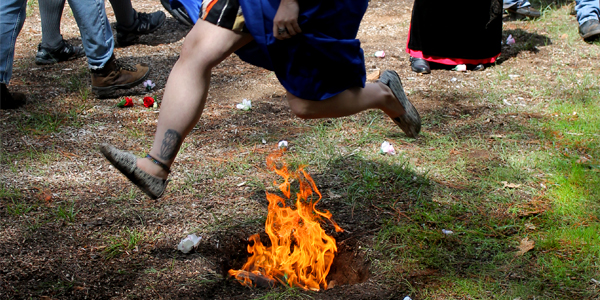
The word “Beltane” comes from the Irish Gaelic word “Bealtaine” and in the Common Celtic language means “bright fire.” “Bel,” the root word, comes from “bale” which means “white” or “shining.” “Tene” means “fire.” The traditional astrological date for Beltane is the midpoint of the Sun’s movement between Ostara/Spring Equinox and Litha/Summer Solstice. This generally occurs between May 5 – May 7; however, the common celebration time is May 1. In Celtic mythology, Beltane marked the beginning of summer and of the light half of the year, which is why the Summer Solstice is referred to as “Midsummer.” Great bonfires (balefires), lit for purification and transitioning the year from dark to light, were the centerpieces of celebrations. Villagers drove herds of cattle between the fires to purify them for the year and ensure their safety and fertility. Ashes from the balefires joined the ashes of the Yule log and were spread through the fields to bless the coming harvest. In Wales, it was customary to place a bit of the balefire ashes in one’s shoe for good luck. The hearth fire, which has burned through the winter, was extinguished at this time, officially welcoming summer. Beltane is the counterpart to Samhain and together they mark the beginning of summer and winter respectively according to the old Celtic calendar. For some ancient Europeans who were involved with animal husbandry as well as agriculture, this festival heralded in the pastoral growing season.
Original maypoles consisted of newly budding branches suspended from a tall pole. Young people grasped the branches and danced around the pole to celebrate new life. Later, the branches were replaced with brightly colored ribbons which were a powerful talisman in the Roman culture and served as protection for the crops that brought the coming harvest.
In Italy, the maypole was greased and topped with a wreath bearing a crown. Competitors tried to climb the pole to claim the crown. Southern Europeans celebrated by tying brightly colored ribbons around flowering tree branches. The Romans commemorated Flora, the Goddess of Spring, at this time and decorated themselves and their animals with flower garlands to garner Her blessings.
As a celebration of fertility, Beltane coupling rites energized the coming harvest. Pairings at this time were often outside of marriage or commitment and the excitement of new seduction and unfamiliar joining fueled the energy sent toward the blessings of fertility of the crops. Beltane was an unlucky time to marry because it was a time of non-commitment rather than solid relationships. Children conceived during these spiritual acts were particularly blessed and often received names of a divine nature.
In the Christian faith, May Day is dedicated to Mary, the mother of Jesus. Schoolchildren, adorned with flowers, formed a processional through the streets singing hymns. A teenage girl, chosen as May Queen, wore a bridal gown and ended the procession by placing a wreath of flowers onto the head of a stature of Mary. Young girls hung small bags or baskets with flowers, treats, or other gifts on the doorknobs of homes, then knocked and ran away.
Beltane in our time is celebrated in a variety of ways by different spiritual paths. The theme usually remains that of fertility and the joining of opposites. Colors used for maypole ribbons are often red and white, symbolizing the blood of the Maiden and the seed of the Creator aspect of the Young God as their consummation conceives the harvest of the year. This symbolic pregnancy transitions the Creator to the Protector and the Maiden to the Mother, representing the seeds that grow in the nurturing soil of the earth until they are birthed or harvested in the fall.
Fire endures as a strong component of Beltane celebrations and many celebrants will “jump the fire” to purge away that which does not serve to enter cleanly into the rest of the year. Fire jumping builds energy levels within a ritual structure with these increased energies released at a particularly poignant moment of the ritual to go toward the support of a group goal.
Beltane is, above all, the joining of opposites; the union of male and female. It celebrates of the perfect complement of yin and yang, dark and light, earth and sky, working together toward the fulfillment of a new life. At Beltane, the days are warm and the nights are cold, which furthers the theme of the blending of opposites.
This sacred duality also honors the union of Heaven and Earth, of humans and their deities. It reminds us of the magical combustion that happens when a person acts in accord with the Universe to create his or her own greatest good. Working in harmony with the natural flow of one’s life and following the guidance of Divinity is one of the most delightful and productive experiences a human can experience. It is not always pretty or easy, but when you collapse yourself into Divine intent and build your life around the flow of universal energy rather than fighting against it, fantastic things happen.
The dynamic marriage of our own actions with the blessings and intention of God and Goddess is great cause for celebration. When the weather warms and we feel the promise of gentler days, there is no better time.
Sources:
Barnhart, Robert K. The Barnhart Concise Dictionary of Etymology. Harper Collins. 1995
Broch, Janice, Veronica, and Veronica MacLer. Seasonal Dance. 1st. York Beach, ME: Samuel Weiser, Inc, 1993.
Campanelli, Pauline. Ancient Ways. 1st. St Paul, MN: Llewellyn Worldwide, 1993.
Campbell, John Gregorson. The Gaelic Otherworld. Edited by Ronald Black.
Edinburgh, Birlinn Ltd. (1900, 1902, 2005)
Chadwick, Nora K. The Celts. Harmondsworth: Penguin, 1970.
Danaher, Kevin. The Year in Ireland: Irish Calendar Customs. Dublin, Mercier, 1972
Hutton, The Stations of the Sun, Oxford, 1996.
Jacob Grimm, (trans. James Stallybrass). Teutonic Mythology, Dover Books, reprint of 1883 edition, volume one.
Grimassi, Raven. Beltane. 1st. St Paul, MN: Llewellyn Worldwide, 2001
Montley, Patricia. In Nature’s Honor. 1st. Boston, MA: Skinner House Books, 2005.
Rahber, Karl. Encyclopedia of Theology: a Concise Sacramentum Mundi. New York, NY: Seabury Press.2004
Wallis, Faith (Trans.). Bede: The Reckoning of Time. Liverpool University Press, 1999
Previous Post

April 23, 2015
All Hail The Mayhole!
Next Post
April 30, 2015 A Beltane Ritual Salute
Browse Our Archives
Select a Category Astrology Book Reviews Current Events CUSP Energy Magic Energy Magic Words Kitchen Magic Magic in the Media Magical Ethics Magical Protection Meditations Modern Mythologies Pagan Commentary Pagan Humor Poetry Rituals Sabbats Spell Work Spiral of the Year Tarot Tarot Deck Reviews Uncategorized Witchcraft
Select a Month February 2021 January 2021 December 2020 November 2020 October 2020 September 2020 August 2020 July 2020 June 2020 May 2020 April 2020 March 2020 February 2020 January 2020 September 2015 August 2015 July 2015 June 2015 May 2015 April 2015 March 2015 February 2015
Follow Us!
TAKE THE
Religious Wisdom Quiz
In the New Testament what is the last book?
Select your answer to see how you score.
Luke Matthew Titus Revelation
Related posts from Witch at the Crossroads
The Top 10 Misperceptions About Me As a...
ABCs of Conjure Curios: Magical Tools for Crisis...
Soul Cleansing: 15 Ways to Clean Out Your...
A Tarot Adventure Through Magic: The Fool's Journey
TRENDING AT PATHEOS Pagan

I was recently chatting with someone on Instagram. She asked me what...

While there are many people who share their results, the end of...

On July 23, I saw Christopher Nolan's The Odyssey which is Homer’s...

As I write this two big events have just finished up. One...

Restoring the Watershed of Divine Love
Perhaps cooperation is not something we manufacture through legislation, ideology, or moral...

Many UUs don’t pray because of bad experiences in a previous religion,...
view all Pagan blogs
Ad-Free & Subscriber Log-In Subscription Support
- About Us
- 2026 Calendar
- Videos
- Podcasts
- Library of World Religions
- Faith In Media Tracker
- Advertise With Us
- Write for Us
- Privacy Policy
- Terms of Service
- Do Not Sell My Data
- Contact Us
- Radiant Digital
- Manage Newsletter Subscriptions
- Unsubscribe From Notifications
- Sitemap
Copyright 2008-2026, Patheos. All rights reserved.
Subscription Support Ad-Free & Subscriber Log-In
Follow Patheos