
BuddhistCatholicContemplativeEvangelicalGeneral ChristianHinduJewishLatter-day SaintMuslimNew VisionsProgressive Christian
Beliefs
- Buddhist
- Catholic
- Contemplative
- Evangelical
- General Christian
- Hindu
- Jewish
- Latter-day Saint
- More Voices
- Muslim
- New Visions
- Pagan
- Progressive Christian
Topics
- Religion News
- Food and Religion
- Sports and Religion
- Religious Art
- Religious Music and Entertainment
- Religious Events
- History and Religion
- Style and Religion
- Politics and Religion
- Women in Religion
- Recreation Outdoors and Religion
- Business Finance and Religion
- Careers Workplace and Religion
- Education and Religion
- Family Parenting and Religion
- Health Fitness and Religion
- Home and Religion
- Relationships and Religion
- Technology and Religion
- Travel and Religion
Columnists
- Buddhist Columnists
- Business Finance and Religion Columnists
- Careers Workplace and Religion Columnists
- Catholic Columnists
- Contemplative Columnists
- Education and Religion Columnists
- Evangelists Columnists
- Family Parenting and Religion Columnists
- General Christian Columnists
- Health Fitness and Religion Columnists
- Hindu Columnists
- History and Religion Columnists
- Home and Religion Columnists
- Jewish Columnists
- More Voices Columnists
- Latter Day Columnists
- Muslim Columnists
- New Visions Columnists
- Nonreligious Columnists
- Pagan Columnists
- Politics and Religion Columnists
- Progressive Columnists
- Recreation Outdoors and Religion Columnists
- Relationships and Religion Columnists
- Religion News Columnists
- Religious Art Columnists
- Religious Events Columnists
- Religious Music and Entertainment Columnists
- Sports and Religion Columnists
- Style and Religion Columnists
- Technology and Religion Columnists
- Travel and Religion Columnists
- Women in Religion Columnists
Resource Library
- 2026 Calendar
- Library of World Religions
- The 100 Most Holy Places on Earth
- Patheos Answers
- Podcasts
- Videos
- Faith Leaders Database
- Anglican Episcopalian
- Bahai
- Baptist
- Buddhism
- Christianity
- Confucianism
- Eastern Orthodoxy
- Hinduism
- Holiness and Pentecostal
- ISKCON
- Islam
- Judaism
- Lutheran
- Methodist
- The Church of Jesus Christ of Latter-day Saints
- New Age
- Paganism
- Presbytarian and Reformed
- Protestantism
- Religion Behind the Scenes
- Roman Catholic
- Scientology
- Shia Islam
- Sikhism
- Sufism
- Sunni Islam
- Taoism
- Zen
- See all religions
Research Tools
 Ad-Free & Subscriber Log-In Subscription Support
Ad-Free & Subscriber Log-In Subscription Support
Follow Patheos 

- Trending:
- Forgiveness
- |
- Marriage
- |
- Consciousness
- |
- Death Penalty
- |
- Election
- |
- Halloween
 Witch at the Crossroads
- Home
- Pagan
- Ostara, Then and Now
Ostara, Then and Now
Last updated on: March 16, 2015 at 7:06 pm by Katrina Rasbold
Ostara, Then and Now 2015-03-16T19:06:41-08:00 Katrina Rasbold
Patheos Explore the world's faith through different perspectives on religion and spirituality! Patheos has the views of the prevalent religions and spiritualities of the world.
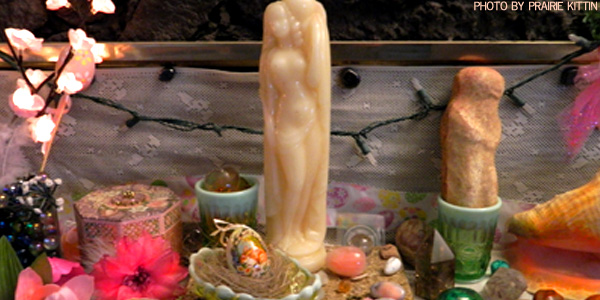
Pagans are big on history and gleaning the ancient origins and practices of our holidays is akin to sifting through piles of sand to find the handful of diamond flecks that might be scattered within. Much of our “history” actually comes from inferences derived from literature and the smattering of observational accounts that managed to survive thousands of years of war and the overt pissiness of nations. It becomes the odious task of modern day readers and scholars to sort out what happened from what we think happened or what we hoped happened during these celebrations of old. So here we go…
The word “equinox” finds its roots in Latin and means “equal night,” referring to the balance between light and dark in the cycle of the year. Winter Solstice brings the longest night and at Summer Solstice, we have the longest day. Ostara or “Spring Equinox” is one of the two mid-points between each of these two extremes creating a perfect balance between the two. During the Spring and Autumnal Equinoxes, the Northern and Southern hemispheres share the same experience of light and dark. At all other times, they provide the yin to the other half’s yang, balancing out the light above with the dark below or vice versa. Around March 21, the Sun crosses the equator separating the two hemispheres, providing twelve hours of daylight and twelve hours of night. I feel as though the Animaniacs should have a song about this [blogger scribbles note].
In the Temporum Ratione or The Reckoning of Time by the Northumbrian monk, The Venerable Bede (673-735), the scholar and historian attributes the origin of the word “Ostara” to “Eostre,” a Germanic goddess of spring called “The Radiant Dawn.” The word “Easter” is also thought to derive from “Eostre.” In Deutsche Mythologie (Teutonic Mythology), a seminal treatise on Germanic mythology (1835), Jacob Grimm also proposes that the Anglo-Saxon name of “Eostre” comes from the Old High German adverb “ostar,” which expresses movement toward the rising Sun. He says. “Ostara, Eostre seems therefore to have been a divinity of the radiant dawn, of upspringing light, a spectacle that brings joy and blessing, whose meaning could be easily adapted to the resurrection-day of the Christian’s God.” Since the Spring Equinox is, from a flowery standpoint, the “dawn” of the light and active part of the year, it seems fitting that a Goddess known as The Radiant Dawn should be its ambassadress.
The Germanic cultures celebrated the feast of Ostara on the Full Moon following the Spring Equinox, which is almost identical to the celebration of the Christian holiday of Easter. During this time, the earliest agricultural societies would celebrate their planting season and bless the new crop. The association of the Vernal Equinox with fertility goddesses leads to the traditional folk name of “Lady Day” for Ostara.
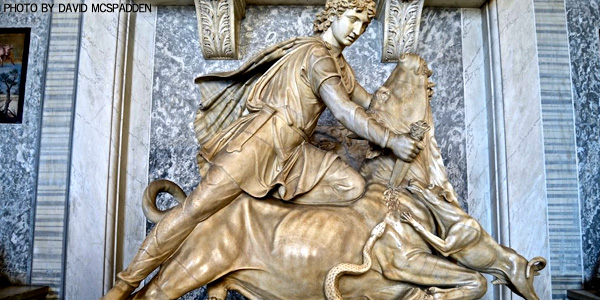
Mithras, starting some crap with a bull, assisted by a snake and a cow-blood thirsty dog.
Ancient Romans held sacred the story of Mithras, who was born on the Winter Solstice and died and resurrected on the Spring Equinox. Mithras rewarded his loyal followers by helping them to ascend to the realm of light after they died (and apparently had an issue with cattle). In another story from ancient Rome, Cybele was a goddess whose consort, Attis, was born of a virgin birth. He also died and was resurrected at Spring Equinox.
The Christian Bible shares the story of Jesus Christ whose birth is celebrated on December 25, 4 days after the Winter Equinox, and who rose from the dead in the Spring on Easter. This is quite thematic.
The Iroquois in America used the equinox to perform fertility rites to bless the coming harvest, including a corn dance that was considered essential for a successful harvest. Ceremonial corn was mixed with the seeds for planting, which was considered to be a blessing for its growth.
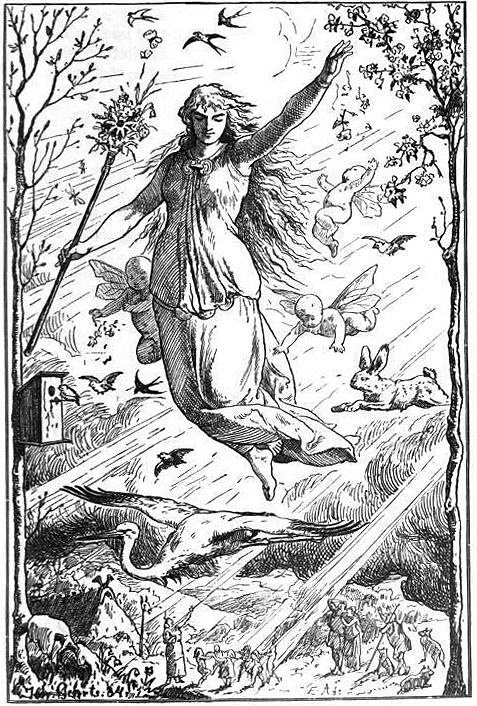
“Ostara” by Johannes Gehrts. Not a dead cow in sight.
In modern Paganism, Ostara/Spring Equinox is a time to celebrate new beginnings and the return of warmth to the land. The promise of warmer weather that still lay in the womb of the Earth Mother at Imbolc now births to the surface and in much of the world, we see tiny plants reaching for the sun, showing us their confident assurance that the cold of winter is over and it is safe to come out. We use the solstices and equinoxes as cross-quarters to the major sabbats of Imbolc, Beltane, Lammas, and Samhain, so there is often a focus on the balance between or dominance of light and dark in these celebrations. Eggs may play a part in ritual, honoring the female life force that will seek fertilization at Beltane.
“Spring Cleaning” is a tradition when weather becomes predictably warm and days are longer. This also reflects a desire for new beginnings and a “clean slate” preparation for the active part of the year that dawns with Ostara and will ends Samhain. Not only should we physically clean and organize our surroundings, but we should also to smudge out our home to make certain that any energies that stagnated over the winter months are cleared out and empowered with positive juju. Wake up, wake up, wake up your sacred space and bring it back from the slumber of dark and Winter.
In CUSP (Climbing Up the Spiral Pathway), Ostara begins our active part of the year when we “plant” our goals for the coming harvest and start the process of manifesting them in our lives, both magically and mundanely. We often plant beans in a peat pot of potting soil to symbolize our goals and nurture them carefully. How the bean seeds grow acts as an oracle for how our harvest goals will manifest. If one bean takes longer to sprout than another, we know that particular goal may take longer to manifest. If one bean flourishes and another is smaller and more fragile, we know which of our goals needs greater care and attention.
Likewise, we begin the mundane activities that will bring our goals to fruition. If we planted a new job, starting at Ostara, we review and optimize our resume, evaluate the current market for the job we seek, and start any necessary training that could make us more marketable in that field. We lay the groundwork to compliment our year’s magical efforts. As above, so below.
Thursday’s post will be a personal Ostara account. Ever have a spiritual miscarriage? I did.
Previous Post

March 12, 2015
On The CUSP
Next Post
March 18, 2015 UnOstara: Celebrating An Unplanting
Browse Our Archives
Select a Category Astrology Book Reviews Current Events CUSP Energy Magic Energy Magic Words Kitchen Magic Magic in the Media Magical Ethics Magical Protection Meditations Modern Mythologies Pagan Commentary Pagan Humor Poetry Rituals Sabbats Spell Work Spiral of the Year Tarot Tarot Deck Reviews Uncategorized Witchcraft
Select a Month February 2021 January 2021 December 2020 November 2020 October 2020 September 2020 August 2020 July 2020 June 2020 May 2020 April 2020 March 2020 February 2020 January 2020 September 2015 August 2015 July 2015 June 2015 May 2015 April 2015 March 2015 February 2015
Follow Us!
TAKE THE
Religious Wisdom Quiz
What is the Christian holy day typically observed with rest and worship?
Select your answer to see how you score.
Monday Friday Saturday Sunday
Related posts from Witch at the Crossroads
ABCs of Conjure Curios: Magical Tools for Crisis...
Soul Cleansing: 15 Ways to Clean Out Your...
A Tarot Adventure Through Magic: The Fool's Journey
A Yule Ritual: Celebrating the Return of the...
TRENDING AT PATHEOS Pagan

I was recently chatting with someone on Instagram. She asked me what...

While there are many people who share their results, the end of...

On July 23, I saw Christopher Nolan's The Odyssey which is Homer’s...

As I write this two big events have just finished up. One...

Restoring the Watershed of Divine Love
Perhaps cooperation is not something we manufacture through legislation, ideology, or moral...

Many UUs don’t pray because of bad experiences in a previous religion,...
view all Pagan blogs
Ad-Free & Subscriber Log-In Subscription Support
- About Us
- 2026 Calendar
- Videos
- Podcasts
- Library of World Religions
- Faith In Media Tracker
- Advertise With Us
- Write for Us
- Privacy Policy
- Terms of Service
- Do Not Sell My Data
- Contact Us
- Radiant Digital
- Manage Newsletter Subscriptions
- Unsubscribe From Notifications
- Sitemap
Copyright 2008-2026, Patheos. All rights reserved.
Subscription Support Ad-Free & Subscriber Log-In
Follow Patheos