
BuddhistCatholicContemplativeEvangelicalGeneral ChristianHinduJewishLatter-day SaintMuslimNew VisionsProgressive Christian
Beliefs
- Buddhist
- Catholic
- Contemplative
- Evangelical
- General Christian
- Hindu
- Jewish
- Latter-day Saint
- More Voices
- Muslim
- New Visions
- Pagan
- Progressive Christian
Topics
- Religion News
- Food and Religion
- Sports and Religion
- Religious Art
- Religious Music and Entertainment
- Religious Events
- History and Religion
- Style and Religion
- Politics and Religion
- Women in Religion
- Recreation Outdoors and Religion
- Business Finance and Religion
- Careers Workplace and Religion
- Education and Religion
- Family Parenting and Religion
- Health Fitness and Religion
- Home and Religion
- Relationships and Religion
- Technology and Religion
- Travel and Religion
Columnists
- Buddhist Columnists
- Business Finance and Religion Columnists
- Careers Workplace and Religion Columnists
- Catholic Columnists
- Contemplative Columnists
- Education and Religion Columnists
- Evangelists Columnists
- Family Parenting and Religion Columnists
- General Christian Columnists
- Health Fitness and Religion Columnists
- Hindu Columnists
- History and Religion Columnists
- Home and Religion Columnists
- Jewish Columnists
- More Voices Columnists
- Latter Day Columnists
- Muslim Columnists
- New Visions Columnists
- Nonreligious Columnists
- Pagan Columnists
- Politics and Religion Columnists
- Progressive Columnists
- Recreation Outdoors and Religion Columnists
- Relationships and Religion Columnists
- Religion News Columnists
- Religious Art Columnists
- Religious Events Columnists
- Religious Music and Entertainment Columnists
- Sports and Religion Columnists
- Style and Religion Columnists
- Technology and Religion Columnists
- Travel and Religion Columnists
- Women in Religion Columnists
Resource Library
- 2026 Calendar
- Library of World Religions
- The 100 Most Holy Places on Earth
- Patheos Answers
- Podcasts
- Videos
- Faith Leaders Database
- Anglican Episcopalian
- Bahai
- Baptist
- Buddhism
- Christianity
- Confucianism
- Eastern Orthodoxy
- Hinduism
- Holiness and Pentecostal
- ISKCON
- Islam
- Judaism
- Lutheran
- Methodist
- The Church of Jesus Christ of Latter-day Saints
- New Age
- Paganism
- Presbytarian and Reformed
- Protestantism
- Religion Behind the Scenes
- Roman Catholic
- Scientology
- Shia Islam
- Sikhism
- Sufism
- Sunni Islam
- Taoism
- Zen
- See all religions
Research Tools
 Ad-Free & Subscriber Log-In Subscription Support
Ad-Free & Subscriber Log-In Subscription Support
Follow Patheos 

- Trending:
- Forgiveness
- |
- Marriage
- |
- Consciousness
- |
- Death Penalty
- |
- Election
- |
- Halloween
 Emerging into Orthodoxy
- Home
- Eastern Orthodox
- Complementary But Equal: Women in Orthodoxy
Complementary But Equal: Women in Orthodoxy
Last updated on: June 5, 2012 at 11:42 am by Andrew Tatusko
Complementary But Equal: Women in Orthodoxy 2012-06-05T11:42:00-06:00 Andrew Tatusko
Patheos Explore the world's faith through different perspectives on religion and spirituality! Patheos has the views of the prevalent religions and spiritualities of the world.
 I don’t understand the full teaching of how Orthodoxy understands the role of women in the church. However, let me restate that this blog is about what I am learning and practicing in a very new way for me to understand “church” and Christianity as a whole. How women are viewed is an important issue and I have only begun to look at the questions much less come up with answers. I figured now is as good of a time as any given that Rachel Held Evans is entertaining a discussion this week. This is my own digestion of what I know so far in my Orthodox journey.
I know that Orthodoxy only ordains men to the priesthood. I come from a tradition in the Presbyterian Church (USA) that does ordain women so I know all of the arguments in support of that practice. I also know the arguments supporting a patriarchal priesthood. Arguments are often vehement on both sides so this is not an apologetic. While I don’t wish an argument ensue, if you want to argue about that below, be kind and respectful.
I am not arguing the fine point here of priesthood here. What I do want to present is what I have digested so far regarding the role of Orthodox women in the life of the church. The basic understanding is complementary but equal.
The dichotomy between egalitarianism and complementarianism is perhaps too rigid from the Eastern Orthodox view. In fact, some of it is against the moral teaching of the church. The idea that social roles are rigidly prescribed is present in the tradition for some, but is not present for others. These two terms require balance. This is true of the roles within the church. In continuation from the Jewish Temple males were responsible for the priesthood. It was a natural fit to continue through Byzantine imperialism as a function of apostolic succession.
When the church rapidly expanded the diaconate took on a far more important role. These men and women were responsible for representing the bishop to Christians and offering the sanctified Eucharist – the high regard for this task cannot be stressed enough – among other important duties. They also fulfilled all other roles that that pastors fulfill today such as visiting shut-ins, caring for the sick, teaching the Scriptures and so forth. It is a fair argument to say that the Church would not have survived if it was not for the important role that women played fulfilled.
When you walk into an Orthodox church it is clear that women are revered along with men in the sainthood. The largest image and most prayed to saint is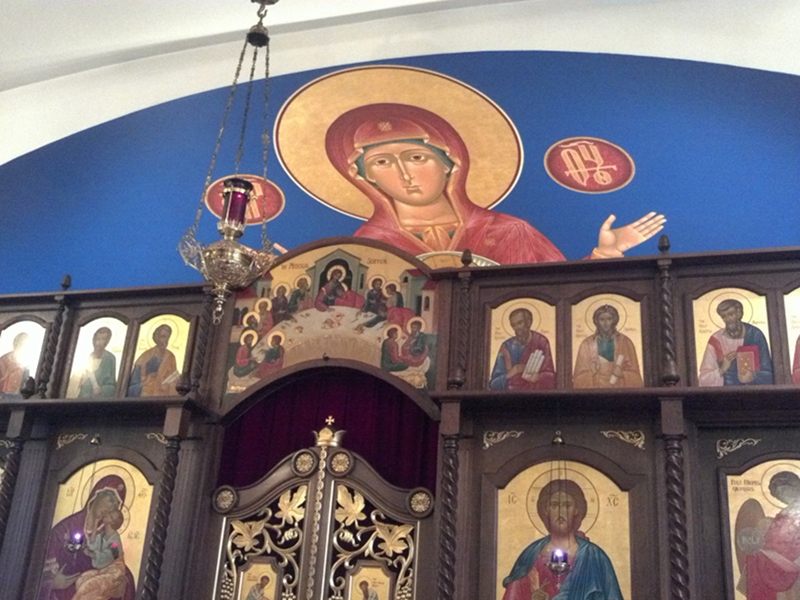 Mary the mother of God or Theotokos. That cannot be emphasized enough and was lost in the movement of Western Protestantism along with the primacy of all the other saints in the life of the church. She is the first Christian. She is the first person to carry God inside of her. She is the image of how all of humankind ought to respond to God in submission – not just women but also men. More than this as the Mother of God, she is also the spiritual Mother of all those who follow Christ. She looks over the church as a mother to her children. Further, honor and veneration are given equally among female saints such as St. Mary of Egypt who is the patron saint of penitents and St. Junia who we see in the icon above that is also on Held Evans’ site this week.
So what is the role of Orthodox women today? While it is clear that while there are always going to be those who will stick with their social and cultural roles as fixed absolutes, it is simply not the case elsewhere. While there are clear roles to fulfill in the family (e.g., men cannot have babies unless through a radical surgical process), they do not translate into fixed social roles (e.g., women serve men and should “stay in the kitchen”). That kind of “complementarianism” is disdainful and demeans the nature of women as image-bearers of God. The context is of mutual obedience to one another.
The kind of complementarianism as Held Evans presents (“In the home, men lovingly are to lead their wives and family as women intelligently are to submit to the leadership of their husbands.”) is a distortion of how the roles of women and men ought really to work. As Archbishop Chrysostomos writes:
Shame, hence, to each of us who proclaims either the man or the woman superior, or pretends to know the proper role and nature of each. This is arrogance , immoderation, intellectual pomposity, and the usurpation of judgments which only God can make. In true spirituality, distinctions, both formal and informal, disappear. This is not to say that we should, in any way, allow our social responsibilities to go unheeded in the name of human freedom and illusory, worldly liberty. Certainly we must not in any sense feel akin to movements which threaten social and spiritual order. But neither should we decide that there are clear offices and stations in life which, gleaned from an improper understanding of the spiritual world, absolutely fix the role of any person, whether Lord or serf, freeman or slave, man or woman.
Further, such fixed roles can be the consequence of sin itself. As Katherine Hyde writes:
(W)e have a picture of God’s intention for men and women—a relationship of loving cooperation between two people equal in value and honor, but differing in roles. And we have a picture of that relationship perverted by sin: women bound by their own desire and their need for children to men who wrongfully dominate and belittle them. But in that very hour when God pronounced the fate of fallen woman, he also pronounced her hope: the Seed that would bruise Satan’s head.
Like any Christian family you will not find absolute agreement among Orthodox here even though things may seem homogeneous to an outsider. That was at least the view I had for a long time. But the distinction between the two poles of complementarian and egalitarian as presented simply don’t work in the Orthodox world, or at least the one in which I now live. Are men and women complementary? Yes. But they are complementary insofar as together they can work to help conform to the likeness of God. The same is true for men and women without partners.
Unilateral submission of one by the other is sinful and is not in anyway something that God would have us practice in a world He has redeemed.
Previous Post

June 5, 2012
If This is Orthodoxy, What is Heterodoxy?
Next Post
June 6, 2012 Refusing the Gangster God: Why I'm Orthodox
Browse Our Archives
Select a Category Uncategorized
Select a Month July 2014 November 2013 March 2013 January 2013 July 2012 June 2012
Follow Us!
TAKE THE
Religious Wisdom Quiz
What is the highest holiday in the Orthodox Christian year?
Select your answer to see how you score.
Epiphany Pentecost Pascha (Easter) Nativity
Related posts from Emerging into Orthodoxy

Dragged into Healing at Wild Goose

The "War on Christmas" is Sinful

Peace, Bombs, and Discrimination Don't Mix
TRENDING AT PATHEOS Eastern Orthodox

Did Prayer Cure His Cancer? Or Was It...
At 4 AM one morning, Joshua W. Brown’s wife awoke to a...

8 Ways a Near-Death Experience Rewires the Soul
Does Consciousness Survive Physical Death? After 50 Years of Research, Dr. Raymond...

Holy Longing: What Our Restlessness Is Telling Us
“One can find so many pains when the rain is falling.” -John...

What this is NOT about. This blog is definitely not about...

Who said the Israelites were God’s chosen? That’s right, they did. Who...

The Spirit World Is the Real World: God...
A Monk’s Wisdom on Body and Spirit I sit with Brother Martin...
view all Eastern Orthodox blogs
Ad-Free & Subscriber Log-In Subscription Support
- About Us
- 2026 Calendar
- Videos
- Podcasts
- Library of World Religions
- Faith In Media Tracker
- Advertise With Us
- Write for Us
- Privacy Policy
- Terms of Service
- Do Not Sell My Data
- Contact Us
- Radiant Digital
- Manage Newsletter Subscriptions
- Unsubscribe From Notifications
- Sitemap
Copyright 2008-2026, Patheos. All rights reserved.
Subscription Support Ad-Free & Subscriber Log-In
Follow Patheos