
BuddhistCatholicContemplativeEvangelicalGeneral ChristianHinduJewishLatter-day SaintMuslimNew VisionsProgressive Christian
Beliefs
- Buddhist
- Catholic
- Contemplative
- Evangelical
- General Christian
- Hindu
- Jewish
- Latter-day Saint
- More Voices
- Muslim
- New Visions
- Pagan
- Progressive Christian
Topics
- Religion News
- Food and Religion
- Sports and Religion
- Religious Art
- Religious Music and Entertainment
- Religious Events
- History and Religion
- Style and Religion
- Politics and Religion
- Women in Religion
- Recreation Outdoors and Religion
- Business Finance and Religion
- Careers Workplace and Religion
- Education and Religion
- Family Parenting and Religion
- Health Fitness and Religion
- Home and Religion
- Relationships and Religion
- Technology and Religion
- Travel and Religion
Columnists
- Buddhist Columnists
- Business Finance and Religion Columnists
- Careers Workplace and Religion Columnists
- Catholic Columnists
- Contemplative Columnists
- Education and Religion Columnists
- Evangelists Columnists
- Family Parenting and Religion Columnists
- General Christian Columnists
- Health Fitness and Religion Columnists
- Hindu Columnists
- History and Religion Columnists
- Home and Religion Columnists
- Jewish Columnists
- More Voices Columnists
- Latter Day Columnists
- Muslim Columnists
- New Visions Columnists
- Nonreligious Columnists
- Pagan Columnists
- Politics and Religion Columnists
- Progressive Columnists
- Recreation Outdoors and Religion Columnists
- Relationships and Religion Columnists
- Religion News Columnists
- Religious Art Columnists
- Religious Events Columnists
- Religious Music and Entertainment Columnists
- Sports and Religion Columnists
- Style and Religion Columnists
- Technology and Religion Columnists
- Travel and Religion Columnists
- Women in Religion Columnists
Resource Library
- 2026 Calendar
- Library of World Religions
- The 100 Most Holy Places on Earth
- Patheos Answers
- Podcasts
- Videos
- Faith Leaders Database
- Anglican Episcopalian
- Bahai
- Baptist
- Buddhism
- Christianity
- Confucianism
- Eastern Orthodoxy
- Hinduism
- Holiness and Pentecostal
- ISKCON
- Islam
- Judaism
- Lutheran
- Methodist
- The Church of Jesus Christ of Latter-day Saints
- New Age
- Paganism
- Presbytarian and Reformed
- Protestantism
- Religion Behind the Scenes
- Roman Catholic
- Scientology
- Shia Islam
- Sikhism
- Sufism
- Sunni Islam
- Taoism
- Zen
- See all religions
Research Tools
 Ad-Free & Subscriber Log-In Subscription Support
Ad-Free & Subscriber Log-In Subscription Support
Follow Patheos 

- Trending:
- Forgiveness
- |
- Marriage
- |
- Consciousness
- |
- Death Penalty
- |
- Election
- |
- Halloween
 Emerging into Orthodoxy
- Home
- Eastern Orthodox
- Sin the Chronic Illness
Sin the Chronic Illness
Last updated on: June 13, 2012 at 2:20 pm by Andrew Tatusko
Sin the Chronic Illness 2012-06-13T14:20:04-06:00 Andrew Tatusko
Patheos Explore the world's faith through different perspectives on religion and spirituality! Patheos has the views of the prevalent religions and spiritualities of the world.
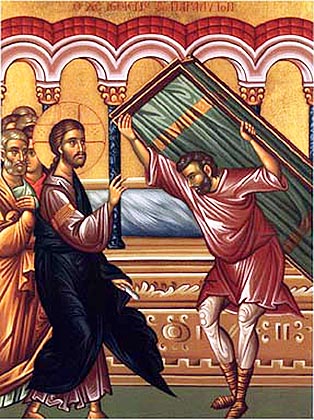
https://stgeorge.ia.goarch.org/Holy%20Week%20Pages/images/paralytic.jpeg
I know something about chronic illness in 2007 I contracted Lyme disease with a co-infection of Bartonella. To add to the bacterial stew my body was doing its best to fight off, a dormant Epstein-Barr Syndrome resurfaced. My immunity was so low that any defenses my body created were torn down. Since then I have learned that other chronic illnesses have come up in my life that have no cure. I have to manage them for the rest of my life. The idea of sin as an illness resonates with me on a deeply personal level.
In Orthodoxy many have called the church a spiritual hospital. I had heard this before, but wasn’t sold on the actual practice of it. Yet healing is always something that seems to pop up in discussions about faith. But where do we go to practice this?
There has always been a progressive movement of spirituality and spiritualism inside and outside of more traditional religious structures. I’m not talking about faith healing or the recent sad events concerning the death of a snake handler. There is an honest desire for something more mystical in religious experience.
As Bruce Epperly writes:
(P)erhaps, we need to ponder more appreciatively the unity of healing and curing in Jesus’ ministry. Jesus touched persons with leprosy and reached out to persons with chronic and socially stigmatized diseases; but in the processes of welcoming them to God’s realm, Jesus may also have encountered them in ways that energized God’s healing presence within their lives, transforming cells as well as souls. This is not magic or supernaturalism but a process of awakening people to the omnipresent movements toward abundant life in the quest for justice, in mystical experiences, and in moments of physical transformation.
Epperly makes a few valid points. Healing in modern Christianity has either been totally missing or tainted by magicians and snake oil salesmen. There is a division then between the miraculous moments of healing and what happens with us every day in our mundane lives. The irony is that Epperly is looking for a more holistic understanding of healing rather than seeing healing as a purely social event as does John Dominic Crossan. I agree with that sentiment. I also think that there is a sense of confusion about where to go with that sentiment.
The USA was built on the foundation that religious beliefs should not be enslaved by the state. One result of the 1st Amendment is an equal playing field for all religions to participate in the religious marketplace from massive cathedrals to snake handlers in Appalachia. Such a smorgasbord of religious mystical ideas and practices, doctrines, communities, and environments leaves a lot of choice if you have a desire for something in religious experience. Often the most accessible religion is the place where a seeker will gravitate. So if your Christianity doesn’t offer the experiences that you are seeking, why not find them in Unitarian Universalism, Buddhism, Sufism, of Kabbalah?
However, healing without all of the magic and spectacle of faith healers and mystical LSD-like trips has a deep tradition within Christianity. In fact it is a foundational understanding of the human condition in Orthodoxy and informs the function of the church and the central ritual in the Eucharist. The references to healing are profound among the Church Fathers and Mothers. It is part of the Divine Liturgy itself. One of the most important mysteries of the church is Holy Unction. The prayers that are at the opening of a prayer cycle for different parts of the day or different parts of the Liturgy are called the Trisagion Prayers. These prayers contain an important line:
All-holy Trinity, have mercy on us. Lord, cleanse us from our sins. Master, pardon our iniquities. Holy God, visit and heal us for thy Name’s sake.
In Orthodoxy sin itself is something of a disease or sickness from which we need healing. Sin in its various forms is the source of our alienation from God the source of life. Any sickness at all is not part of God’s image in us. Through our prayers and through our participation in the Liturgy we find that source of healing. The closer we come to God, the more healing we find. It’s no wonder the Eucharist is central. It is the act of bringing the body and blood of Christ into one’s self.
Sin is a chronic illness that has acute symptoms that pop up here and there. The result of sin going untreated is death. However, finding spiritual healing through the mysteries (sacraments) of the church results in life. To know that God wants nothing more than to heal us from our spiritual sickness isn’t just a comfort to me, but a knowledge that is healing in itself.
Previous Post

June 7, 2012
There is No Place God is Not
Next Post
June 15, 2012 Does Communion Build Up or Tear Down Love?
Browse Our Archives
Select a Category Uncategorized
Select a Month July 2014 November 2013 March 2013 January 2013 July 2012 June 2012
Follow Us!
TAKE THE
Religious Wisdom Quiz
What does "Shema," the central Jewish prayer, mean?
Select your answer to see how you score.
Pray Light Hear Peace
Related posts from Emerging into Orthodoxy


I Don't Need Anything I Think I Do

Dragged into Healing at Wild Goose
TRENDING AT PATHEOS Eastern Orthodox

Did Prayer Cure His Cancer? Or Was It...
At 4 AM one morning, Joshua W. Brown’s wife awoke to a...

8 Ways a Near-Death Experience Rewires the Soul
Does Consciousness Survive Physical Death? After 50 Years of Research, Dr. Raymond...

Holy Longing: What Our Restlessness Is Telling Us
“One can find so many pains when the rain is falling.” -John...

What this is NOT about. This blog is definitely not about...

Who said the Israelites were God’s chosen? That’s right, they did. Who...

The Spirit World Is the Real World: God...
A Monk’s Wisdom on Body and Spirit I sit with Brother Martin...
view all Eastern Orthodox blogs
Ad-Free & Subscriber Log-In Subscription Support
- About Us
- 2026 Calendar
- Videos
- Podcasts
- Library of World Religions
- Faith In Media Tracker
- Advertise With Us
- Write for Us
- Privacy Policy
- Terms of Service
- Do Not Sell My Data
- Contact Us
- Radiant Digital
- Manage Newsletter Subscriptions
- Unsubscribe From Notifications
- Sitemap
Copyright 2008-2026, Patheos. All rights reserved.
Subscription Support Ad-Free & Subscriber Log-In
Follow Patheos