
BuddhistCatholicContemplativeEvangelicalGeneral ChristianHinduJewishLatter-day SaintMuslimNew VisionsProgressive Christian
Beliefs
- Buddhist
- Catholic
- Contemplative
- Evangelical
- General Christian
- Hindu
- Jewish
- Latter-day Saint
- More Voices
- Muslim
- New Visions
- Pagan
- Progressive Christian
Topics
- Religion News
- Food and Religion
- Sports and Religion
- Religious Art
- Religious Music and Entertainment
- Religious Events
- History and Religion
- Style and Religion
- Politics and Religion
- Women in Religion
- Recreation Outdoors and Religion
- Business Finance and Religion
- Careers Workplace and Religion
- Education and Religion
- Family Parenting and Religion
- Health Fitness and Religion
- Home and Religion
- Relationships and Religion
- Technology and Religion
- Travel and Religion
Columnists
- Buddhist Columnists
- Business Finance and Religion Columnists
- Careers Workplace and Religion Columnists
- Catholic Columnists
- Contemplative Columnists
- Education and Religion Columnists
- Evangelists Columnists
- Family Parenting and Religion Columnists
- General Christian Columnists
- Health Fitness and Religion Columnists
- Hindu Columnists
- History and Religion Columnists
- Home and Religion Columnists
- Jewish Columnists
- More Voices Columnists
- Latter Day Columnists
- Muslim Columnists
- New Visions Columnists
- Nonreligious Columnists
- Pagan Columnists
- Politics and Religion Columnists
- Progressive Columnists
- Recreation Outdoors and Religion Columnists
- Relationships and Religion Columnists
- Religion News Columnists
- Religious Art Columnists
- Religious Events Columnists
- Religious Music and Entertainment Columnists
- Sports and Religion Columnists
- Style and Religion Columnists
- Technology and Religion Columnists
- Travel and Religion Columnists
- Women in Religion Columnists
Resource Library
- 2026 Calendar
- Library of World Religions
- The 100 Most Holy Places on Earth
- Patheos Answers
- Podcasts
- Videos
- Faith Leaders Database
- Anglican Episcopalian
- Bahai
- Baptist
- Buddhism
- Christianity
- Confucianism
- Eastern Orthodoxy
- Hinduism
- Holiness and Pentecostal
- ISKCON
- Islam
- Judaism
- Lutheran
- Methodist
- The Church of Jesus Christ of Latter-day Saints
- New Age
- Paganism
- Presbytarian and Reformed
- Protestantism
- Religion Behind the Scenes
- Roman Catholic
- Scientology
- Shia Islam
- Sikhism
- Sufism
- Sunni Islam
- Taoism
- Zen
- See all religions
Research Tools
 Ad-Free & Subscriber Log-In Subscription Support
Ad-Free & Subscriber Log-In Subscription Support
Follow Patheos 

- Trending:
- Forgiveness
- |
- Marriage
- |
- Consciousness
- |
- Death Penalty
- |
- Election
- |
- Halloween

- Home
- General Christian
- Education and Religion
- Crossing Cultures in Corinth: Unity Amid Diversity: 11:11-16
Crossing Cultures in Corinth: Unity Amid Diversity: 11:11-16
Last updated on: May 21, 2026 at 6:19 pm by Miranda Turner
Crossing Cultures in Corinth: Unity Amid Diversity: 11:11-16 2026-05-21T18:19:01-04:00 Miranda Turner
Patheos Explore the world's faith through different perspectives on religion and spirituality! Patheos has the views of the prevalent religions and spiritualities of the world.
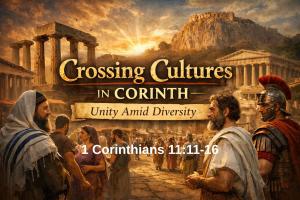
Image Generated By Microsoft Copilot
My last post discussed 1 Corinthians 11 verses 4-10. We now move to the next and final section of the passage.
I continue to emphasize that this is simply my interpretation, and I’m not claiming it to be 100% accurate. My primary goal is to capture the general sense of these verses.
Let’s now turn our attention to 1 Corinthians verses 11 through 16 to complete our exploration of this passage.
Verses 11-12
For some reason, many readers move straight through this section without noticing the clear transition, or even acknowledging that Paul is overturning the previous statements. Yet, as I explained in my previous post, and as a careful reading of the passage makes evident, that is exactly what’s happening.
It is illogical to claim that Paul would endorse gender‑based power divisions only to immediately deny that such divisions exist. So let’s take a closer look at what’s going on.
Man and Woman—One in the Lord
1 Corinthians 11:11–12 reads as follows:
11 Nevertheless, in the Lord woman is not independent of man, nor is man independent of woman. 12 For as woman came from man, so also man is born of woman. But everything comes from God. — NIV
This is the turning point of the passage. After stating common beliefs on the matter, Paul begins the process of correction as he transitions to explaining what is true according to God—that is, what is actual reality, regardless of human constructs and divisions.
The Greek term χωρίς often translated as “independent of” can actually signify being “separate or apart from,” “being other than,” or being “of a different kind or quality.” So, what it means is that neither a man differs in nature from a woman, nor a woman from a man. They are therefore the same in the Lord’s eyes.
Thus, Paul is emphasizing their spiritual unity rather than simply stating how they’re dependent on one another.
And before you start reasoning within yourself with that whole “equal in nature, distinct in function” spiel, notice that Paul says nothing about any differences between men and women in the Lord. That idea is entirely human‑made.
So, if God regards men and women as one and the same, why do we insist on drawing lines between them?”
Next, Paul corrects the notion of male superiority based on the claim that “man did not come from woman, but woman from man and neither was man created for woman, but woman for man” (vv. 8–9). He acknowledges that while it’s true that a woman came from a man, it is equally true that a man is brought into existence by a woman.
For this reason—that woman originally came from man, and now every man comes through a woman—Paul can say that both genders share the same nature—they are made of the same stuff—and are as one in God. Together they point back to him, who is their original source. Let’s now turn to verse 13.
Verse 13
13 Judge for yourselves: Is it proper for a woman to pray to God with her head uncovered?
The original language makes the understanding clear. The Greek words ἐν ὑμῖν αὐτοῖς κρίνατε can literally translate as “Among you—yourselves decide.” Paul explicitly asks the community to decide for themselves what is appropriate—whether it’s proper for a woman to be uncovered while “earnestly petitioning” or offering vows to God (or in the presence of God).
This is not a hypothetical statement. Paul couldn’t hold their hand through every issue, and he wouldn’t always be around to answer every problem they faced. In order to learn to make such decisions for themselves, he really wants them to decide.
The main message he is trying to convey is to put aside individual preferences and traditions in favor of decisions that are beneficial to the entire community. Regarding such matters, his prayer for the Corinthians would have been the same as for the Philippians. Philippians 1:9-10 reads:
And this is my prayer: that your love may abound more and more in knowledge and depth of insight, 10 so that you may be able to discern what is best and may be pure and blameless for the day of Christ, — Phil. 1:9-10 NIV
As I mentioned in an earlier post, the Greek word translated as “blameless” here in Philippians, is the same word in 1 Corinthians 10:32 that means “non-striking-against.”
Paul desires the Philippians to live in peace and unity. He wants them to be pure—meaning whole and unified—and “non‑striking‑against,” that is, not fighting against one another.”
This could only happen if they grew in their knowledge of God’s truth and love, so they could learn to see things as God sees them, to make decisions that benefited the whole church, promoting unity and peace. This was Paul’s hope for the Corinthians as well.
And so to recap, Paul lays out the current situation, drops some necessary truth, and then essentially tells them that it is up to them to decide whether head coverings are appropriate, since the matter does not seem to concern God.
God does not view humanity through the lens of gender hierarchy the way some people do. Therefore, if someone wanted to wear something on their head while worshiping the one true God, what harm would it cause? If another didn’t, who cares? Sure, there was the risk of being “disgraced”; but those were human concerns, not God’s.
In God’s sight, it isn’t wrong for a man to wear a head covering if that’s his custom, and it isn’t wrong for a woman to go without one. As long as their service is to him alone that’s all that really matters.
Nevertheless, to promote unity, they were to decide on a best practice based on what benefited the many when they came together—much like how they were instructed to treat the one who still believed sacrificial food was wrong to eat (1 Cor. 10).
With that in mind, we now move into our final section, verses 14–16.
Verses 14-16
14 Does not the very nature of things teach you that if a man has long hair, it is a disgrace to him, 15 but that if a woman has long hair, it is her glory? For long hair is given to her as a covering. 16 If anyone wants to be contentious about this, we have no other practice—nor do the churches of God. — 1 Corinthians 11:14-16 NIV
“Firstly, Paul—if he is truly a man of God whose words we should follow—is not saying that women must have long hair or that it is shameful if they do not. Any interpretation that treats ‘“he very nature of things” as if nature itself teaches that men naturally have short hair while women naturally have long hair is very much misguided.
Nature, or “the very nature of things” (whatever that is supposed to mean), teaches no such thing about hair for either men or women. Many men only have short hair because they cut it; otherwise, it naturally grows long. Whether they lose it later in life is irrelevant, despite what I’ve heard several teachers argue.
Furthermore, not all women naturally grow long hair. A significant number—if not the majority—of fully African or African‑American women do not naturally retain length, and their hair therefore remains short—sometimes very short, meaning not “long.”
Therefore, the idea that long hair is unnatural and disgraceful for a man yet glorious and natural for a woman, would not be a teaching grounded in biological nature. That conclusion is derived from an ethnocentric perspective, not a universal one, and thus cannot be a teaching from God for his people. It also reflects both the imbalance of teachers of African descent and the lack of acknowledgment of them in Christian Bible teaching.
In God’s sight, long hair is not equivalent to a woman’s glory, nor does it distinguish a man from a woman. So, what exactly is going on with hair and the word “nature” in this passage? A good place to begin is with the meaning of the word physis.
Physis
The Greek term physis (φύσις), translated as “nature” in most English versions of verse 14, historically meant “origin,” “birth,” or “growth.” It could also refer to what is “natural” in the sense of a natural disposition, or mindset—describing what people instinctively feel is normal or fitting. This is generally shaped by one’s culture and upbringing.
In 1 Corinthians 11, Paul seems to use physis in this everyday sense. He’s not talking about biological nature or scientific fact. Instead, he’s appealing to what the Corinthian culture commonly viewed as “natural” or appropriate.
Under this interpretation, the verse could be understood as:
But does not “the natural” (mind) teach you: that for a man, if he has long hair, it is a disgrace to him, but for a woman, if she has long hair, it is her glory, because her hair is given to her as a covering? —- (my translation)
Here, Paul is prompting them to reflect on whether this belief stems from God’s law or from human tradition, and to factor that distinction into their decision-making. In other words he’s saying” Is it not human thinking— common societal norms—that teaches you this? Since it doesn’t come from God, how important is it to hold on to it at the cost of peace and unity?
Paul ultimately notes that if anyone insists on being argumentative about this issue, they should understand that neither he nor the other churches observe such a custom.
And if anyone seems to be eager for strife, we have no such custom—nor do the churches of God. —- (my translation)
This indicates that the practice is a human tradition, not a divine command, and the community must work through it together in light of what is true before God. Next, I’ll share some final thoughts.
Final Thoughts
In this passage, Paul does not advocate for gender-based authority, a concept never found in his writings. What’s happened is that contemporary Bible scholars have distorted this and other scriptures, and many people accept these views without personal study or simply thinking it through.
Neither is he teaching women and men about covering their heads. Rather, Paul addresses “head coverings” as a representative issue for how to navigate cultural differences, neither commanding nor forbidding the practice but simply acknowledging societal norms.
He addresses the issue by engaging the Corinthians’ assumptions, correcting them with God’s truth, and urging them to act accordingly. And on the question of head coverings in Corinth, he makes it clear: neither he nor the churches of God practice such a custom.
Ultimately, the practice of wearing head coverings, as well as long or short hair, has no modern relevance. If someone chooses to wear a head covering, that is their personal choice, and it should not become an issue whether one wears one or not.
Nevertheless, I am 99% sure that whatever we think about head coverings and hairstyles today is not what Paul or the Corinthians thought about them when this letter was written. Because of that, it should not be a point of contention for us now.
The bottom line is that it doesn’t matter—just as Paul’s point to the Corinthians was that it didn’t matter. It was, and still is, a human‑devised problem. God’s teachings have nothing to do with it. Therefore, decide among yourselves and come to an agreement within your own community so you remain unified and at peace with one another.
What we should take away from this passage is, first, that we must learn and understand what is true according to God and learn to distinguish that truth from human traditions. Second, we should not impose our personal beliefs or convictions on others. We should respect the cultural practices of others, recognizing that we all come from different backgrounds.
Where any of these practices appear to conflict with the teachings or honor of God, wisdom, truth, and careful consideration should guide us in choosing a course of action that benefits the many and strengthens the church of God.
Those within that community should respect the agreed‑upon practice for the sake of unity—or seek a different community that aligns with their personal convictions.
If we remember that unity, love, and mutual honor—not our hairstyles, clothing choices, or any other human‑made tradition—are the true marks of God’s people, then the church can walk in the unity Paul sought for Corinth and the unity God desires for his people today.
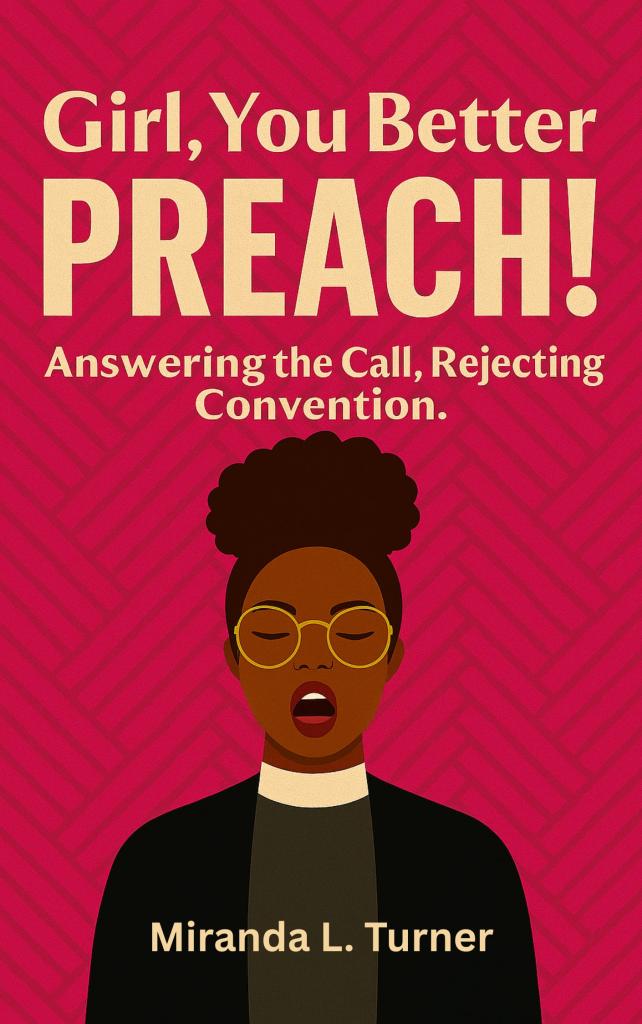
For centuries, women have been told to sit down, be silent, and leave the preaching to men. Girl, You Better PREACH! confronts that narrative head-on with unapologetic clarity and thoughtful depth.
In this groundbreaking work, Miranda L. Turner takes readers on a rigorous journey through the very scriptures often used to silence women—from Genesis to 1 Timothy—unpacking the historical, linguistic, and cultural contexts that have shaped traditional interpretations. With careful exegesis and fearless inquiry, she challenges long-held assumptions and exposes the theological gymnastics behind exclusionary doctrines.
But this book is more than a rebuttal—it’s a reclamation. Turner weaves together biblical analysis, historical insight, and prophetic conviction to reveal a truth too long buried: God never prohibited women from proclaiming his love, truth, and mercy. In fact, Scripture is filled with women who preached, prophesied, and led with divine authority.
Whether you’re a skeptic, a seeker, or a sister ready to step into your calling, Girl, You Better PREACH! is a rallying cry for every woman who’s ever felt the fire of God’s word burning in her bones. It’s time to answer the call—and reject the convention.
Progressive Christian
Home and Religion

About Miranda Turner
Miranda Turner is an author, blogger, and podcaster. In her writings, she discusses God, the Bible, and anything else related to glorifying the Lord. Find out more at https://truthtrumpstradition.wordpress.com/. You can read more about the author here.
Previous Post
May 20, 2026
Crossing Cultures In Corinth: Unity Amid Diversity 11:4-10
Next Post

June 30, 2026 If God Knows Everything, Why Do We Need to Pray?
Recent Comments
"Yes the world has changed. But is it for the better.The bad news for you ..."
Is ‘Male Headship’ Biblical?: 1 Corinthians ..."
"Many of us have been lured down that same path--and taken years to get over ..."
If God Knows Everything, Why Do ..."
"For some reason, many readers move straight through this section without noticing the clear transition, ..."
Crossing Cultures in Corinth: Unity Amid ..."
"Yes. Toss those rules. Whatever in scripture doesn't fit my current culture, toss it out, ..."
Is ‘Male Headship’ Biblical?: 1 Corinthians ..."
Browse Our Archives
Select a Category Beatitudes church leadership discipleship Practical Christian Living Salvation sin Uncategorized water baptism Women in Ministry
Select a Month July 2026 June 2026 May 2026 March 2026 February 2026 December 2025 November 2025 September 2025 August 2025 July 2025 June 2025 May 2025 April 2025 March 2025 February 2025 January 2025 December 2024 November 2024 October 2024 September 2024 August 2024 July 2024 June 2024 May 2024 April 2024 March 2024 February 2024 January 2024 December 2023 September 2023 August 2023 July 2023 June 2023 May 2023
Follow Us!
TAKE THE
Religious Wisdom Quiz
How many disciples did Jesus call as His closest followers?
Select your answer to see how you score.
Twenty Twelve Ten Seven
Related posts from Embracing Truth, Escaping Tradition
Aproskopos in the New Testament: Definition and Meaning
Embracing Truth, Escaping Tradition
A Non-Traditional Understanding: Examining Genesis 3:16
Embracing Truth, Escaping Tradition

You Shall Surely Die: What Does It Mean?
Embracing Truth, Escaping Tradition

What Is Death According to the Bible?
Embracing Truth, Escaping Tradition
TRENDING AT PATHEOS General Christian

The Pillar of the Boatmen: the Ancient Monument...
The Pillar of the Boatmen is a Romano-Gaulish sculpture that dates from...

In one sense walking into Westminster Abbey is like walking down the...

'Super Scam Me' Exposes AI Jon Bon Jovi...
Leslie Pickett believed she was in a relationship with Jon Bon Jovi....

The Brazilian Remake of Kendricks' 'Flywheel' Opens in...
“Flywheel,” the story that launched the Kendrick Brothers’ filmmaking career is getting...

The Dangers of Gradual Accommodation (Winking at Sin)
Recently, the “law of gradualness” resurfaced during the opening of a weeklong,...

The Iron Gates and the Lion of the...
Yesterday, I didn't finish my report about, well, yesterday. So I'll...
view all General Christian blogs
What Are Your Thoughts?leave a comment
Ad-Free & Subscriber Log-In Subscription Support
- About Us
- 2026 Calendar
- Videos
- Podcasts
- Library of World Religions
- Faith In Media Tracker
- Advertise With Us
- Write for Us
- Privacy Policy
- Terms of Service
- Do Not Sell My Data
- Contact Us
- Radiant Digital
- Manage Newsletter Subscriptions
- Unsubscribe From Notifications
- Sitemap
Copyright 2008-2026, Patheos. All rights reserved.
Subscription Support Ad-Free & Subscriber Log-In
Follow Patheos