
BuddhistCatholicContemplativeEvangelicalGeneral ChristianHinduJewishLatter-day SaintMuslimNew VisionsProgressive Christian
Beliefs
- Buddhist
- Catholic
- Contemplative
- Evangelical
- General Christian
- Hindu
- Jewish
- Latter-day Saint
- More Voices
- Muslim
- New Visions
- Pagan
- Progressive Christian
Topics
- Religion News
- Food and Religion
- Sports and Religion
- Religious Art
- Religious Music and Entertainment
- Religious Events
- History and Religion
- Style and Religion
- Politics and Religion
- Women in Religion
- Recreation Outdoors and Religion
- Business Finance and Religion
- Careers Workplace and Religion
- Education and Religion
- Family Parenting and Religion
- Health Fitness and Religion
- Home and Religion
- Relationships and Religion
- Technology and Religion
- Travel and Religion
Columnists
- Buddhist Columnists
- Business Finance and Religion Columnists
- Careers Workplace and Religion Columnists
- Catholic Columnists
- Contemplative Columnists
- Education and Religion Columnists
- Evangelists Columnists
- Family Parenting and Religion Columnists
- General Christian Columnists
- Health Fitness and Religion Columnists
- Hindu Columnists
- History and Religion Columnists
- Home and Religion Columnists
- Jewish Columnists
- More Voices Columnists
- Latter Day Columnists
- Muslim Columnists
- New Visions Columnists
- Nonreligious Columnists
- Pagan Columnists
- Politics and Religion Columnists
- Progressive Columnists
- Recreation Outdoors and Religion Columnists
- Relationships and Religion Columnists
- Religion News Columnists
- Religious Art Columnists
- Religious Events Columnists
- Religious Music and Entertainment Columnists
- Sports and Religion Columnists
- Style and Religion Columnists
- Technology and Religion Columnists
- Travel and Religion Columnists
- Women in Religion Columnists
Resource Library
- 2026 Calendar
- Library of World Religions
- The 100 Most Holy Places on Earth
- Patheos Answers
- Podcasts
- Videos
- Faith Leaders Database
- Anglican Episcopalian
- Bahai
- Baptist
- Buddhism
- Christianity
- Confucianism
- Eastern Orthodoxy
- Hinduism
- Holiness and Pentecostal
- ISKCON
- Islam
- Judaism
- Lutheran
- Methodist
- The Church of Jesus Christ of Latter-day Saints
- New Age
- Paganism
- Presbytarian and Reformed
- Protestantism
- Religion Behind the Scenes
- Roman Catholic
- Scientology
- Shia Islam
- Sikhism
- Sufism
- Sunni Islam
- Taoism
- Zen
- See all religions
Research Tools
 Ad-Free & Subscriber Log-In Subscription Support
Ad-Free & Subscriber Log-In Subscription Support
Follow Patheos 

- Trending:
- Forgiveness
- |
- Marriage
- |
- Consciousness
- |
- Death Penalty
- |
- Election
- |
- Halloween

- Home
- General Christian
- Education and Religion
- A Non-Traditional Understanding: Examining Genesis 3:16
A Non-Traditional Understanding: Examining Genesis 3:16
Last updated on: September 29, 2025 at 5:50 pm by Miranda Turner
A Non-Traditional Understanding: Examining Genesis 3:16 2025-09-29T17:50:22-04:00 Miranda Turner
Patheos Explore the world's faith through different perspectives on religion and spirituality! Patheos has the views of the prevalent religions and spiritualities of the world.
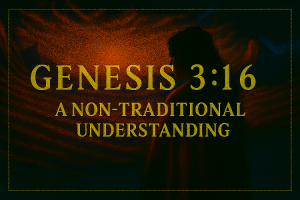
This discussion will conclude our analysis of Genesis 3:16, by considering a non-traditional, yet reasonable interpretation of the text. Let me begin by offering my completed translation, followed by the interpretation and some final thoughts.
Translation
After a time of prayer and meditation and considering what makes the most sense, I have settled on the following translation for Genesis 3:16:
And to the woman he said, “I will greatly multiply your grief and your sighing. Among sorrow you will bring forth descendants; but your turning-away (escape /help) shall be toward your man, and he will rule with you.”
Next, I’ll share my interpretation and explanation of the text, based on the above translation.
Interpretation
A Purpose for the Grief
You can find a more detailed explanation in my earlier post, but essentially, what I believe God is saying is this: I will greatly increase your grief and sorrow on this earth. This would come not as a curse God would place on the woman or humanity, but as a result of humankind being left to our own devices and our desire to live apart from God’s authority and teachings.
This natural desire is evident by the fact that Eve, the mother of all the living, chose to disregard the command of God and partake of the fruit, seeking to gain knowledge and become as a god herself.
Her actions were reflective of her inner passion to live apart from God. Although the Lord would not necessarily cause her grief, he would allow it to be multiplied by letting her find out what it’s like to try and make it on her own, using her own power and understanding.
As I mentioned in the first post of this study, this seems to be for the purpose of repentance; so that human beings everywhere would begin to grope for God in the “darkness” and begin to call upon his name for help, acknowledging that he alone is God; not ourselves or anyone else.
26 “From one man he made every nation living on the entire surface of the earth, and he fixed the limits of their territories and the periods when they would flourish. 27 God did this so that people would look for him and perhaps reach out and find him although in fact, he is not far from each one of us, — Act 17:26-27 CJB
The above passage is packed with meaning, and while I haven’t fully explored it, a clear takeaway is that if these people groups and territories experience periods of prosperity, then they will also experience periods of hardship.
This hardship is probably referred to by the setting of limits or rather the setting of limitations on their dwelling-places (soil quality, climate conditions, water availability, foreign rule, etc.), directly in contrast to flourishing periods. This must be intentional. But why? It’s so we might seek the Lord, and reach out for him and find him.
Whenever we feel full, fat, and merry—that is, during comfortable and joyous times of abundance—our attention to God and his teachings tends to diminish or is absent entirely. However, when life takes an unfavorable turn and our carefree existence is disrupted, we often become anxious, seeking a path back to tranquility and plenty.
Though we can resolve many issues ourselves, some situations demand the intervention of a supreme omnipotent Creator whose power far exceeds our own, prompting our reliance on this superior being for solutions.
We’ve seen this throughout history, from biblical droughts and famines to recent prayers for rain and COVID relief. It seems we only truly acknowledge God’s power and turn to him once we’ve exhausted all our own resources and attempts, and realized we can’t fix everything ourselves.
When we’ve pushed our own limits and tried to handle everything on our own without success, that’s when we finally look to God. That’s when we have to acknowledge that we ourselves are not God.
It is at this point when we must choose not just whether or not to have faith, but also who to put our faith in. Oftentimes we forget, that there is only God standing between us and a world of trouble. He is the wall that keeps everything from crashing down on us. I think this is why the Lord lets bad things happen and why he told Eve what he did.
Her sorrow would increase, and her descendants would be born and would experience that sorrow as well. Not only that, but her rebellious heart and the consequences of her actions would be reflected in her offspring, beginning with Cain.
He would inherit her sinful nature as would the rest of mankind—a concept often promoted in Christian doctrine as “original sin.” Rarely, however, do we investigate or attempt to explain how this is possible. However, scientific studies, such as those by the APA, support the possibility that maternal stress during pregnancy can influence a child’s behavioral development.
Eve was destined to face profound sorrow which was sure to lead to significant stress. These conditions would manifest as behavioral difficulties in her child. Thus, Cain’s aggressive nature and other behavioral concerns could be interpreted as a direct consequence of his mother’s initial disobedience.
This inherited flaw would affect all descendants, though in varying degrees, ensuring every individual would inherently fall short of the Lord’s moral expectations (Rom. 3:23). This meant that, alongside natural adversities, mankind’s greatest suffering would likely be caused by the human race itself—-a fact whose deep implications are well understood by anyone who has lived for some time, and thus, it needs no further explanation.
But to put it simply, life would be hard. As a result, humanity would begin to return to the Lord and with understanding, willingly submit themselves to him, obeying his teachings as was originally the intention. This truth is powerfully expressed in Jesus’ Parable of the Prodigal Son (Lk. 15:11-32), which we will look at next..
The Prodigal Son and Us
In this story, we encounter a restless son who wishes to live independently from his father—-just like Eve, and just like all of us at one point. As a result, he demands his inheritance at an inappropriate time, taking it before it is rightfully his. He then wastes it all on the fleeting pleasures, promises, and distractions of the world, leaving him without life’s necessities.
Consequently, he ends up working for a pig farmer, and hungers to the extent that he is willing to eat the very slop he feeds the pigs. Being left to his own devices, his existence becomes one of hardship, filled with sorrow and toil, until he eventually comes to a realization. He recognizes how fortunate he was while living under the security, comfort, and abundance of his father’s household.
After this moment of clarity, he sets aside his pride, humbles himself, and returns to his father, filled with shame, hope, and a newfound willingness to submit to his father‘s will. His father, far from rejecting him, joyfully embraces him, even running out to meet his boy.
I can only imagine that he spent each day hoping, watching, and waiting for his child’s return. When he finally did return, there was a joyous celebration.
The affection this father had for his son mirrors the love that our God holds for each of us. Luke 15:7 teaches us that there is more rejoicing in heaven over one sinner who turns back to God, than over ninety-nine righteous people (Lk. 15:7).
Nevertheless, there is rejoicing over us all. Thus, our heavenly Father does not seek to punish or curse us for our wrongdoing; rather, love necessitates correction, which is essential for transformation.
Therefore, I believe God allows us to face adversities such as drought, sickness, and famine, as well as personal struggles, so that we, as human beings, can recognize our need for him on our own, making our return to him genuine and sincere.
And so, he patiently waits for us to increasingly realize our need for him and to grasp his loving and gracious nature, enabling us to return to him with faith— trusting in him and trusting that his way is far better. This, I believe, is the purpose of Eve’s sorrow.
Your Turning (Away) Will Be Toward Your Man
For a more in-depth exploration of my perspective on the woman’s ‘turning,’ often translated as ‘desire,’ but which I believe signifies her ‘escape’ or ‘help,’ please refer to my previous articles.
But ultimately, what this means is that she looks to her male counterpart for help in overcoming life’s many challenges. He is her mental, physical, and emotional escape from the sorrow that threatens to overwhelm her.
He Will Rule Over/With/Within You
While my previous article presented three possible meanings for the phrase often rendered “and he will rule over you” (a discussion I will not repeat here), the unifying theme is clear.
This ‘ruling’ consistently denotes a shared obligation between spouses, allowing them to collaboratively overcome life’s hurdles and jointly oversee their family and household.
There is no reason to believe that this text establishes a God-ordained hierarchy placing men above women. Nevertheless, you’re welcome to disagree and offer a well-reasoned, scriptural rebuttal to try and convince me otherwise. Other than that, this remains the conclusion. Next, I’ll offer some closing thoughts.
Final Remarks
In summary, our multi-part study of Genesis 3:16 produced significant insights. Our initial segment clarified that God’s message to Eve pertains to the mental anguish and sorrow brought about by sin’s consequences, as opposed to the physical pain of childbirth.
The second portion dug into various interpretations of “the woman’s desire,” and the concluding sections examined the nature of the “ruling” God pronounced to Eve as well as offered a different perspective on the overall meaning of the verse.
To conclude, I argue that Genesis 3:16 is more accurately and biblically understood as outlining a partnership where man and woman—together—manage their home and mutually assist each other through life’s difficulties.
At this moment in time, God officially instituted the organized family structure, which had not been mentioned before. Maybe this is because it was never needed before—before mankind discovered good and evil and had to learn to choose good over evil, requiring dedicated teachers a.k.a. “parents.”
Nevertheless, the woman now had a greater responsibility in life—to teach and provide for her offspring, which would not come without tears and hardship. However, she would have her man to turn to for help. Together they would rule, and overcome life’s trials.
Now, before you go huffing and puffing and blowing down this understanding, rendering it ridiculous and absurd, allow me to clarify that all convictions concerning this scripture are based on assumption. No one has definitive knowledge of its meaning, so your guess is as good as mine.
As noted at the start, my intention is not to offer a final word on the passage’s meaning, but to illustrate that varying interpretations are possible—especially since the rest of Scripture does not endorse male dominion over wives and all women.
Still, certain verses, much like the case with Genesis 3:16, are frequently distorted to appear supportive of this stance, clearly shaped by a prior conviction or agenda. However, the texts in their original form do not support this man-made idea.
Absolutely no conclusive evidence supports interpreting Genesis 3:16 as justification for male authority over women. Neither does it conclude or even suggest that any woman will have an inherent desire to control a man. There are simply no real facts behind these ideas.
Therefore, I say with all gentleness: If your marriage is dysfunctional, it’s because of sin in general, and possibly, a lack of mutual respect and authority. An imagined rebellious nature attributed to all women, has nothing to do with it.
So, please don’t universalize your household’s issues to all families around the world, as preachers and pastors often do (with a chuckle, of course). Especially if you’re trying to present these subjective interpretations as God’s principles.
The bottom line is that these ideas are simply concocted. They are made up. This leads to a crucial question: why is such a harmful and unjustifiable doctrine so esteemed within the church? To be honest, I’m not sure we will ever know.
So a better question to ask is: are you completely confident in these man-made doctrines, to the point where you are prepared to face the Lord on the day of judgement, and respond to the question: “Why did you hinder my faithful daughters from proclaiming my mercy, love, and forgiveness? Why did you prevent them from teaching my commandments and statutes?”
How will you respond? Will you present your interpretations of scriptures such as Genesis 3:16 and 1 Timothy 2:12 to justify your position? Are you 100% confident that this will suffice?
Do you believe this line of reasoning will supersede the reasoning of God’s love and compassion? How important will following popular, yet questionable teachings be compared to God’s desire for everyone to repent?
If you are completely confident, proceed without hesitation. It is your conviction, your choice, your consequences. But, if uncertainty lingers, it’s time to re-evaluate what you’ve been taught.
Evangelical
Women in Religion

About Miranda Turner
Miranda Turner is an author, blogger, and podcaster. In her writings, she discusses God, the Bible, and anything else related to glorifying the Lord. Find out more at https://truthtrumpstradition.wordpress.com/. You can read more about the author here.
Previous Post

September 24, 2025
And He Will Rule Over You?: Examining Genesis 3:16
Next Post
November 28, 2025 Is ‘Male Headship’ Biblical? A Closer Look at 1 Corinthians
Recent Comments
"Yes the world has changed. But is it for the better.The bad news for you ..."
Is ‘Male Headship’ Biblical?: 1 Corinthians ..."
"Many of us have been lured down that same path--and taken years to get over ..."
If God Knows Everything, Why Do ..."
"For some reason, many readers move straight through this section without noticing the clear transition, ..."
Crossing Cultures in Corinth: Unity Amid ..."
"Yes. Toss those rules. Whatever in scripture doesn't fit my current culture, toss it out, ..."
Is ‘Male Headship’ Biblical?: 1 Corinthians ..."
Browse Our Archives
Select a Category Beatitudes church leadership discipleship Practical Christian Living Salvation sin Uncategorized water baptism Women in Ministry
Select a Month July 2026 June 2026 May 2026 March 2026 February 2026 December 2025 November 2025 September 2025 August 2025 July 2025 June 2025 May 2025 April 2025 March 2025 February 2025 January 2025 December 2024 November 2024 October 2024 September 2024 August 2024 July 2024 June 2024 May 2024 April 2024 March 2024 February 2024 January 2024 December 2023 September 2023 August 2023 July 2023 June 2023 May 2023
Follow Us!
TAKE THE
Religious Wisdom Quiz
What does "Pentecost" mean?
Select your answer to see how you score.
Forty Firstfruits Twelve Fiftieth
Related posts from Embracing Truth, Escaping Tradition
Crossing Cultures in Corinth: Unity Amid Diversity: 11:11-16
Embracing Truth, Escaping Tradition
Aproskopos in the New Testament: Definition and Meaning
Embracing Truth, Escaping Tradition

You Shall Surely Die: What Does It Mean?
Embracing Truth, Escaping Tradition

What Is Death According to the Bible?
Embracing Truth, Escaping Tradition
TRENDING AT PATHEOS General Christian

The Iron Gates and the Lion of the...
Yesterday, I didn't finish my report about, well, yesterday. So I'll...

Dolly Parton’s Last Song Wins Dove Award with...
Bluegrass band The Grascals, speaking on the red carpet at the 57th...

The Image: On the Horror of Capitalism and...
The Image Then went the Pharisees, and took counsel how they might...

We are approaching the date of our new American national holiday: October...

Letters on Living the Faith by C.S. Lewis
Most of us met C.S. Lewis as a public intellectual. Mere Christianity....

When Halloween Unmasks Married Hearts
Written by Dr. David K. Ewen from Eternal Truth Bible College Behind...
view all General Christian blogs
What Are Your Thoughts?leave a comment
Ad-Free & Subscriber Log-In Subscription Support
- About Us
- 2026 Calendar
- Videos
- Podcasts
- Library of World Religions
- Faith In Media Tracker
- Advertise With Us
- Write for Us
- Privacy Policy
- Terms of Service
- Do Not Sell My Data
- Contact Us
- Radiant Digital
- Manage Newsletter Subscriptions
- Unsubscribe From Notifications
- Sitemap
Copyright 2008-2026, Patheos. All rights reserved.
Subscription Support Ad-Free & Subscriber Log-In
Follow Patheos