
BuddhistCatholicContemplativeEvangelicalGeneral ChristianHinduJewishLatter-day SaintMuslimNew VisionsProgressive Christian
Beliefs
- Buddhist
- Catholic
- Contemplative
- Evangelical
- General Christian
- Hindu
- Jewish
- Latter-day Saint
- More Voices
- Muslim
- New Visions
- Pagan
- Progressive Christian
Topics
- Religion News
- Food and Religion
- Sports and Religion
- Religious Art
- Religious Music and Entertainment
- Religious Events
- History and Religion
- Style and Religion
- Politics and Religion
- Women in Religion
- Recreation Outdoors and Religion
- Business Finance and Religion
- Careers Workplace and Religion
- Education and Religion
- Family Parenting and Religion
- Health Fitness and Religion
- Home and Religion
- Relationships and Religion
- Technology and Religion
- Travel and Religion
Columnists
- Buddhist Columnists
- Business Finance and Religion Columnists
- Careers Workplace and Religion Columnists
- Catholic Columnists
- Contemplative Columnists
- Education and Religion Columnists
- Evangelists Columnists
- Family Parenting and Religion Columnists
- General Christian Columnists
- Health Fitness and Religion Columnists
- Hindu Columnists
- History and Religion Columnists
- Home and Religion Columnists
- Jewish Columnists
- More Voices Columnists
- Latter Day Columnists
- Muslim Columnists
- New Visions Columnists
- Nonreligious Columnists
- Pagan Columnists
- Politics and Religion Columnists
- Progressive Columnists
- Recreation Outdoors and Religion Columnists
- Relationships and Religion Columnists
- Religion News Columnists
- Religious Art Columnists
- Religious Events Columnists
- Religious Music and Entertainment Columnists
- Sports and Religion Columnists
- Style and Religion Columnists
- Technology and Religion Columnists
- Travel and Religion Columnists
- Women in Religion Columnists
Resource Library
- 2026 Calendar
- Library of World Religions
- The 100 Most Holy Places on Earth
- Patheos Answers
- Podcasts
- Videos
- Faith Leaders Database
- Anglican Episcopalian
- Bahai
- Baptist
- Buddhism
- Christianity
- Confucianism
- Eastern Orthodoxy
- Hinduism
- Holiness and Pentecostal
- ISKCON
- Islam
- Judaism
- Lutheran
- Methodist
- The Church of Jesus Christ of Latter-day Saints
- New Age
- Paganism
- Presbytarian and Reformed
- Protestantism
- Religion Behind the Scenes
- Roman Catholic
- Scientology
- Shia Islam
- Sikhism
- Sufism
- Sunni Islam
- Taoism
- Zen
- See all religions
Research Tools
 Ad-Free & Subscriber Log-In Subscription Support
Ad-Free & Subscriber Log-In Subscription Support
Follow Patheos 

- Trending:
- Forgiveness
- |
- Marriage
- |
- Consciousness
- |
- Death Penalty
- |
- Election
- |
- Halloween
 Ellen Painter Dollar
- Home
- Progressive Christian
- Consider the Birds: What happens to a writer (this writer) when words fail
Consider the Birds: What happens to a writer (this writer) when words fail
Last updated on: April 30, 2016 at 9:30 am by Ellen Painter Dollar
Consider the Birds: What happens to a writer (this writer) when words fail 2016-04-30T09:30:45-04:00 Ellen Painter Dollar
Patheos Explore the world's faith through different perspectives on religion and spirituality! Patheos has the views of the prevalent religions and spiritualities of the world.
The birds are trying to tell me something. If only I could figure out what.
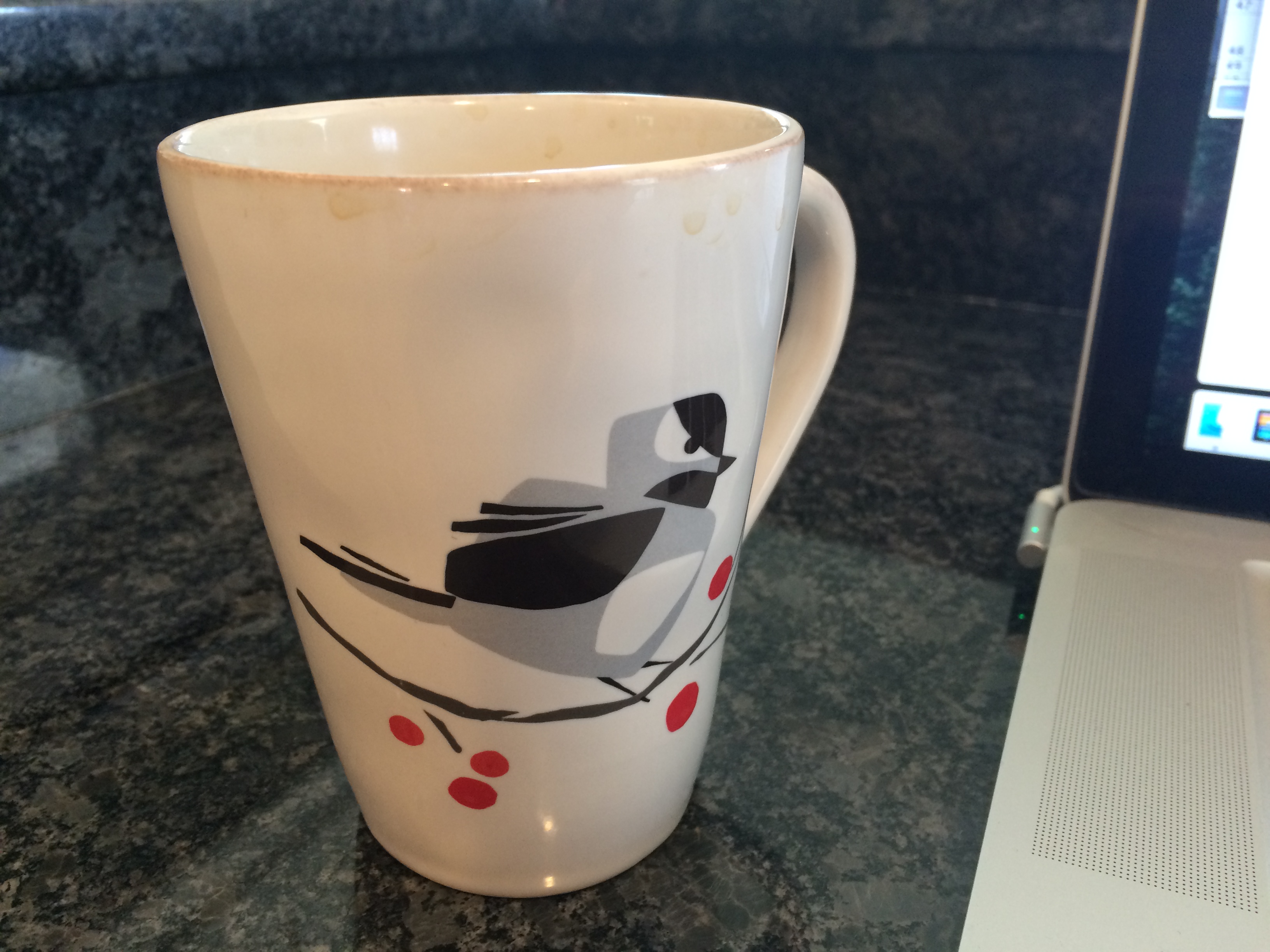
I have a thing for birds, live ones and otherwise. I drink my coffee every morning out of a chickadee mug—my favorite from the set of four bird mugs my husband gave me for Christmas. When I’m browsing for goods from notebooks to fabric, I’m drawn to designs featuring birds. Until a bear destroyed it in his pursuit of a midnight snack two winters ago, a bird feeder outside my kitchen window attracted finches, sparrows, titmice, juncos, chickadees, mourning doves, and woodpeckers. When a species I didn’t recognize showed up, I would page through my dog-eared copy of Peterson’s A Field Guide to the Birds to figure out what I had just seen. Even when the strange bird ended up being just another version of a plain old sparrow, these revelations thrilled me.
 My Peterson’s guide once belonged to my grandfather, for whom the descriptor “avid bird watcher” is far too tame. He tagged birds to track migration patterns; I remember the thrill of being allowed to hold a just-tagged bird to release it back into the yard. My grandparents vacationed in national parks and other wilderness areas with new bird sightings as their focus. My grandfather was honorable and smart (he worked for Thomas Edison’s company and could fix anything), gentle and kind. That I might have inherited my penchant for birds from my grandfather pleases me, because being like him is a very good thing.
I’ve been thinking about my attraction to birds because of a gift I received upon returning home from traveling last week. I had been at the Festival of Faith and Writing, a biannual gathering of faith-oriented writers that I’ve now attended three times. I go to the festival to be among my people—people who care about words as a means of illuminating what is vital, sacred, and true. I see friends there with whom I normally have only virtual connections. For the first time this year, I was scheduled to speak as part of a panel on “How Chronic Conditions Challenge and Enrich the Writing Life.” I love public speaking; in many ways, speaking comes more naturally to me than writing. Speaking at the Festival of Faith and Writing, even if it was just as one person on a three-person panel at 8:30 in the morning, was a career dream come true.
And on that morning, I was lying in bed dehydrated, exhausted, and unable to do anything more than sip from a bottle of Sierra Mist, after being violently ill all night with what I believe was food poisoning. The remainder of the festival is a blur. I managed to get to a friend’s house that night for a gathering of my writers group, where I lasted for all of 45 minutes before gratefully accepting the offer of a ride back to my hotel. The next day, I went to two morning sessions, met with an editor, then spent the rest of the day and evening resting in bed while various friends graciously visited for a few minutes of conversation. The following day, I headed home, still exhausted and carrying a load of sadness over all I had missed—my own presentation, talks by favorite authors such as George Saunders, and conversations with writers and editors I had planned to meet over coffee or a meal.
On arriving home, my kids presented me with a gift they picked out when visiting family in North Carolina while I was at the festival—a hand-carved wooden spoon with a bird motif. I told the kids and my husband (who worried that a wooden spoon was an inappropriate gift, akin to that scene in the Father of the Bride movie when the bride-to-be is in tears over her fiancé’s choice of a small appliance as a wedding gift) that the bird spoon was perfect. It was perfect. That’s when I began wondering if I needed to pay more attention to why I’m so attracted to birds. Maybe God is trying to tell me something through these ubiquitous and beautiful creatures. What might the message be?
Birds feed themselves with tiny bits—seeds and corn kernels and bread crumbs. Somehow, all those little bits add up to real sustenance. Was this the message for me? That in light of the disappointments and worries weighing on me now—the failed festival along with tough questions around my chronic joint pain, the direction of my writing career, my kids, and money—I should look for the crumbs, the tiny bits of sustenance that each day offers?
My doomed festival, for example, also included several long conversations (before I got sick) with a friend from our Washington, DC, church, with whom I’ve reconnected thanks to our shared vocation as writers. In my last venture out of my hotel room before succumbing to The Plague, I went down to the hotel vending machines to get a soda, and ran into a writer whom I only knew from Facebook and Twitter interactions. I introduced myself, and in the conversation that followed, he said unexpected and lovely things about how certain turns of phrase and ideas in my writing have been meaningful for him and others.
Perhaps the birds, I thought, are telling me to focus on these crumbs of sustaining conversation.
My next thought, however, was that maybe birds can live on crumbs, but I can’t. Those crumbs of connection and affirmation were gifts, but they were simply not big or solid enough to fill the hole of disappointment and grief over missing out on an event I’d looked forward to for two years, where I hoped that sharing my public speaking skills with colleagues could lead to new work opportunities.
So I’m still trying to figure out what the deal is with the birds. Maybe there’s no message there at all. Maybe some wisp of genetic material handed down from my grandfather just makes me like birds.
I feel like God has given me a metaphor, but as yet, no meaning. My writer’s brain looks for pattern, symbol, and meaning everywhere, assigning words to what I observe and experience to figure out what I need and know and believe, to illuminate the world for myself and for other people. Dani Shapiro (hers was one of the few Festival of Faith and Writing sessions I made it to) writes in her memoir Slow Motion about the day her writing class deemed a section of her first novel “beautiful”:
[T]oday, something begins to shift. I see that there might be some way I can take the raw material of my life and transform it into something that transcends my own experience. I can organize the noise in my head into something that has order and structure. I can make sense of what, until now, has been senseless.
This revelation came to Shapiro when she shared her writing with others. I write not only to uncover meaning, but also to connect with other people in a way that changes both me and them. The story isn’t complete until it is shared. When I think about the presentation I was supposed to give at the festival, I ask my own version of the old “if a tree falls in the forest” cliché: If I wrote a bunch of words but no one ever heard them, do they still exist? I’ve never been one of those writers who says, “I have to write regardless of whether anyone ever reads or hears my words.” No. Without an audience to absorb what I meant to say, what I meant to say feels inadequate. Rough and unfinished.
So I have not returned from my third Festival of Faith and Writing inspired and energized as I usually do. Instead, I have avoided my keyboard, discouraged by the fact that words are failing me—failing to uncover meaning, failing to move beyond my computer screen to be received by others and, in that connection, become something more vital, sacred, and true.
The core of my Christian faith is that God can wrest goodness and meaning from all circumstances.. The act of writing, when I wrest something good and meaningful from what I hear, see, and live, echoes God’s redemptive presence and power. A metaphor without meaning, a collection of words that I never got to share—these leave me feeling unsettled, adrift, abandoned. (Am I taking all of this—the whole bird thing, missing a single speaking gig in a career full of speaking gigs—a little too seriously? Maybe so. Let’s blame it on the eight hours I spent on the bathroom floor of my hotel room.)
I avoided writing for a full 10 days after returning home. Now I’m back, my faith in a God who is always bringing order from chaos, light from darkness, and life from death leading me back to my keyboard, where I am best equipped to mirror these redemptive patterns. Eventually, I will look ahead to the Festival of Faith and Writing 2018. For now, I’m back to writing, and watching for birds.
Previous Post

March 15, 2016
A Mother's Call to Care for Other People's Children
Next Post
May 3, 2016 God in My Gut
Browse Our Archives
Select a Category disability ethics parenthood Uncategorized
Select a Month September 2016 June 2016 May 2016 April 2016 March 2016 February 2016 January 2016 December 2015 November 2015 October 2015 September 2015 August 2015 July 2015 June 2015 May 2015 April 2015 March 2015 February 2015 January 2015 December 2014 November 2014 October 2014 September 2014 August 2014 July 2014 June 2014 May 2014 April 2014 March 2014 February 2014 January 2014 December 2013 November 2013 October 2013 September 2013 August 2013 July 2013 June 2013 May 2013 April 2013 March 2013 February 2013 January 2013 December 2012 November 2012 October 2012 September 2012 August 2012 July 2012 June 2012 May 2012 April 2012 March 2012 February 2012 January 2012 December 2011
Follow Us!
TAKE THE
Religious Wisdom Quiz
What does "be salt and light" mean in Jesus' teaching?
Select your answer to see how you score.
Be invisible Lose your flavor Be a good example Change nothing
Related posts from Ellen Painter Dollar

Disability as the Last Acceptable Prejudice: A Farewell...

Seven Favorite Posts on Disability, in Honor of...

Why Slow Writing is the Only Kind I...

Rethinking Margaret Sanger, Contraception, & How We are...
TRENDING AT PATHEOS Progressive Christian

What Being a Modern-Day Apostle Means to Me
In my last column, I discussed the ins and outs of modern-day...

Did Ancient China Once Worship the God of...
Across human history, a common thread weaves through the origins of the...

Love Your Neighbor – Including Earth-Kin: Lev. 19,...
God’s command to love your neighbor means acting in an ethical and...

Lead a Church Study of “Jesus and Lao...
Guest writer Jack Thomas (The Irreverent Reverend) reflects on leading his church...

Pastoral Wisdom for Responding to Sermon Pushback
Getting sermon pushback on your social justice sermon? Learn practical, Proverbs-based strategies...

Principles for Understanding the Apostolic Ministry Today
Whenever people discover that my formal ministry title is "apostle," as in...
view all Progressive Christian blogs
Ad-Free & Subscriber Log-In Subscription Support
- About Us
- 2026 Calendar
- Videos
- Podcasts
- Library of World Religions
- Faith In Media Tracker
- Advertise With Us
- Write for Us
- Privacy Policy
- Terms of Service
- Do Not Sell My Data
- Contact Us
- Radiant Digital
- Manage Newsletter Subscriptions
- Unsubscribe From Notifications
- Sitemap
Copyright 2008-2026, Patheos. All rights reserved.
Subscription Support Ad-Free & Subscriber Log-In
Follow Patheos