
BuddhistCatholicContemplativeEvangelicalGeneral ChristianHinduJewishLatter-day SaintMuslimNew VisionsProgressive Christian
Beliefs
- Buddhist
- Catholic
- Contemplative
- Evangelical
- General Christian
- Hindu
- Jewish
- Latter-day Saint
- More Voices
- Muslim
- New Visions
- Pagan
- Progressive Christian
Topics
- Religion News
- Food and Religion
- Sports and Religion
- Religious Art
- Religious Music and Entertainment
- Religious Events
- History and Religion
- Style and Religion
- Politics and Religion
- Women in Religion
- Recreation Outdoors and Religion
- Business Finance and Religion
- Careers Workplace and Religion
- Education and Religion
- Family Parenting and Religion
- Health Fitness and Religion
- Home and Religion
- Relationships and Religion
- Technology and Religion
- Travel and Religion
Columnists
- Buddhist Columnists
- Business Finance and Religion Columnists
- Careers Workplace and Religion Columnists
- Catholic Columnists
- Contemplative Columnists
- Education and Religion Columnists
- Evangelists Columnists
- Family Parenting and Religion Columnists
- General Christian Columnists
- Health Fitness and Religion Columnists
- Hindu Columnists
- History and Religion Columnists
- Home and Religion Columnists
- Jewish Columnists
- More Voices Columnists
- Latter Day Columnists
- Muslim Columnists
- New Visions Columnists
- Nonreligious Columnists
- Pagan Columnists
- Politics and Religion Columnists
- Progressive Columnists
- Recreation Outdoors and Religion Columnists
- Relationships and Religion Columnists
- Religion News Columnists
- Religious Art Columnists
- Religious Events Columnists
- Religious Music and Entertainment Columnists
- Sports and Religion Columnists
- Style and Religion Columnists
- Technology and Religion Columnists
- Travel and Religion Columnists
- Women in Religion Columnists
Resource Library
- 2026 Calendar
- Library of World Religions
- The 100 Most Holy Places on Earth
- Patheos Answers
- Podcasts
- Videos
- Faith Leaders Database
- Anglican Episcopalian
- Bahai
- Baptist
- Buddhism
- Christianity
- Confucianism
- Eastern Orthodoxy
- Hinduism
- Holiness and Pentecostal
- ISKCON
- Islam
- Judaism
- Lutheran
- Methodist
- The Church of Jesus Christ of Latter-day Saints
- New Age
- Paganism
- Presbytarian and Reformed
- Protestantism
- Religion Behind the Scenes
- Roman Catholic
- Scientology
- Shia Islam
- Sikhism
- Sufism
- Sunni Islam
- Taoism
- Zen
- See all religions
Research Tools
 Ad-Free & Subscriber Log-In Subscription Support
Ad-Free & Subscriber Log-In Subscription Support
Follow Patheos 

- Trending:
- Forgiveness
- |
- Marriage
- |
- Consciousness
- |
- Death Penalty
- |
- Election
- |
- Halloween
 Ellen Painter Dollar
- Home
- Progressive Christian
- When Love Outlasts Death: Janis Heaphy Durham’s “The Hand on the Mirror”
When Love Outlasts Death: Janis Heaphy Durham’s “The Hand on the Mirror”
Last updated on: May 22, 2015 at 6:07 pm by Ellen Painter Dollar
When Love Outlasts Death: Janis Heaphy Durham’s “The Hand on the Mirror” 2015-05-22T18:07:37-04:00 Ellen Painter Dollar
Patheos Explore the world's faith through different perspectives on religion and spirituality! Patheos has the views of the prevalent religions and spiritualities of the world.
In the film Interstellar, Anne Hathaway, in her role as a space-exploring scientist, won me over in a key scene contemplating the nature of love.
In the film, Matthew McConaughey and Hathaway leave behind a decimated, dust storm-riddled Earth to seek habitable planets where the human race can go to save themselves from extinction. Other scientists have gone ahead of them to several promising planets. McConaughey, Hathaway, and their fellow astronaut must decide, based on the data these scientists have been sending back, which planet appears most promising for human civilization. Limited fuel and some funny business involving space and time (e.g., a several-hour jaunt out onto a water-covered planet actually took 27 years in Earth time) means they cannot visit all of the potentially promising planets. They must choose one.
In the key scene, Hathaway is arguing for one planet over the other. Turns out that she has a personal motive. The astronaut who already traveled to that planet, who might still be alive awaiting their arrival, was Hathaway’s lover. When McConaughey argues that Hathaway’s feelings are keeping her from making a rational decision, Hathaway responds:
Yes, and that [her love for the astronaut] makes me want to follow my heart. But maybe we’ve spent too long trying to figure this out with theory. Love isn’t something we invented, it’s observable, powerful. It has to mean something.
McConaughey says sure, love has social utility, creating bonds, ensuring that people will care for their children, etc. Hathaway comes back:
We love people who have died. Where’s the social utility in that? Maybe it [love] means something more, something we can’t yet understand. Maybe it’s some evidence, some artifact of a higher dimension we can’t consciously perceive.
I’m drawn across the universe to someone I haven’t seen in a decade who I know is probably dead. Love is the one thing we are capable of perceiving that’s capable of transcending dimensions of time and space. Maybe we should trust that even if we can’t understand it yet.
Hathaway’s speech gets at the most fundamental belief that I hold, the belief that leads me to claim the Christian faith in spite of all the ways that Christians mess up and theology fails to give satisfying answers to our most difficult questions. I believe that love is more than brain chemistry, more than an evolutionary quirk that makes it marginally more likely for people to care for one another than kill each other. I believe that love is a real power, that love exercises real influence in the world—the way that gravity and weather and the earth’s rotation are real powers exercising real influence in the world—even if we can’t always see or understand how. That is why the scriptures say that God is love, why Jesus boiled all of God’s laws and desires for humankind into two simple commandments: Love God. Love one another.
I thought of Anne Hathaway’s speech about love transcending space and time—about love crossing even the boundary between life and death—when I read Janis Heaphy Durham’s memoir The Hand on the Mirror.
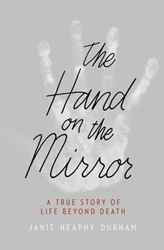 Durham is a journalist who experienced odd phenomena after the death of her husband, Max Besler. Clocks would randomly flip to 12:44—the time of Max’s death. Lights would flicker and go out. Rugs that had been in the home Durham shared with Max, now relocated to the home she shares with her current husband Jim, would move many inches in the course of a day, even with no one walking on them. The book’s title refers to powdery handprints that appeared on Durham’s bathroom mirrors several times, always right around the anniversary of Max’s death.
As Durham does research to try to explain these strange occurrences, she emphasizes her skepticism and journalistic desire to ask hard questions and dig deep. But much of her research ends up not quite satisfying. She recounts conversations with experts in such areas as paranormal activity or the idea of consciousness as a force that exists not solely in the brains of living people, but can continue to exist after death. These conversations provide much food for thought but little in the way of definitive explanation or scientific rigor. Durham seems to rely on experts’ impressive Ivy League credentials as proof that their ideas hold merit, when these credentials merely illustrate that very smart people can think and believe all sorts of things.
Durham never really tests alternate theories to explain the strange experiences, and tries a little too hard to read coincidences as signs that Max is still present after his death. She noticed the name “Max,” for example, painted on a boat’s hull in the background of a photo of her and her son in Italy. After attending a memorial service for her parents in Nebraska, she took her dog on a hike and came across a bridge called “The Max Bridge.” “I know Max is not an uncommon name, but still, what are the chances?” she asks. Later the same day, she drives by a sign for “Besler Industries.” “What was Max’s last name doing on a sign outside the only manufacturing plant in Cambridge [Nebraska]? This is a tiny town, and there are only 512 people named Besler out of about 314 million Americans. So this struck me as very unusual. Ultimately, I viewed both the Max Bridge and the Besler Industries sign as synchronicity. They were messages from Max and the spirit world that our connections with loved ones are not limited by place.”
I ended Hand on the Mirror wishing for fewer coincidences and powdery handprints, and more exploration of Durham’s core belief—one that I share with her and Anne Hathaway’s Interstellar character—that love is more than synapses firing, more than a practical way for people to give and receive the care we need to survive. I wanted to hear more about how Durham’s new interest in paranormal phenomena relates to her childhood faith. She states early in the book that she was “heavily influenced by my father, a Presbyterian minister deeply devoted to God and his faith. But,” she goes on, “like many people I had evolved in my thinking as I grew older. Now my faith was not as central to my daily life…” I wonder if, in casting Christianity as something to be left behind by an “evolved” mind, Durham also left behind a rich context for considering those odd handprints and coincidences that could have provided more satisfying avenues (more satisfying for me as a reader, anyway) for contemplating love, life, death, and eternity.
While many Christians see paranormal activity as a threat to orthodoxy, surely those of us who believe that a dead man rose to life again after three days in a tomb, that he both healed the sick and empowered his followers to do the same, that he fed thousands of people with a few fish and loaves of bread, and that he both sits at God’s right hand and is always, ever present to us when we call on his name—surely, we can make room in our world for the possibility that loved ones will reach out to us from beyond the grave, that the love we shared continues as a real and powerful force in the world.
Despite my quibbles with how Durham framed and explored the questions raised by her story, fundamentally, she believes as I do in love as a force whose power cannot be limited by mortal bodies, space, time, or death. She writes,
It wasn’t until I lost Max that I was confronted with the full magnitude of what love means. Max is teaching me that love transcends this world and the next. And even though the physical part of life is no longer attainable with him, the love remains a constant in my heart. I believe he carried this same love in his heart with him to the other side, to heaven or to whatever nonphysical plane in which he now exists. And I believe it’s this love that powered his ability to reach across from the spirit world to this world.
Yes. As Anne Hathaway’s character insisted in Interstellar, “maybe we should trust that even if we can’t understand it yet.”
This post is part of a Patheos Book Club on The Hand On the Mirror. Click here to learn more about the book and the author, and read other Patheos bloggers’ take on the book.
Previous Post

May 7, 2015
How Technology Has—and Hasn't—Changed the Experience of Having a Baby
Next Post
June 13, 2015 On a Difficult Anniversary, Making Room for the Better Stories
Browse Our Archives
Select a Category disability ethics parenthood Uncategorized
Select a Month September 2016 June 2016 May 2016 April 2016 March 2016 February 2016 January 2016 December 2015 November 2015 October 2015 September 2015 August 2015 July 2015 June 2015 May 2015 April 2015 March 2015 February 2015 January 2015 December 2014 November 2014 October 2014 September 2014 August 2014 July 2014 June 2014 May 2014 April 2014 March 2014 February 2014 January 2014 December 2013 November 2013 October 2013 September 2013 August 2013 July 2013 June 2013 May 2013 April 2013 March 2013 February 2013 January 2013 December 2012 November 2012 October 2012 September 2012 August 2012 July 2012 June 2012 May 2012 April 2012 March 2012 February 2012 January 2012 December 2011
Follow Us!
TAKE THE
Religious Wisdom Quiz
Who is known as the "weeping prophet"?
Select your answer to see how you score.
Isaiah Ezekiel Jeremiah Joel
Related posts from Ellen Painter Dollar
A Cancer Memoir that (Mostly) Gets It Right

After 25 Years of the ADA, What Disabled...
Who Exactly Are "the Least of These"?

TRENDING AT PATHEOS Progressive Christian

What Being a Modern-Day Apostle Means to Me
In my last column, I discussed the ins and outs of modern-day...

Did Ancient China Once Worship the God of...
Across human history, a common thread weaves through the origins of the...

Love Your Neighbor – Including Earth-Kin: Lev. 19,...
God’s command to love your neighbor means acting in an ethical and...

Lead a Church Study of “Jesus and Lao...
Guest writer Jack Thomas (The Irreverent Reverend) reflects on leading his church...

Pastoral Wisdom for Responding to Sermon Pushback
Getting sermon pushback on your social justice sermon? Learn practical, Proverbs-based strategies...

Principles for Understanding the Apostolic Ministry Today
Whenever people discover that my formal ministry title is "apostle," as in...
view all Progressive Christian blogs
Ad-Free & Subscriber Log-In Subscription Support
- About Us
- 2026 Calendar
- Videos
- Podcasts
- Library of World Religions
- Faith In Media Tracker
- Advertise With Us
- Write for Us
- Privacy Policy
- Terms of Service
- Do Not Sell My Data
- Contact Us
- Radiant Digital
- Manage Newsletter Subscriptions
- Unsubscribe From Notifications
- Sitemap
Copyright 2008-2026, Patheos. All rights reserved.
Subscription Support Ad-Free & Subscriber Log-In
Follow Patheos