
BuddhistCatholicContemplativeEvangelicalGeneral ChristianHinduJewishLatter-day SaintMuslimNew VisionsProgressive Christian
Beliefs
- Buddhist
- Catholic
- Contemplative
- Evangelical
- General Christian
- Hindu
- Jewish
- Latter-day Saint
- More Voices
- Muslim
- New Visions
- Pagan
- Progressive Christian
Topics
- Religion News
- Food and Religion
- Sports and Religion
- Religious Art
- Religious Music and Entertainment
- Religious Events
- History and Religion
- Style and Religion
- Politics and Religion
- Women in Religion
- Recreation Outdoors and Religion
- Business Finance and Religion
- Careers Workplace and Religion
- Education and Religion
- Family Parenting and Religion
- Health Fitness and Religion
- Home and Religion
- Relationships and Religion
- Technology and Religion
- Travel and Religion
Columnists
- Buddhist Columnists
- Business Finance and Religion Columnists
- Careers Workplace and Religion Columnists
- Catholic Columnists
- Contemplative Columnists
- Education and Religion Columnists
- Evangelists Columnists
- Family Parenting and Religion Columnists
- General Christian Columnists
- Health Fitness and Religion Columnists
- Hindu Columnists
- History and Religion Columnists
- Home and Religion Columnists
- Jewish Columnists
- More Voices Columnists
- Latter Day Columnists
- Muslim Columnists
- New Visions Columnists
- Nonreligious Columnists
- Pagan Columnists
- Politics and Religion Columnists
- Progressive Columnists
- Recreation Outdoors and Religion Columnists
- Relationships and Religion Columnists
- Religion News Columnists
- Religious Art Columnists
- Religious Events Columnists
- Religious Music and Entertainment Columnists
- Sports and Religion Columnists
- Style and Religion Columnists
- Technology and Religion Columnists
- Travel and Religion Columnists
- Women in Religion Columnists
Resource Library
- 2026 Calendar
- Library of World Religions
- The 100 Most Holy Places on Earth
- Patheos Answers
- Podcasts
- Videos
- Faith Leaders Database
- Anglican Episcopalian
- Bahai
- Baptist
- Buddhism
- Christianity
- Confucianism
- Eastern Orthodoxy
- Hinduism
- Holiness and Pentecostal
- ISKCON
- Islam
- Judaism
- Lutheran
- Methodist
- The Church of Jesus Christ of Latter-day Saints
- New Age
- Paganism
- Presbytarian and Reformed
- Protestantism
- Religion Behind the Scenes
- Roman Catholic
- Scientology
- Shia Islam
- Sikhism
- Sufism
- Sunni Islam
- Taoism
- Zen
- See all religions
Research Tools
 Ad-Free & Subscriber Log-In Subscription Support
Ad-Free & Subscriber Log-In Subscription Support
Follow Patheos 

- Trending:
- Forgiveness
- |
- Marriage
- |
- Consciousness
- |
- Death Penalty
- |
- Election
- |
- Halloween
 Ellen Painter Dollar
- Home
- Progressive Christian
- When Failure Leads to Blessing
When Failure Leads to Blessing
Last updated on: November 3, 2014 at 2:54 pm by Ellen Painter Dollar
When Failure Leads to Blessing 2014-11-03T14:54:03-05:00 Ellen Painter Dollar
Patheos Explore the world's faith through different perspectives on religion and spirituality! Patheos has the views of the prevalent religions and spiritualities of the world.
When Jesus saw the crowds, he went up the mountain; and after he sat down, his disciples came to him. Then he began to speak, and taught them, saying:
“Blessed are the poor in spirit, for theirs is the kingdom of heaven.
“Blessed are those who mourn, for they will be comforted.
“Blessed are the meek, for they will inherit the earth.
“Blessed are those who hunger and thirst for righteousness, for they will be filled.
“Blessed are the merciful, for they will receive mercy.
“Blessed are the pure in heart, for they will see God.
“Blessed are the peacemakers, for they will be called children of God.
“Blessed are those who are persecuted for righteousness’ sake, for theirs is the kingdom of heaven.
“Blessed are you when people revile you and persecute you and utter all kinds of evil against you falsely on my account. Rejoice and be glad, for your reward is great in heaven, for in the same way they persecuted the prophets who were before you.
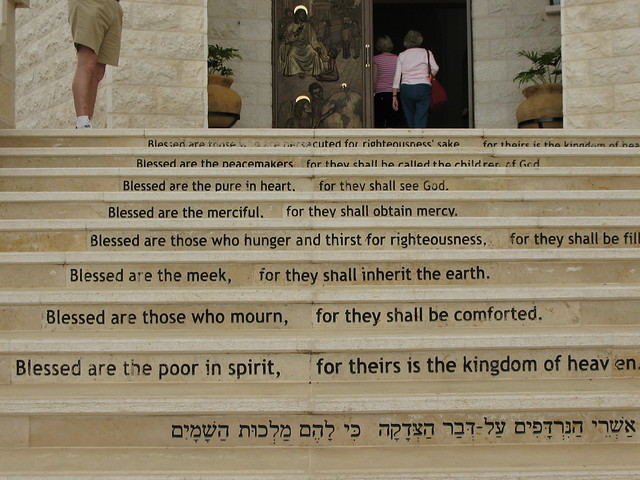
© 2007 James Emery, Flickr | CC-BY | via Wylio
These words of Jesus, known as the Beatitudes and featured in our lectionary last Sunday, are some of the most well-known and beloved in scripture. I’ve always loved them for how they communicate Jesus’s topsy-turvy theology, his habit of turning treasured notions of how the world and God work upside down, forcing listeners to rethink where true “blessedness” lies. I have usually heard the Beatitudes through a social justice lens, interpreting them as a challenge to our cultural notions of what makes someone significant, successful, and strong. What brings you closer to God and what is most significant, the Beatitudes tell us, isn’t hard work or power or happiness, but mercy, peacemaking, and sacrifice.
Before yesterday morning, if someone had asked me who the Beatitudes are about, I would have said they are about those who are so often victimized and voiceless—the poor, the sick, the very young, the very old. Before yesterday morning, I would not have said that the Beatitudes were about me. I would have said that I have so many worldly blessings—relative wealth, relative health, thriving intimate relationships, the socioeconomic and racial/ethnic identity most linked with power and prestige in our culture—that I bear little resemblance to the poor-in-spirit, mourning, thirsting-after-righteousness peacemakers who the Beatitudes tell us are truly blessed and close to God.
But I heard this scripture from a different perspective yesterday.
I came to church after a week in which circumstances chipped away at many sources of reassurance and confidence in my life. Some rash words directed at friends left them feeling unfairly criticized and me feeling like a jerk. While my immediate apology was graciously accepted, I was still embarrassed by what I said and how I said it. A radio interview I did on Saturday morning went as badly as I knew it might (because I was representing a position at odds with that of the network’s core audience and the host/moderator), despite my efforts to clarify expectations and boundaries ahead of time. I did as well as I could under the circumstances, but in an interview environment that so heavily favored the opposing position, my arguments inevitably fell flat and there were no opportunities to challenge some of the other participants’ assumptions. I berated myself for failing to heed my concerns about whether doing this interview would be worthwhile.
Because of these and a few other circumstances, I came to church Sunday morning feeling demoralized, stripped of confidence that, despite many faults, I also have many gifts, including being a good friend and an effective communicator.
I was feeling, in other words, poor in spirit. Chastened, humbled, meek. I was mourning my faults and the hurt I can cause other people. I was even feeling a little bit persecuted and reviled, because of how heavily the decks were stacked against my being able to fully articulate my position or challenge the alternative in the radio interview.
That morning, the promises of the Beatitudes felt personal in a way they never had before. It was not some other “they” who would be comforted and embraced by God, but me. In these beautiful words, I heard a reminder that God can and will fill the empty places in my soul, comfort the sore spots, and embrace the prickly, unpleasant parts of me that aren’t so easy to embrace. These reminders are comforting, certainly, but they go beyond comfort. The Beatitudes aren’t only reminders that God is present to us no matter what, including in difficult times. They go a step further to say that God is especially *present (*or perhaps it’s just that we become especially open to God’s presence), that we are not just loved but blessed when we experience emptiness, discomfort, failure, mourning, hunger, thirst, and alienation.
This notion that God is especially present in hard times isn’t a sign that we worship some sadistic God who wants us to suffer and only shows up when we do. It’s simply a recognition of reality, of how human minds and spirits function. When I’m feeling confident in my abilities—to be a supportive friend or an effective communicator, for example—I forget what it feels like to be needy. I convince myself that I’ve got everything under control, thank you very much. Humility and gratitude take a back seat to self-reliance. And then when I fail, as I did several times in several ways last week, in come those voices telling me how messed up and inadequate and ridiculous I am.
But if, instead of indulging in self-bashing, I turn to the Beatitudes, I am reminded that in my most messy, inadequate, awkward moments, I am blessed. God is here, with me, ready to help me pick myself up, dust myself off, and go back to being the imperfect friend and mother and wife and writer and speaker and person I am, with as much grace, gratitude, and perseverance as I can muster.
The Beatitudes are, no doubt, a call to embrace Jesus’s topsy-turvy theology, which turns our cultural notions of what makes someone strong, significant, and powerful on their heads. The Beatitudes are also a call to embrace our own topsy-turvy nature, as people capable of great love and good works as well as great callousness and ineptitude. The Beatitudes invite us to understand that though we will fail miserably, in God’s eyes we are never merely miserable, but always beloved and blessed.
Previous Post

October 31, 2014
Bittersweet Bedtime Stories
Next Post
November 7, 2014 Revelation on an Ordinary Wednesday
Browse Our Archives
Select a Category disability ethics parenthood Uncategorized
Select a Month September 2016 June 2016 May 2016 April 2016 March 2016 February 2016 January 2016 December 2015 November 2015 October 2015 September 2015 August 2015 July 2015 June 2015 May 2015 April 2015 March 2015 February 2015 January 2015 December 2014 November 2014 October 2014 September 2014 August 2014 July 2014 June 2014 May 2014 April 2014 March 2014 February 2014 January 2014 December 2013 November 2013 October 2013 September 2013 August 2013 July 2013 June 2013 May 2013 April 2013 March 2013 February 2013 January 2013 December 2012 November 2012 October 2012 September 2012 August 2012 July 2012 June 2012 May 2012 April 2012 March 2012 February 2012 January 2012 December 2011
Follow Us!
TAKE THE
Religious Wisdom Quiz
What is the last book in the Old Testament?
Select your answer to see how you score.
Daniel Genesis Jonah Malachi
Related posts from Ellen Painter Dollar

Who Exactly Are "the Least of These"?

A Theology of Radical Attachment: Finding God in...

TRENDING AT PATHEOS Progressive Christian

What Being a Modern-Day Apostle Means to Me
In my last column, I discussed the ins and outs of modern-day...

Did Ancient China Once Worship the God of...
Across human history, a common thread weaves through the origins of the...

Love Your Neighbor – Including Earth-Kin: Lev. 19,...
God’s command to love your neighbor means acting in an ethical and...

Lead a Church Study of “Jesus and Lao...
Guest writer Jack Thomas (The Irreverent Reverend) reflects on leading his church...

Pastoral Wisdom for Responding to Sermon Pushback
Getting sermon pushback on your social justice sermon? Learn practical, Proverbs-based strategies...

Principles for Understanding the Apostolic Ministry Today
Whenever people discover that my formal ministry title is "apostle," as in...
view all Progressive Christian blogs
Ad-Free & Subscriber Log-In Subscription Support
- About Us
- 2026 Calendar
- Videos
- Podcasts
- Library of World Religions
- Faith In Media Tracker
- Advertise With Us
- Write for Us
- Privacy Policy
- Terms of Service
- Do Not Sell My Data
- Contact Us
- Radiant Digital
- Manage Newsletter Subscriptions
- Unsubscribe From Notifications
- Sitemap
Copyright 2008-2026, Patheos. All rights reserved.
Subscription Support Ad-Free & Subscriber Log-In
Follow Patheos